Understanding Korean Food Culture: How Koreans Eat, Share, and Celebrate
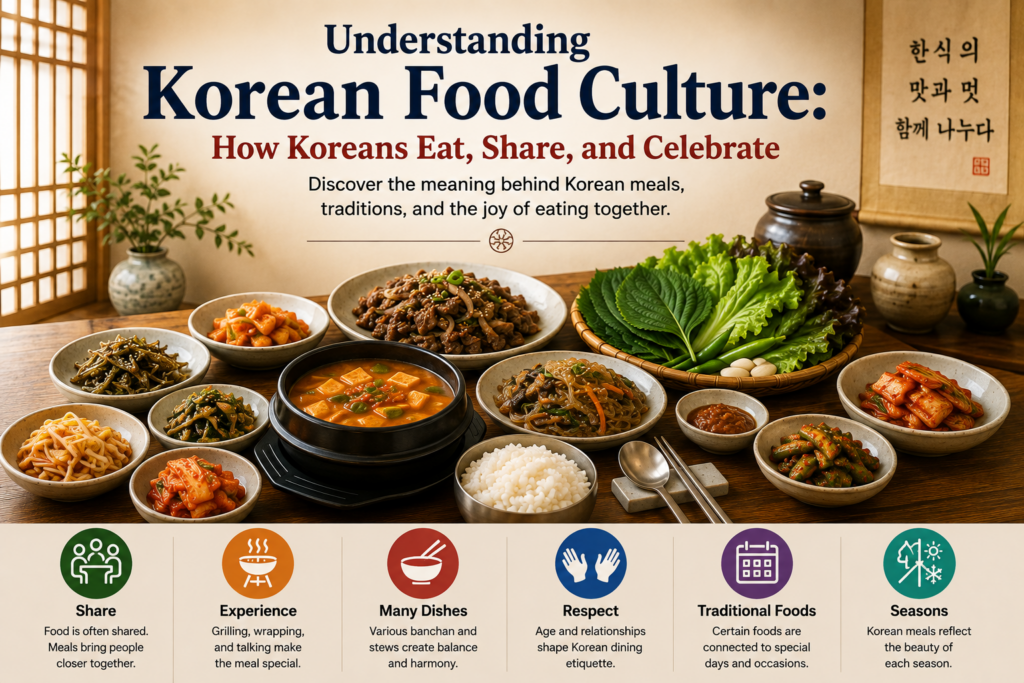
Discover Korean food culture through shared meals, dining etiquette, birthday miyeokguk, Seollal tteokguk, kimjang, regional traditions, and seasonal eating.
Korean Food Culture Is About More Than Food
Understanding Korean food takes more than knowing the names of dishes or the ingredients that go into them.
The meaning of a meal can change depending on who you eat with, when you eat it, and what other foods are served alongside it.
In Korea, food has long been connected with family, seasons, holidays, social relationships, and everyday routines. A shared dinner, a bowl of seaweed soup on a birthday, tteokguk on Lunar New Year, or a family making kimchi together can each tell a different story about Korean life.
If you are new to Korean food, first understanding the basic structure of the Korean table can make many of these customs easier to understand.
Korean food culture is not frozen in tradition, either. The way people eat has continued to change as families, work patterns, restaurants, delivery services, and younger generations have changed.
That mix of continuity and change is one of the most interesting parts of Korean food culture.
Why Is Eating Together Important in Korean Food Culture?
One of the most noticeable features of Korean dining is the way a meal can become a shared experience.
Rice and some soups are usually served individually, while banchan, grilled meat, stews, and other dishes may be placed in the center of the table.
But for me, the idea of eating together begins with family rather than restaurant etiquette.
When I was growing up in Korea, we tried to eat dinner together whenever possible. We often waited until my father came home from work before starting the evening meal.
Dinner was an important time when the family gathered at the table.
That does not mean every Korean family followed exactly the same routine, and modern lifestyles have made family schedules much more complicated. But in my childhood home, eating together was simply part of everyday family life.
This is one reason shared dishes can feel natural on a Korean table. The meal is not always organized around one separate plate for each person. Instead, some parts belong to the individual and others belong to the table.
For a closer look at this distinction, see why Koreans share food at the table and why eating together is important in Korea.
Korean BBQ Shows the Social Side of a Meal
Korean barbecue is one of the easiest places to see shared dining in action.
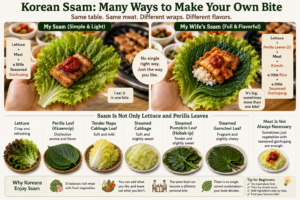
People may sit around one grill, cook the meat together, pass banchan and sauces, and make ssam with lettuce or perilla leaves.
The important part is not only the grilled meat.
People talk while the food cooks. Someone may turn the meat, another person may cut it, and someone may place a cooked piece on another person’s plate.
This makes Korean barbecue both a meal and a social activity.
Rather than explaining every type of meat or every way to make ssam here, the main point is that the cooking process itself becomes part of eating together.
If you want to explore that experience in more detail, see what makes Korean BBQ different.
Why Are Many Korean Foods Served Together?
At many Korean meals, rice, soup or stew, kimchi, banchan, and a main dish may appear at the same time rather than in separate courses.
That makes it possible to move back and forth among different flavors during the meal.
One bite may be rice and kimchi. Another may combine rice with a mild vegetable dish. A strongly seasoned stew may be followed by plain rice.
The meal is therefore built through combinations rather than through a fixed sequence of courses.
At home, this does not necessarily mean preparing a large number of new dishes every day. Several banchan may already be in the refrigerator and can be served again with one or two freshly prepared dishes.
This is a practical part of everyday Korean eating as well as a cultural one.
How Did Age Shape Korean Dining Etiquette?
Age and social relationships traditionally had a visible role at the Korean table.
When I was young, we were expected to wait until the older people began eating before we picked up our own spoon or chopsticks. If a child started first, he or she could be scolded.
Using both hands when receiving a drink from an older person was also something we learned naturally rather than as a special rule.
These customs reflected the broader importance of age and respect in Korean social life.
Today, I feel many of these rules have become more relaxed, especially among younger people. The level of formality also depends greatly on whether the meal is with family, friends, coworkers, or people meeting in a formal situation.
For a visitor, there is no need to memorize every rule. Paying attention to the people around you and showing basic respect is usually more important.
Why Do Koreans Eat Miyeokguk on Birthdays?
Miyeokguk (미역국), or seaweed soup, is closely associated with birthdays in Korea.
The tradition is connected with childbirth. Seaweed soup has long been given to mothers after giving birth, and that connection between the mother and the child became part of the birthday tradition as well.
This custom has always been very real in my own family.
When I was young, my mother made miyeokguk for my birthday. Now my wife does.
I have eaten it on my birthday since childhood, and I still make sure to have it today.
I also saw the other side of the tradition when my wife gave birth. She ate miyeokguk regularly for a period after childbirth.
Because of experiences like these, birthday miyeokguk does not feel to me like an old custom that exists only in books. It connects birth, family, and memory in a very ordinary and continuing way.
Why Do Koreans Eat Tteokguk on Seollal?
Seollal, the Korean Lunar New Year, is strongly associated with tteokguk (떡국), or rice cake soup.
When I was a child, our family ate tteokguk together on the morning of Seollal.
I also heard the familiar saying that you had to eat a bowl of tteokguk to become one year older.
The holiday meal was not limited to tteokguk. Jeon, galbijjim, namul, and other dishes could also be part of the table.
One of my strongest memories is actually the day before Seollal, when making jeon became a major kitchen job. Preparing the holiday meal required a great deal of work before the family sat down to eat it.
Even now, living in the United States, my wife and I still eat tteokguk on Seollal almost automatically.
For us, it has become less about thinking consciously about the tradition and more about a habit that continues wherever we live.
Why Is Songpyeon Connected With Chuseok?
Songpyeon (송편) is one of the foods most closely associated with Chuseok, Korea’s major autumn holiday.
When I was younger, making songpyeon at home was common in my family.
Family members gathered and shaped the rice cakes together. Making them was part of preparing for the holiday, not simply a matter of buying a finished dessert.
Today, buying prepared songpyeon has become much more common.
That change is a good example of how Korean food traditions can continue even when the way people prepare the food changes.
The association between songpyeon and Chuseok remains strong, but fewer families may spend as much time making everything from scratch as they once did.
How Do the Seasons Influence Korean Food?
Korea has four distinct seasons, and seasonal changes have long affected what people eat.
Spring brings seasonal greens and vegetables. Cold foods such as naengmyeon are especially popular in summer, while hot samgyetang is traditionally eaten during some of the hottest days of the year.
Autumn is connected with harvest foods and Chuseok.
Winter historically made preserving vegetables especially important, which helped strengthen traditions such as fermentation and kimjang.
Modern supermarkets have made many ingredients available year-round, so seasonality does not control everyday meals as strongly as it once did.
Even so, certain foods still feel closely tied to particular seasons and times of year.
For a broader look at these changes, see how Korean food changes with the seasons.
Why Is Kimjang More Than Making Kimchi?
Kimjang (김장) is the tradition of making a large amount of kimchi before winter.
When I was a child, kimjang could be a major family event.
Large amounts of cabbage were prepared at home or at a relative’s house, and family members or neighbors often helped one another.
As a child, salting the cabbage was difficult work, but I helped with jobs such as cutting radish and spreading the seasoning mixture onto the cabbage.
One of the best parts came after much of the work was finished.
Eating freshly made kimchi with suyuk or bossam was a familiar reward after kimjang.
Today, kimjang has changed considerably. Many households make smaller quantities, and buying kimchi from supermarkets or specialty stores is completely normal.
Even when the scale changes, however, kimjang still carries memories of cooperation, preparation for winter, and eating together after the work is done.
If you want to understand the broader role of fermentation in Korean food, see why fermented foods are so important in Korea.
How Does Korean Food Differ by Region?
Korean food can taste noticeably different from one region to another.
Climate, local ingredients, agriculture, access to the sea, and regional cooking traditions have all played a role.
My own memories of regional food are quite specific.
I remember food in the Jeolla region as especially generous in banchan and strongly seasoned. Personally, some of my most memorable Korean meals were there, and I also remember enjoying the kimchi very much.
My experience in Gyeongsang was quite different.
I attended graduate school in Gyeongsang Province, and I still remember trying the soup in the school cafeteria for the first time and being surprised by how salty it tasted to me. Even later, I often found the soup there saltier than I preferred.
In Gangwon Province, I particularly enjoyed dishes made with buckwheat and potatoes, including memil dishes and gamjajeon.
Jeju left another kind of impression. Grilled black pork and braised hairtail were both distinctive foods that I especially enjoyed there.
These are personal memories rather than rules about how every dish in a region tastes.
But they are also a reminder that “Korean food” is not a single uniform style.
What Can Street Food Tell Us About Korean Food Culture?
Street food shows a more casual side of Korean eating.
Traditional markets and busy shopping areas may offer foods such as tteokbokki, eomuk, hotteok, twigim, gimbap, and many newer snacks.
Street food can be eaten quickly, shared with friends, or enjoyed while walking through a market.
It also reflects the seasons. Hot eomuk broth or hotteok can feel especially appealing in winter, while cold desserts and drinks become more attractive in summer.
The important point here is not to create another list of street foods, but to recognize that Korean food culture exists outside formal meals as well.
For more detail, see Korean street food and what to try in Korea.
Korean Food Culture Continues to Change
Korean food culture today is very different in some ways from the Korea I grew up in.
Eating alone, or honbap, has become much more normal. Many restaurants now have seating arrangements that make solo dining easy.
Food delivery has become an ordinary part of daily life.
Prepared banchan shops have also become much more common, with a wide variety of side dishes available for people who do not want to make everything at home.
Families often have more difficulty gathering for meals because work and personal schedules are different. As a result, the amount of time families spend eating together has decreased.
Eating out is also more common, and the range of ready-made and convenience foods available today is enormous.
At the same time, younger generations tend to express themselves and behave more freely than people of my generation were expected to when we were young. That change can be felt in dining etiquette as well.
None of this means traditional Korean food culture has disappeared.
Instead, old habits and newer lifestyles now exist side by side.
A person may order dinner through a delivery app one day and still eat tteokguk with family on Seollal. Someone may buy kimchi from a supermarket but still think of miyeokguk as essential on a birthday.
That mixture is part of modern Korean food culture too.
How Can Travelers Experience Korean Food Culture?
If you visit Korea, try not to experience Korean food only as a checklist of famous dishes.
Pay attention to the situation around the food.
Who is eating together?
Which dishes are shared?
What foods are connected with the season?
Is this an everyday meal, a restaurant experience, a market snack, or a holiday food?
Regional specialties, traditional markets, family-style restaurants, barbecue meals, and ordinary neighborhood restaurants can all show different sides of Korean food culture.
You do not need to understand every custom before you begin.
Simply noticing how people eat can reveal as much as learning the name of the dish itself.
Frequently Asked Questions About Korean Food Culture
Do Koreans share all their food?
No. Rice and many soups are usually served individually. Banchan, grilled meat, stews, hot pots, and other foods may be shared, depending on the meal.
Should the oldest person start eating first in Korea?
Traditionally, yes. In my childhood, children were expected to wait for older family members to begin. Today, the custom is often more relaxed and depends on the people and situation.
Why do Koreans eat seaweed soup on birthdays?
The tradition is connected with the seaweed soup traditionally eaten by mothers after childbirth. Birthday miyeokguk therefore links the birthday with birth and the mother who gave birth to the child.
Why do Koreans eat tteokguk on Lunar New Year?
Tteokguk is one of the most recognizable foods of Seollal. Koreans have also traditionally joked or said that eating a bowl means becoming one year older.
What is kimjang?
Kimjang is the tradition of preparing kimchi for winter, historically in large quantities. It was also a cooperative activity involving families and neighbors.
Does Korean food differ by region?
Yes. Ingredients, seasoning, cooking methods, and local specialties can differ significantly from one region to another.
Do travelers need to know all Korean dining etiquette?
No. Basic respect and attention to how the people around you behave are usually enough.
Understanding Korean Food Means Understanding the Stories Around It
Korean food culture is about much more than deciding which dishes taste good.
A family waiting for a parent to come home before dinner, a mother making miyeokguk for a birthday, relatives preparing jeon before Seollal, or neighbors helping with kimjang all reveal something that a recipe alone cannot explain.
Many of the customs I grew up with have changed.
Families do not always eat together as often. People buy prepared banchan and kimchi more frequently. Delivery meals and honbap are now ordinary parts of daily life.
But some habits continue remarkably well.
I still eat miyeokguk on my birthday. My wife and I still eat tteokguk on Seollal even though we now live in the United States.
That is how I think Korean food culture is best understood.
It is not simply a collection of old traditions, and it is not only a collection of dishes.
It is a living part of everyday life, carried forward, adjusted, and sometimes simplified from one generation to the next.