Why Is Eating Together So Important in Korea?
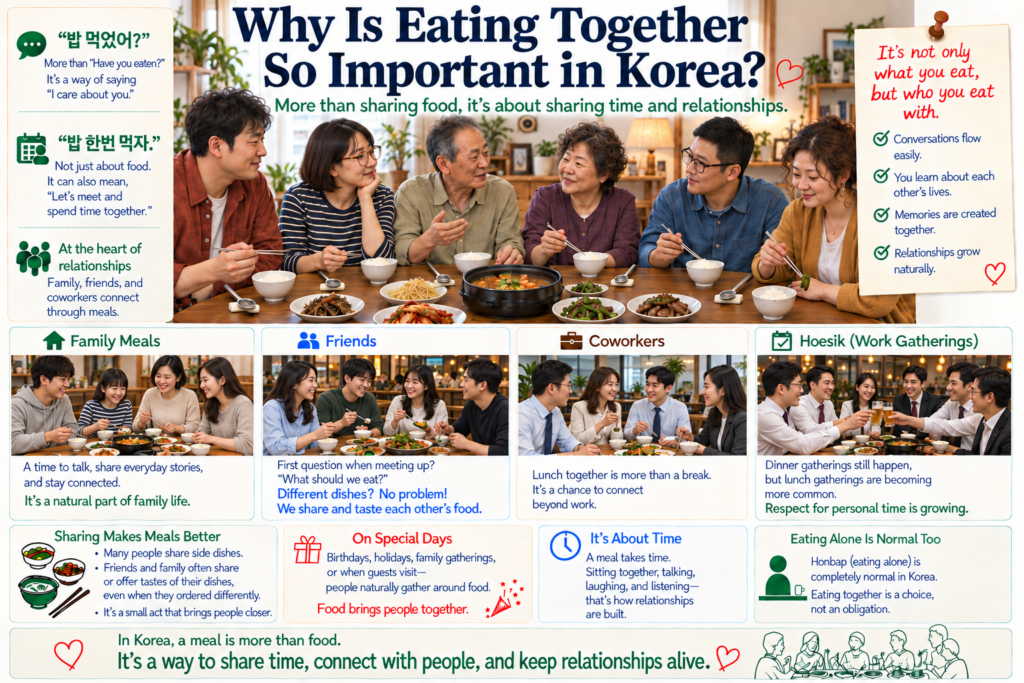
Learn why eating together matters in Korea, from family meals and friendships to workplace lunches, hoesik, and the everyday choice to eat alone.
Sharing a Meal Is a Familiar Way to Meet and Catch Up
In Korea, when saying goodbye to someone you have not seen for a while, you may hear, “Let’s have a meal sometime.” Even without choosing a restaurant or a date, the invitation can express a wish to meet again and talk.
When families gather, they decide what to eat. Friends making plans may arrange to meet for lunch or dinner. Coworkers sometimes use mealtimes to have conversations they would not normally have during work. Eating is an everyday activity, but the meaning of that time can change depending on who is at the table.
Eating together in Korea is a familiar way to make time for one another and maintain relationships. To understand it, it helps to look at why people gather around the table as well as how the food is served.
“Have You Eaten?” Can Also Be a Way of Checking In
“Bap meogeosseoyo?” means “Have you eaten?” Sometimes it is simply a question about whether you have had a meal. If a coworker asks around lunchtime, the conversation may lead to an invitation to eat together.
Among people who are close, it can also be a way of asking how someone is doing. When a family member asks, they may care less about exactly what you ate than whether you are taking care of yourself and eating regularly. Asking about an ordinary part of the day becomes a way to show concern.
If you are unfamiliar with Korean, you do not need to search for a special meaning every time you hear the question. You can answer, “Yes, I have. Have you eaten?” or simply say that you have not eaten yet.
“Let’s have a meal sometime” also depends on the situation. It may be an invitation to make definite plans, or a friendly expression of wanting to meet again. If you would like to get together, you can suggest a date: “How about lunch next week?”
Not every Korean uses these expressions in the same way. Your relationship with the person, the timing, and the conversation that follows can help you understand what they mean.
Family Meals Create Time to Hear About One Another’s Lives
Even family members who live together may have different daily schedules. Work, school, and personal commitments can leave little time to sit down together. A shared meal offers a chance to stay in the same place for a while and hear about one another’s day.
The conversation does not have to be special. It might be about something that happened that day, plans for tomorrow, or the food on the table. A few short questions and answers can help family members stay familiar with each other’s lives.
Meals can also become the center of a gathering when relatives who live apart meet after some time. Preparing food at home or choosing a restaurant helps turn the idea of meeting into a specific time and place. On birthdays or holidays, sitting down to eat becomes part of the occasion.
This does not mean every family meal needs an elaborate spread. Simple food can bring people to the same table. The value lies in having time to talk, rather than in how much food someone has prepared.
My Family and Close Friends Often Taste One Another’s Dishes
When my family orders different dishes at a restaurant, we tend to let one another try a little instead of eating only what we ordered. We do something similar with close friends. If we choose different foods, we may share small portions or offer each other a taste.
Eating this way gives us something to talk about. Two people can try the same dish and enjoy different things about it: one may like the seasoning, while another notices the texture. Learning about each other’s tastes is part of the pleasure.
A group does not have to order everything to share from the beginning. People can choose what they want and then exchange small tastes, or keep their dishes to themselves. The way my family and friends enjoy eating is not a rule for every gathering.
Especially when eating with someone you do not know well, it is better to ask before reaching for their food. You can offer, “Would you like to try a little?” and accept it comfortably if they decline.
Sharing food is most enjoyable when everyone wants to take part. People do not have to eat the same food to feel close to one another.
Workplace Lunches and Hoesik Offer Different Ways to Spend Time Together
Lunch with coworkers can begin with a conversation about what to eat. One person may want noodles, while another would rather avoid something they had yesterday. Deciding where to go becomes a small, everyday interaction.
At the table, coworkers may talk about things unrelated to work. Someone you mainly know through their job may tell you about a hobby or weekend plans. Even a short lunch can provide a chance to learn a little more about each other.
Hoesik means a group meal with coworkers. It may bring to mind an evening of grilled meat and drinks, but it does not have to take that form. Some workplaces hold the gathering at lunchtime to leave employees’ evenings free. People can still share a meal while keeping their personal plans after work.
Whether it is an ordinary lunch or a planned hoesik, the atmosphere depends on the workplace and the people attending. Work relationships and tensions do not automatically disappear at the table. One person may find it easy to talk, while another may still feel cautious.
For the meal to feel comfortable, people’s circumstances need to be respected, including whether they can attend, whether they drink alcohol, and how long they can stay. Missing a meal does not necessarily mean someone has no interest in getting along with colleagues.
At Korean BBQ, Conversation Continues While the Food Cooks
At a Korean BBQ restaurant, people sit around a grill in the middle of the table. They talk while the meat cooks, eat the pieces that are ready, and wait for the next batch. This gives the meal a different rhythm from receiving a finished individual plate.
If diners are doing the grilling, someone may turn the meat while another points out which pieces are ready. At a restaurant where the staff cooks, people can watch and talk. The pace of cooking helps shape the pace of both eating and conversation.
There is no need to think of this as a special ceremony. People come to enjoy food and spend time together. But afterward, they may remember who sat with them and what they talked about as much as the flavor of the meal.
The practical steps of ordering and grilling are explained in my guide to eating Korean BBQ for the first time.
You Can Eat Together Without Eating the Same Food
Sharing food from one pot and spending time at the same table are two different things. Two people can each order their own bowl of gukbap, a Korean soup served with rice, and still be eating together. Choosing completely different dishes does not prevent them from enjoying a conversation.
How food is shared depends on the dishes and the table setting. If you are wondering which foods are individual and which are communal, see my guide to how Koreans share food at the table. The question here is who you spend the meal with, rather than whether you use the same serving plate.
Eating alone is also a natural part of everyday life. Korean even has a word for it: honbap, meaning eating a meal alone. Schedules may not line up, or someone may want a quiet meal and the freedom to choose exactly what they feel like eating.
Understanding the importance of shared meals does not mean you need company at every meal. Respecting each other’s time and choosing occasions that work for everyone can make eating together more comfortable.
“Let’s have a meal together” can be an invitation to make time for each other’s stories. An ordinary meal becomes a chance to share family news, catch up with a friend, or get to know a coworker a little better.