How to Eat Korean BBQ for the First Time
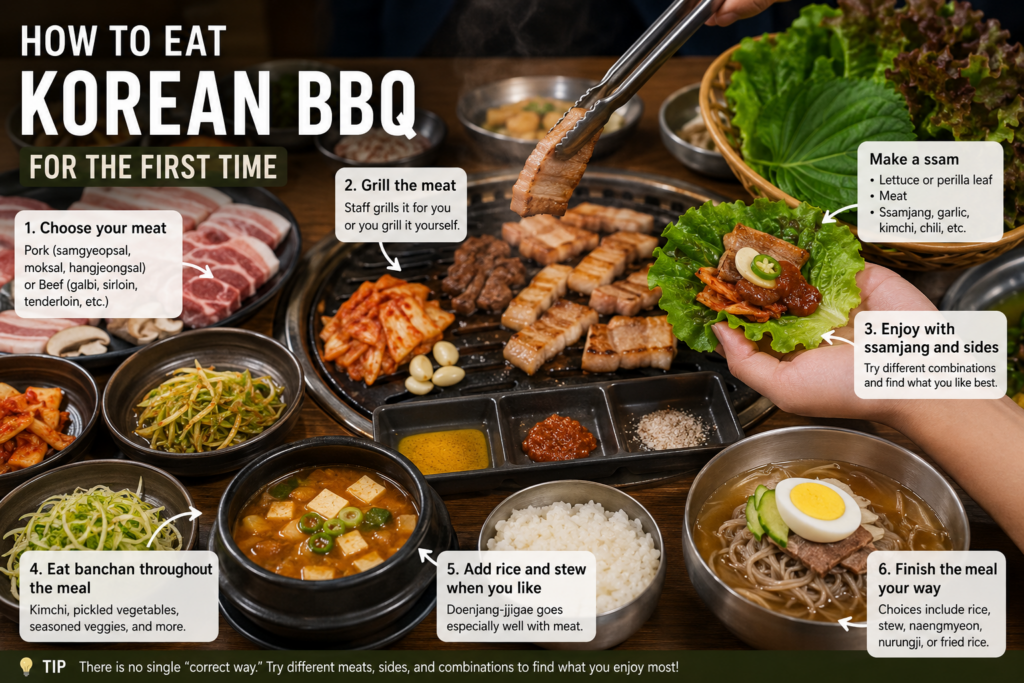
Learn how to eat Korean BBQ, from ordering meat and checking who grills to making wraps, enjoying banchan, and choosing rice or noodles.
Start by Choosing Your Meat and Checking Who Does the Grilling
At a Korean BBQ restaurant, the grill in the middle of the table may be unfamiliar at first, especially when raw meat arrives with tongs and scissors. Add lettuce, perilla leaves, ssamjang, and several side dishes, and you may wonder where to begin.
Start by choosing the meat you want and checking whether the staff will grill it for you. Once it is cooked, try a piece and add sauces or vegetables as you go. You do not need to know the name of every side dish and sauce before you start eating.
When I go out for pork BBQ, I order pork belly along with other cuts, such as pork collar and hangjeongsal. With my family, I usually have rice and doenjang jjigae alongside the meat. At work dinners where we eat meat first, I sometimes finish with naengmyeon, or cold noodles. Even for the same person, the order of the meal changes depending on the company and what is being served.
For the broader dining customs behind the meal, see what makes Korean BBQ different.
Check the Meat Options and Minimum Order Before You Order
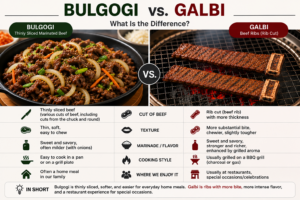
Menus vary from one Korean BBQ restaurant to another. Some focus on pork, others offer a wide selection of beef cuts, and some specialize in galbi, or ribs. Look at the menu photos and cut names, and ask the staff what is popular if you are unsure.
You may see “1인분,” meaning one serving, and a weight listed beside the price. Here, a serving is an ordering unit. It does not necessarily mean a separate, fully prepared plate for one person. The meat is often grilled and shared by everyone at the table. Serving weights also vary, so the number of servings alone does not tell you how much meat you will get.
Some restaurants require a minimum number of servings for the first order. Check whether you can combine different cuts to meet that minimum and whether rice and stew must be ordered separately. Start with an amount that suits your group, then order more after you have tried the meat.
I like eating samgyeopsal, moksal, and hangjeongsal together to compare the flavors of the different cuts. Samgyeopsal is pork belly, while moksal is pork neck or collar. I particularly enjoy the pleasantly springy texture of hangjeongsal. If other specialty cuts are on the menu, I sometimes try those too. There is no fixed rule that you must begin with pork belly.
When I order both saeng galbi and yangnyeom galbi, I eat the saeng galbi first. In this context, saeng galbi means unmarinated ribs, not ribs that you eat raw. Tasting the meat on its own before moving on to marinated ribs makes it easier to compare the two.
Some colleagues from other countries who have eaten with me preferred the marinated ribs. Personally, I feel I can eat more meat when I start with the unmarinated ribs. You can try both and decide which you prefer.
For more on beef and pork ribs and how they are prepared, see my guide to Korean galbi.
Check Who Will Grill the Meat When It Arrives
You do not have to cook your own meat at every Korean BBQ restaurant. At some places, the staff handles the grilling from start to finish. At others, they help you get started or leave the cooking to you.
When the raw meat arrives, check for instructions before picking up the tongs and putting everything on the grill. If you are unsure, ask, “Do we grill it ourselves?” If a staff member is cooking, listen for their guidance on whether the meat is properly cooked and ready to eat.
If you are grilling, put on only as much as you can manage. Different cuts and thicknesses cook at different speeds, and a crowded grill makes it harder to keep track of which pieces are properly cooked. Cutting larger pieces into manageable bites with scissors is also common at Korean BBQ restaurants.
Avoid using utensils that have touched raw meat to pick up side dishes or food that is ready to eat. If the restaurant provides separate utensils for raw and cooked meat, use them accordingly. Ask the staff if you are unsure whether the meat is sufficiently cooked. There is no single cooking time that works for every cut and thickness.
Before grilling begins, it is also helpful to check whether there is somewhere to store your coat or bag. Some restaurants have storage inside the seats or a separate place for belongings. Even with ventilation, the smell of grilled meat can linger on clothing.
Try the First Piece Plain, Then Add Salt or Ssamjang
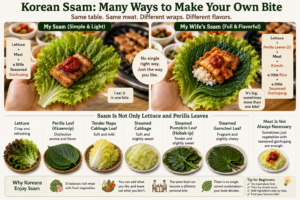
You do not need to turn your first piece of cooked meat into a large lettuce wrap. Try it on its own, then have the next piece with a little salt or ssamjang. This makes it easier to notice how the seasonings change the flavor.
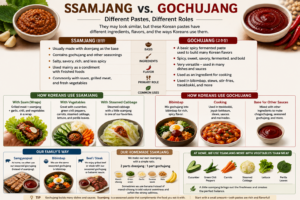
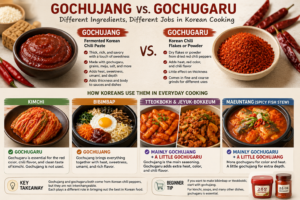
Ssamjang is a seasoned paste that you can dab onto cooked meat or add to a wrap. You do not need to spread it over the raw meat before grilling. I explain its flavor and how we make it at home in my guide to ssamjang.
A simple ssam, or leafy wrap, needs only a lettuce or perilla leaf, a piece of meat, and a little ssamjang. You can add rice, garlic, seasoned shredded scallions, or kimchi according to your taste, but you do not need to include everything. Start with a wrap small enough to eat comfortably in one bite.
If the aroma of perilla leaves is unfamiliar, use lettuce alone. If raw garlic tastes too sharp, leave it out. Some grills allow you to cook garlic or kimchi alongside the meat, but ask the staff where and how to place them. Not every grill is suitable for adding side dishes wherever you like.
You do not need to make a wrap for every bite, either. Try one piece plain, another with kimchi, and the next in a small wrap to find the combinations you enjoy.
Enjoy Banchan While You Wait and Throughout the Meal
The side dishes that arrive before the meat are not an appetizer course that you must finish before the meat comes. You can taste a little while you wait and continue eating them once the meat is cooked.
Have some kimchi or pickled vegetables between bites of meat, or eat the side dishes with rice when it arrives. You do not need to put every side dish on the grill or inside a wrap. Eating them separately also lets you compare their flavors.
If you would like more of a particular side dish, ask the staff or check whether there is a self-service station. Many restaurants refill basic banchan, but do not assume that every item is free and unlimited. Check which dishes are included and which cost extra.
For more on serving yourself from shared dishes and requesting refills, see my guide to how to eat Korean banchan.
Order More Before the Meat Runs Out and Check the Grill
If you are still hungry, it helps to decide on the next order before you finish the last piece. I usually order more while there is still some meat on the grill or plate. That way, we can keep eating what is left while the next order arrives, which can help avoid a pause in the middle of the meal.
If you enjoyed the first cut, order more of it. If you want to try a different texture, choose another cut. Remember to leave room if you also plan to have rice or noodles.
If burnt marinade or bits of meat build up on the grill, ask the staff to replace or clean it. This can happen more quickly with marinated meat. Leave the hot grill plate to the staff rather than trying to move it yourself.
The staff may also change the grill when you switch meats. Beef, pork, marinated meat, and unmarinated meat may use different grill plates, so follow their guidance when the next order arrives.
Have Rice With the Meat or Order It Later
I prefer eating rice alongside the meat. The meal feels less rich than when I eat meat alone, and I enjoy the way the two taste together. When I eat with my family, having doenjang jjigae, or soybean paste stew, on the table as well feels natural.
At work dinners, we sometimes spend time eating meat, having drinks, and talking before ordering rice or noodles later. When the meal follows that pattern, I often choose naengmyeon to finish. Alcohol can accompany the meal, but it is not a requirement for enjoying Korean BBQ.
Even if the menu has a separate section labeled “식사,” or “meal dishes,” that does not mean you must wait until all the meat is gone before ordering from it. If you would like rice and stew with your meat, ask whether they can be served together.
| Dish | How It Fits Into the Meal |
|---|---|
| Rice and doenjang jjigae | Have them alongside the meat or order them after you have eaten some of it. |
| Naengmyeon | Cold noodles are one option for finishing the meal after the meat. |
| Nurungji | Depending on the restaurant, scorched rice may be served softened in hot water or simmered in it. |
| Fried rice | Restaurants that offer it may prepare it after you have eaten the meat. |
Not every restaurant serves all these options. If you are already full, you do not need to order a separate dish to finish.
For your first Korean BBQ meal, it is easier to taste and decide as you go than to memorize a fixed sequence. Choose your meat, check who is grilling, and try small amounts of sauces and vegetables with the cooked pieces. Order more of a cut you enjoy, or bring rice and stew to the table, and let the meal take shape around your preferences.