Korean Ssam Explained: Why Koreans Wrap Meat in Lettuce and Perilla Leaves
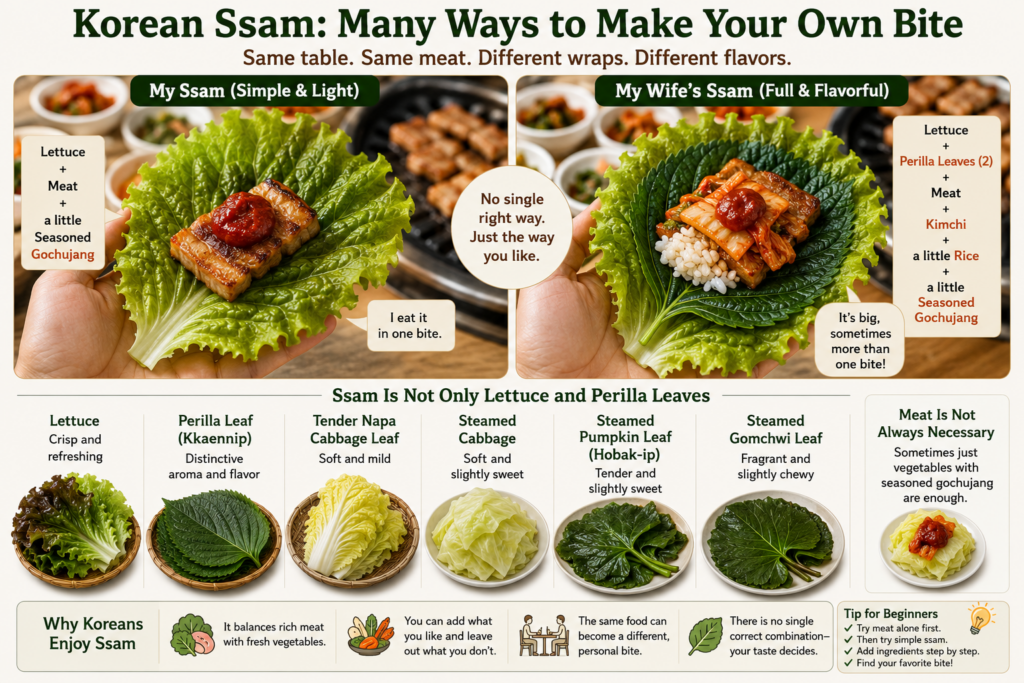
Discover what goes inside Korean ssam, how lettuce, perilla, meat, rice, and seasonings are combined, and why there’s no single right way to make one.
Why Do Koreans Wrap Meat in Lettuce?
If you visit a Korean BBQ restaurant for the first time, you may notice something on the table almost as quickly as you notice the meat.
There are usually fresh leaves, especially lettuce and perilla leaves, waiting beside the grill.
Once the samgyeopsal or other meat is cooked, some people eat it by itself. Some dip it in salt or a sauce. Others place a piece of meat on a lettuce or perilla leaf, add a little ssamjang and perhaps a few other ingredients, wrap everything together, and eat it.
This way of wrapping food in leaves or vegetables is called ssam in Korean.
But describing ssam simply as “wrapping Korean BBQ meat in lettuce” does not tell the whole story.
Part of the fun of ssam is that the same food can become a completely different bite depending on what you wrap it in, what you put inside, and how much you add.
Meat is not always necessary.
Lettuce and perilla leaves are not the only possible wraps.
And even two people sitting at the same table and eating the same meat may make completely different ssam.
My wife and I are a good example.
I prefer lettuce and usually make a very simple wrap. My wife loves the distinctive aroma of perilla leaves and likes to combine more ingredients.
Even within one family, there is no single correct way to make ssam.
Ssam is therefore better understood not as one specific dish with a fixed recipe, but as a Korean way of combining food into a bite that suits your own taste.
What Is Ssam?
The Korean word ssam (쌈) refers to the practice of wrapping food in a leaf or vegetable before eating it.
At Korean BBQ restaurants, lettuce and perilla leaves are probably the two most familiar choices.
A very simple ssam might be:
lettuce + one piece of grilled meat + a little ssamjang
You can then add other ingredients according to your preference.
These might include garlic, chili peppers, kimchi, pa-muchim (seasoned green onion salad), or a little rice.
But you do not need to put everything into every wrap.
There is no single recipe for ssam.
And meat itself is not always required.
Once you understand that, ssam becomes much broader than simply a Korean BBQ technique.
It is a flexible way of eating in which different ingredients can be combined according to the food on the table and the preferences of the person eating it.
Why Wrap Meat Instead of Eating It by Itself?
There is no single reason Koreans eat ssam.
One reason is the contrast it creates.
Fatty cuts such as samgyeopsal can begin to feel rich after you eat several pieces.
Fresh lettuce adds a crisp, refreshing element, while perilla leaves add their own distinctive aroma.
A little ssamjang can bring saltiness and umami.
Garlic, chili peppers, kimchi, and other ingredients can change the flavor again.
The purpose is not necessarily to cover the flavor of the meat.
Instead, ssam gives you different ways to experience the same meat during one meal.
You might eat one piece of meat by itself.
You might wrap the next piece in lettuce.
Then you might try another piece with a perilla leaf.
The meat has not changed, but each bite can taste different.
Ssam is only one part of the larger experience of what makes Korean BBQ different.
What Is the Difference Between Lettuce and Perilla Leaves?
Lettuce and perilla leaves are both common for ssam, but they taste quite different.
Lettuce has a relatively mild flavor and a fresh texture.
It can add freshness without dramatically changing the flavor of the meat.
Perilla leaves have a much more distinctive aroma.
For someone trying Korean food for the first time, that aroma may be unfamiliar.
Some people love it immediately, while others may need time to get used to it.
There is also something useful to know about what Koreans call kkaennip (깻잎).
Kkaennip is the leaf of the perilla plant, called deulkkae (들깨) in Korean.
Koreans use more than just the leaves of this plant.
Perilla seeds can be pressed to make perilla oil (deulgireum). Ground perilla seeds are used as perilla seed powder (deulkkae-garu) and can be added to soups and tang for a rich, nutty flavor. Whole perilla seeds can also be used in foods such as salads.
Perilla leaves are sometimes called “sesame leaves” in English, but perilla and sesame are different plants.
As for our family, I prefer lettuce.
My wife prefers perilla leaves, especially because she loves their aroma.
I usually eat lettuce and perilla leaves separately, while my wife also enjoys layering them together.
Can You Use Lettuce and Perilla Leaves Together?
Absolutely.
You can place a perilla leaf on top of a lettuce leaf and then add the meat and whatever other ingredients you like.
This gives you the relatively mild freshness of lettuce together with the stronger aroma of perilla.
But again, it is not a rule.
You can use only lettuce.
You can use only perilla.
You can layer the two.
I prefer eating them separately.
My wife enjoys combining them and sometimes uses one lettuce leaf with two perilla leaves in a single ssam.
Which way is better?
Whichever tastes better to you.
My Wife and I Make Very Different Ssam
The difference between the ssam my wife and I make shows how personal a wrap can become.
Mine is quite simple:
lettuce + one piece of meat + a little seasoned gochujang
I do not put rice inside my ssam.
I prefer to eat the rice separately.
My wife’s ssam is much more elaborate:
lettuce + two perilla leaves + one piece of meat + one piece of kimchi + a little rice + a little seasoned gochujang
Because she loves the aroma of perilla, she sometimes uses two leaves.
She also likes to add a little rice and kimchi.
Naturally, her ssam can become much larger than mine.
I normally make a small enough ssam to eat in one bite.
My wife’s wraps contain more ingredients, so sometimes they are too large for her to eat in a single bite.
Neither one is the “correct” Korean ssam.
They are simply two different ways that two Koreans sitting at the same table enjoy the same food.
Do You Have to Put Garlic in Ssam?
No.
Photos of Korean BBQ often show a beautiful lettuce wrap topped with meat, ssamjang, garlic, and chili pepper.
That can make it seem as though these are required ingredients.
They are not.
Neither my wife nor I particularly enjoy raw garlic.
We do eat grilled garlic, but we normally eat it separately rather than putting it inside our ssam.
Other Koreans may do the opposite.
When I have eaten at group dinners with coworkers and other people, I have seen plenty of people add raw garlic directly to their ssam.
Some people enjoy raw garlic.
Some prefer grilled garlic.
Others leave garlic out entirely.
What goes into your ssam is largely a matter of personal preference.
Do You Always Have to Use Ssamjang?
No.
Ssamjang is one of the most familiar condiments for ssam, but it is not mandatory.
Because ssamjang has a concentrated salty and savory flavor, only a small amount may be enough.
But people can also choose other seasonings according to their taste.
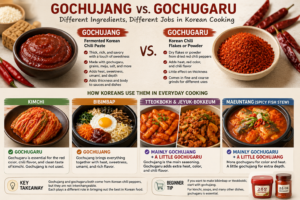
At home, for example, we often use our own seasoned gochujang when eating pork such as samgyeopsal.
This is not simply plain gochujang straight from the container. It is a seasoned version that we prepare according to our family’s taste.
Both my wife and I use a small amount of this seasoned gochujang in our ssam.
This is our family’s preference, not a general rule for how Koreans make ssam.
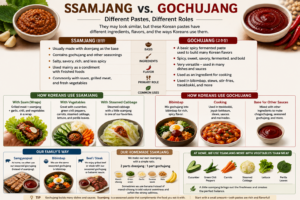
Ssamjang itself has its own ingredients, flavor, and uses, so it is better understood separately rather than treating every seasoning used in a ssam as ssamjang.
If you want to understand the condiment itself, see what ssamjang is and how Koreans eat it.
Do Koreans Wrap Pork and Beef the Same Way?
Not necessarily.
In our family, we often make ssam when eating pork cuts such as samgyeopsal, moksal, and hangjeongsal.
The combination of pork and fresh vegetables can create a pleasant contrast, especially with richer cuts.
But even when we eat pork, we do not wrap every piece.
We might eat several pieces as ssam and then eat the next few pieces of meat by themselves.
Beef is different for us.
Neither my wife nor I particularly enjoys wrapping beef in lettuce or perilla leaves.
We generally prefer to enjoy the flavor of the beef itself without adding too many other flavors.
So the common idea that “Koreans wrap grilled meat in lettuce” needs some qualification.
It can depend on the meat, how it is seasoned, and the person eating it.
Does Ssam Have to Be Eaten in One Bite?
A ssam that is small enough to eat in one bite can certainly be convenient.
You can experience the different flavors and textures together, and there is less chance of the ingredients falling out.
But this should not be treated as an absolute rule.
I usually make a relatively small and simple ssam, so I normally eat mine in one bite.
My wife puts lettuce, perilla leaves, meat, kimchi, rice, and seasoned gochujang together, so her ssam can become quite large.
Sometimes she cannot eat the entire wrap in one bite.
That does not mean she is eating ssam incorrectly.
For a beginner, starting with a small wrap may simply be easier.
After that, the best size is the size that works for you.
Ssam Is Not Limited to Lettuce and Perilla Leaves
If your first experience with ssam is at a Korean BBQ restaurant, it is easy to assume that lettuce and perilla are the only vegetables used.
They are not.
At home, the possibilities can be much broader.
Our family also eats ssam with vegetables and leaves such as:
- tender inner napa cabbage leaves
- steamed cabbage
- steamed pumpkin leaves
- steamed gomchwi leaves
Each has a different flavor, aroma, and texture.
Some leaves can be eaten fresh.
Others, such as pumpkin leaves, can be steamed until tender before they are used as wraps.
Steamed vegetables also offer a different experience from raw lettuce. They can be softer and bring their own natural sweetness.
At home, we also use steamed cabbage to wrap Korean-style boiled beef shank (suyuk) with seasoned bok choy.
So when thinking about ssam, it is more useful to focus on the practice of wrapping and combining food rather than on lettuce alone.
Does Ssam Always Contain Meat?
No.
This can be surprising if you first discovered ssam through Korean BBQ.
At home, for example, we sometimes eat steamed cabbage without putting any meat inside.
We may simply add a little of our seasoned gochujang to the steamed cabbage and wrap it.
Meat or another protein can certainly be added, but it does not define whether something is ssam.
This is why the formula
ssam = lettuce + Korean BBQ meat
is too narrow.
Korean ssam is much broader than that.
Everyone Can Have Their Own Ssam
You can see how much personal preference matters just by comparing my wife and me.
I prefer lettuce.
She prefers perilla leaves.
I do not put rice inside my ssam.
She adds a little.
I make a simple wrap that I usually eat in one bite.
She combines more ingredients and makes a much larger one.
Neither of us adds raw garlic, but I have eaten with many other Koreans who enjoy putting raw garlic in their wraps.
We often make ssam with pork, but when we eat beef, both of us generally prefer to enjoy the meat without wrapping it.
All of these differences reveal something important about ssam.
Koreans do not all make ssam in the same way.
Even when people are sitting around the same grill and sharing the same meat, each person can turn that shared food into a completely different bite.
That fits naturally with the structure of many Korean meals.
Food can be shared at the center of the table, while how each person combines and eats that food remains an individual choice.
This balance becomes easier to understand when you look at why Koreans share food at the table.
Ssam is one of the clearest examples of that balance between sharing and personal preference.
How Should a Beginner Try Ssam?
You do not need to copy a complicated Korean BBQ photo on your first try.
Start with the meat.
Taste one piece by itself first.
That gives you a reference point for understanding how the other ingredients change the flavor.
Next, place one piece of meat on a lettuce leaf and add a small amount of ssamjang.
Then try perilla instead of lettuce.
Notice how much the aroma changes the bite.
If you enjoy perilla, try layering it with lettuce.
After that, experiment with ingredients such as kimchi, garlic, chili pepper, pa-muchim, or a little rice.
Add what you like.
Leave out what you do not.
And you do not need to wrap every piece of meat.
Eat some pieces by themselves.
Try others as ssam.
The goal is not to discover the one correct Korean combination. It is to find the bite that tastes best to you.
If the entire Korean BBQ table feels unfamiliar, how to eat Korean BBQ for the first time explains the meal step by step.
Frequently Asked Questions
What Is Ssam?
Ssam is a Korean way of eating in which food is wrapped in a leaf or vegetable.
Lettuce and perilla leaves with grilled meat are among the best-known examples, especially at Korean BBQ restaurants, but ssam can involve many different leaves, vegetables, fillings, and seasonings.
Does Ssam Always Have Meat?
No.
Meat is common in Korean BBQ ssam, but it is not required.
At home, we sometimes eat steamed cabbage with only a little seasoned gochujang.
Which Is Better for Ssam, Lettuce or Perilla Leaves?
It depends on your taste.
Lettuce is relatively mild and fresh, while perilla has a much more distinctive aroma.
I prefer lettuce, while my wife prefers perilla leaves.
Can You Use Lettuce and Perilla Leaves Together?
Yes.
They can be layered together in one ssam.
My wife enjoys doing this, while I usually prefer eating them separately.
Are Perilla Leaves the Same as Sesame Leaves?
No.
Kkaennip is the leaf of the perilla plant.
Perilla and sesame are different plants.
Do Koreans Put Rice in Ssam?
Some do, but it is not required.
My wife adds a little rice to her ssam, while I prefer to eat my rice separately.
Do You Have to Put Raw Garlic in Ssam?
No.
Some Koreans enjoy raw garlic in their ssam, but it is a matter of preference.
My wife and I do not put raw garlic in ours. We eat grilled garlic separately.
Does Ssam Have to Be Eaten in One Bite?
Not necessarily.
A small one-bite ssam is convenient, especially for beginners, but it is not an absolute rule.
I usually eat mine in one bite, while my wife’s larger wraps sometimes require more than one bite.
Do Koreans Wrap Beef in Lettuce?
They can, but not everyone does.
My wife and I frequently make ssam with pork cuts such as samgyeopsal, moksal, and hangjeongsal, but we usually prefer eating beef without wrapping it because we want to enjoy the flavor of the meat itself.
Are Lettuce and Perilla the Only Leaves Used for Ssam?
No.
Depending on the household and the food, Koreans can use many different vegetables and leaves.
Our family also eats ssam with tender inner napa cabbage leaves, steamed cabbage, steamed pumpkin leaves, and steamed gomchwi leaves.
There Is No Single Correct Way to Make Ssam
The easiest way to understand Korean ssam is to stop looking for one fixed recipe.
Some people prefer lettuce.
Others love perilla.
Some layer the two.
Some put rice inside their wraps.
Others eat rice separately.
Some people love raw garlic.
Others leave it out.
Someone may frequently wrap pork but prefer to eat beef by itself.
And ssam does not have to use lettuce or perilla at all.
Napa cabbage, steamed cabbage, pumpkin leaves, gomchwi leaves, and other vegetables can become wraps too.
Meat is not always necessary.
My wife and I can sit at the same table, eat the same grilled pork, and make completely different ssam.
Other Koreans have their own preferences and habits as well.
Ultimately, that is part of what makes ssam interesting.
The same food shared at the same table can become a different, personal bite in each person’s hand.
Ssam is therefore more than simply wrapping Korean BBQ meat in lettuce.
It is a flexible way of combining flavors, textures, and preferences—and finding the bite that tastes right to you.