Gochujang vs. Gochugaru: What Is the Difference?
Learn how these two Korean chili ingredients differ in flavor, texture, and fermentation—and how Koreans actually use them in everyday cooking.
They Are Both Red, So Why Are They Different Ingredients?
If you are new to Korean cooking, gochujang and gochugaru can seem like similar ingredients.
Both are connected to red chili peppers.
Both can add red color to food.
Both can add heat.
And in dishes such as tteokbokki and jeyuk-bokkeum, they may even be used together.
So it is natural to wonder:
“What exactly is the difference between gochujang and gochugaru?”
“Can I use gochugaru if I do not have gochujang?”
“If both can make food spicy, why do some Korean dishes use one while others use the other?”
The simplest answer is this:
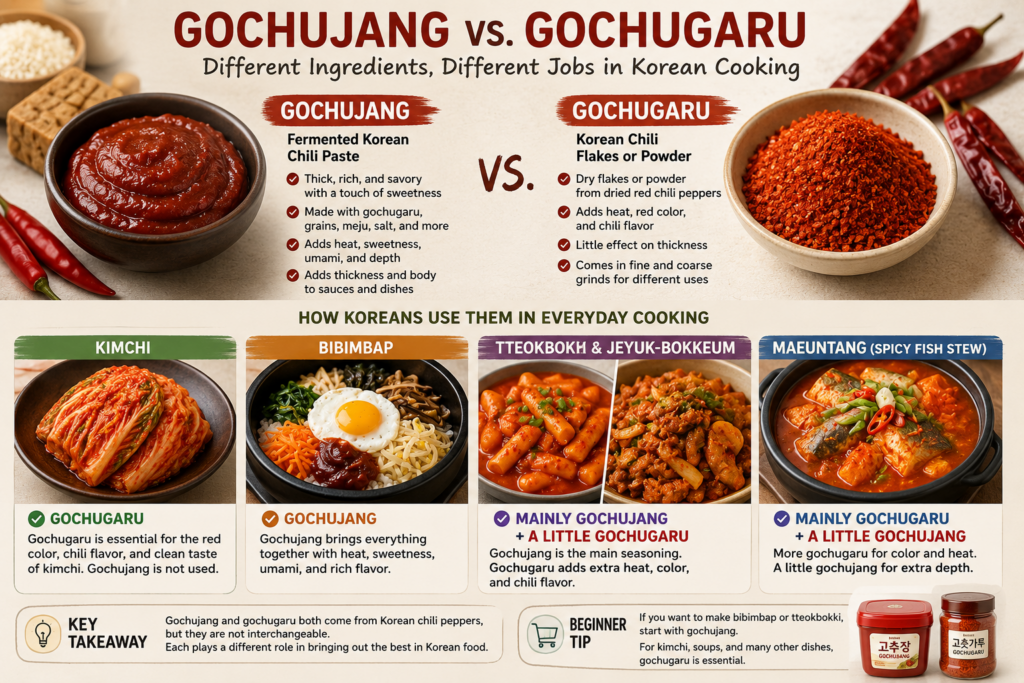
Gochugaru is made from dried Korean red peppers ground into flakes or powder, while gochujang is a fermented paste made with gochugaru, grains, meju powder, salt, and other ingredients.
The difference, therefore, is not simply paste versus powder.
They affect the flavor, aroma, texture, thickness, and overall character of a dish in different ways.
For Koreans, the distinction between where to use gochujang and where to use gochugaru is generally quite familiar.
If one is missing, we do not normally treat the other as an equal one-for-one replacement.
One of the easiest ways to understand the difference is not simply to compare ingredient lists, but to look at how Koreans actually use the two ingredients in different foods.
What Is the Biggest Difference Between Gochujang and Gochugaru?
Here is a simple mobile-friendly comparison.
Gochujang
- Form: Thick fermented paste
- Main ingredients: Gochugaru, grains, meju powder, salt, and other ingredients
- Fermented: Yes
- What it adds: Heat, sweetness, saltiness, umami, fermented depth, and thickness
- Effect on texture: Can make sauces and dishes thicker
- Common examples: Bibimbap, tteokbokki, jeyuk-bokkeum
Gochugaru
- Form: Dried chili flakes or powder
- Main ingredient: Dried Korean red chili peppers
- Fermented: No
- What it adds: Heat, red color, chili aroma, and chili flavor
- Effect on texture: Usually much less than gochujang
- Common examples: Kimchi, soups, stews, and seasoned vegetables
The most important difference is that gochujang is a fermented seasoning with several flavors already built into it.
Gochugaru can add the heat, color, aroma, and flavor of chili peppers.
Gochujang adds more than that.
It can also bring sweetness, saltiness, umami, fermented depth, and a thicker consistency.
That means the same amount of gochujang and gochugaru can change a dish in very different ways.
What Is Gochujang Made From?
Gochujang is not simply gochugaru turned into a paste.
It is a fermented jang made by combining several ingredients.
Traditional gochujang generally includes ingredients such as:
- gochugaru
- glutinous rice flour or other grain ingredients such as rice, wheat, or barley
- meju powder
- salt
- water
Depending on the method, malt may also be used to help develop sweetness.
Modern homemade recipes and commercial products can contain additional sweeteners or seasonings such as sugar, syrup, or honey.
Vinegar is commonly used when gochujang is mixed with sweetness to make chogochujang, the tangy red dipping sauce often served with seafood and hoe.
This is why gochujang should not be understood simply as a “spicy chili paste.”
The combination of chili, grains, meju, salt, and fermentation gives it a much more complex character.
If you are new to this fermented paste, how gochujang tastes and how Koreans use it explains its flavor and everyday uses in more detail.
What Does Gochugaru Add to Korean Food?
Gochugaru is made from dried Korean red chili peppers ground into flakes or powder.
But describing it simply as something that makes food spicy misses much of what it does.
Gochugaru can add:
- heat
- red color
- chili aroma
- subtle sweetness
- chili flavor
It is especially useful when a dish needs chili flavor and red color without the thickness and pronounced fermented character that gochujang can bring.
Gochugaru also comes in different grind sizes.
At home, unless a dish works particularly well with fine gochugaru, we generally use coarse gochugaru for everyday cooking.
For foods such as musaengchae, yukgaejang, or bibim-naengmyeon sauce, however, we sometimes use fine gochugaru because it blends more evenly into the food or seasoning.
Fine gochugaru is not automatically hotter than coarse gochugaru.
For a closer look at grind size and different uses, see the difference between fine and coarse gochugaru.
Grind size and heat level are different characteristics.
What Does Gochujang Add to Korean Food?
Gochujang is a more complex seasoning.
Along with doenjang and ganjang, it belongs to Korea’s traditional family of fermented jang.
Although chili heat is part of its character, gochujang cannot be explained by spiciness alone.
It can add:
- heat
- sweetness
- saltiness
- umami
- fermented depth
- thickness and body
That last point is especially important when comparing it with gochugaru.
If you add gochugaru to a broth, you can add red color, heat, and chili flavor.
If you add a large amount of gochujang to the same broth, you also introduce the paste’s sweetness, saltiness, fermented flavor, and thickness. The broth can become heavier and cloudier as well.
So Korean cooking is not simply a matter of asking:
“How spicy do I want this dish?”
A more useful question is:
“What kind of flavor and texture am I trying to create?”
Why Don’t We Use Gochujang in Kimchi?
Kimchi is one of the clearest ways to understand the difference between gochujang and gochugaru.
In familiar red baechu kimchi, gochugaru plays an important role in the seasoning.
It combines with ingredients such as garlic, ginger, green onion, fish sauce, and shredded radish to create the characteristic kimchi seasoning.
That seasoning is part of the larger story of how kimchi is made and fermented.
What if you used gochujang instead simply because it is also red and spicy?
That would change the character of the seasoning.
Traditional Korean kimchi does not normally use gochujang, and we do not use it when making kimchi in our home either.
Gochujang would introduce its own sweetness, saltiness, fermented flavor, and thick texture, taking the seasoning away from the cleaner flavor we expect from kimchi.
This illustrates an important principle:
Two ingredients can both add red color and heat without serving the same purpose.
Why Do We Use Gochujang in Bibimbap?
Bibimbap shows the difference from the opposite direction.
At home, we use gochujang with bibimbap. We do not normally add gochugaru separately.
Using gochujang, or a sauce based on it, is also a familiar way to season bibimbap more generally.
Bibimbap combines rice with different namul, vegetables, meat, egg, and other ingredients.
When gochujang is mixed into the bowl, its heat, sweetness, saltiness, umami, and fermented flavor help bring those different ingredients together.
Sesame oil adds another layer of nutty aroma.
When I eat bibimbap, I do not add a large amount of gochujang at once.
I start with a little, mix everything, taste it, and add more if needed.
Too much gochujang can overpower the individual flavors of the namul and other ingredients.
This balance is also part of how Koreans actually eat bibimbap, where the ingredients are mixed but their individual flavors still matter.
If you simply sprinkled gochugaru over bibimbap instead, you could add chili heat and flavor.
But you would not create the flavor or texture normally associated with gochujang-seasoned bibimbap.
Put kimchi and bibimbap side by side and the difference becomes easy to see:
Kimchi → gochugaru plays the important role
Bibimbap → gochujang plays the important role
Both foods can be red and spicy, but the ingredients are doing very different jobs.
Why Do Tteokbokki and Jeyuk-Bokkeum Use Both?
Some dishes make the comparison even more interesting.
In our home, we use both gochujang and gochugaru when making tteokbokki or jeyuk-bokkeum.
But we do not use them in equal proportions.
For these dishes, gochujang is the main chili seasoning, while we use a smaller amount of gochugaru as a supporting ingredient.
Gochujang helps form the basic flavor and body of the seasoning.
A smaller amount of gochugaru can then complement it with additional chili flavor, heat, and red color.
Tteokbokki sauce may also include soy sauce, sweetening ingredients, broth, and other seasonings.
Jeyuk-bokkeum recipes can likewise vary from one household or recipe to another.
The important point is that gochujang and gochugaru are not simply doing the same job twice.
They can be used together because they contribute different things to the final seasoning.
Why Do We Use More Gochugaru in Maeuntang?
Maeuntang is another dish for which we use both ingredients at home.
But the balance is different from tteokbokki or jeyuk-bokkeum.
When we make maeuntang, we use only a little gochujang and relatively more gochugaru.
One reason is the broth.
If too much gochujang is added, the broth can become thicker and cloudier.
So we use only a small amount of gochujang and rely more heavily on gochugaru for the red color, chili flavor, and heat.
This gives us a useful comparison:
Tteokbokki and jeyuk-bokkeum → mainly gochujang + a smaller amount of gochugaru
Maeuntang → mainly gochugaru + a smaller amount of gochujang
The same two ingredients can appear in both dishes, yet their proportions and roles change according to the food.
That tells you much more about the difference than simply saying that one is a paste and the other is a powder.
Why Do Some Koreans Sprinkle Gochugaru on Jajangmyeon?
Gochugaru is not limited to Korean foods that are already red.
At Korean Chinese restaurants, some people sprinkle a little gochugaru over jajangmyeon.
Jajangmyeon itself is not normally a spicy dish.
Adding a little gochugaru can give it some extra heat and chili flavor without completely changing the basic character of the noodles and black bean sauce.
Gochujang would be very different.
It would add not only heat but also its own sweetness, saltiness, fermented flavor, and thick texture.
Personally, I do not add gochugaru to my jajangmyeon. I prefer to eat it as it is.
But in Korea, it is not unusual to see someone add a little gochugaru because they want their jajangmyeon slightly spicier.
Even this small example helps show why gochugaru and gochujang are not interchangeable.
Can You Substitute Gochugaru for Gochujang?
In general, you should not substitute one for the other in the same amount and expect the same result.
Removing a spoonful of gochujang and replacing it with a spoonful of gochugaru does not reproduce the same seasoning.
Without the gochujang, you also lose the sweetness, saltiness, umami, fermented depth, and thickness it would have contributed.
The reverse is also true.
Replacing gochugaru with gochujang can introduce sweetness, saltiness, fermented flavor, and thickness that the original dish was not meant to have.
If a recipe calls for gochujang and you only have gochugaru—or vice versa—you would need to reconsider the balance of the entire seasoning rather than make a simple one-for-one substitution.
This is particularly clear in dishes such as kimchi, where gochugaru has a specific role, and bibimbap, where the character of gochujang matters.
For Koreans, the uses of these two ingredients are generally familiar enough that mistakenly swapping one for the other is not especially common.
Gochujang and gochugaru are not two forms of the same seasoning. They are two seasonings with different jobs.
Which Is Spicier: Gochujang or Gochugaru?
This sounds like a simple question, but there is no single answer.
Different gochujang products can have different heat levels.
Gochugaru can also vary in heat depending on the peppers used and the product.
Fine gochugaru is not necessarily hotter than coarse gochugaru either.
Instead of memorizing:
Gochujang = hotter
or
Gochugaru = hotter
it is more useful to ask:
What combination of flavor and texture does gochujang add?
What kind of chili flavor, color, and heat does gochugaru add?
If you compare them only by heat level, you miss the most important difference between them.
And if heat itself is your concern, there are practical ways to enjoy Korean food even if you don’t like spicy food.
Why Do We Keep Both Gochujang and Gochugaru at Home?
In our home, we use roughly similar amounts of gochujang and gochugaru.
But that is not because we use them interchangeably.
It is because there are many different dishes that need each one.
For bibimbap, we use gochujang.
For kimchi, we use gochugaru.
For tteokbokki and jeyuk-bokkeum, we mainly use gochujang and add some gochugaru.
For maeuntang, we do the opposite: we rely more on gochugaru and use only a little gochujang.
And some Koreans sprinkle gochugaru on jajangmyeon when they want a little extra heat.
Gochujang cannot do everything gochugaru does.
Gochugaru cannot do everything gochujang does.
That is why both are basic ingredients in Korean kitchens.
Which Should a Beginner Buy First?
It depends on what you want to cook.
If you want to make a simple bibimbap, gochujang may be the more immediate purchase.
If you want to make kimchi or explore a wider range of Korean soups, stews, and seasoned vegetables, gochugaru may become important very quickly.
And because dishes such as tteokbokki, jeyuk-bokkeum, and maeuntang can use both, anyone planning to cook a variety of Korean food will eventually find it useful to have both in the kitchen.
If you are buying only one type of gochugaru to start, think about the foods you plan to make.
In our home, we use coarse gochugaru for many everyday dishes unless there is a specific reason to use the fine type.
Gochujang also varies by product in sweetness, saltiness, heat, and fermented character.
There is no need to begin with the hottest version.
Most importantly, do not think of these as simply “two spicy red Korean seasonings.”
If you are building your Korean pantry from scratch, see the essential Korean ingredients every beginner should know.
Frequently Asked Questions
Are Gochujang and Gochugaru the Same Thing?
No.
Gochugaru is made from dried Korean red chili peppers ground into flakes or powder.
Gochujang is a fermented paste made with gochugaru, grains, meju powder, salt, and other ingredients.
They differ in flavor, texture, fermentation, and how they are used in cooking.
What Is Gochujang Made From?
Traditional gochujang generally includes gochugaru, glutinous rice or other grain ingredients, meju powder, salt, and water.
Depending on the method or product, other ingredients such as malt or sweeteners may also be used.
Can I Use Gochugaru Instead of Gochujang?
Not as a simple one-for-one substitution.
Gochujang contributes sweetness, saltiness, umami, fermented flavor, and thickness that gochugaru does not provide on its own.
Can I Use Gochujang Instead of Gochugaru?
Again, not as a direct substitute.
Adding gochujang can introduce sweetness, saltiness, fermented flavor, and thickness that the original dish may not need.
Does Kimchi Contain Gochujang?
Traditional Korean kimchi does not normally use gochujang.
In familiar red baechu kimchi, gochugaru is the important chili ingredient.
We do not use gochujang when making kimchi in our home either.
Does Bibimbap Use Gochujang or Gochugaru?
Gochujang, or a sauce based on it, is commonly used with bibimbap.
At home, we use gochujang and do not normally add gochugaru separately.
I add the gochujang gradually so that it does not overpower the other ingredients.
Does Tteokbokki Use Gochujang or Gochugaru?
Recipes vary, but both can be used.
At home, we mainly use gochujang and add a smaller amount of gochugaru.
Does Jeyuk-Bokkeum Use Both?
We use both gochujang and gochugaru at home.
As with our tteokbokki, gochujang is the main seasoning and gochugaru plays a supporting role.
Other households and recipes may use different proportions.
Does Maeuntang Use Gochujang or Gochugaru?
At home, we use both, but we use more gochugaru.
We keep the amount of gochujang relatively small because too much can make the broth thicker and cloudier.
Is Fine Gochugaru Hotter Than Coarse Gochugaru?
Not necessarily.
Grind size and heat level are separate characteristics.
Understanding the Difference Makes Korean Cooking Easier
At first, gochujang and gochugaru can look quite similar.
Both are red.
Both are connected to chili peppers.
Both appear frequently in spicy Korean food.
But their roles in cooking are clearly different.
Gochugaru adds chili heat, red color, aroma, and flavor.
Gochujang is a fermented seasoning that can add heat along with sweetness, saltiness, umami, fermented depth, and a thicker texture.
Think about kimchi and you can see the role of gochugaru.
Think about bibimbap and you can see the role of gochujang.
In tteokbokki and jeyuk-bokkeum, gochujang can take the leading role while gochugaru supports it.
In maeuntang, the balance can reverse, with gochugaru playing the larger role and gochujang used only in a smaller amount.
We use roughly similar amounts of gochujang and gochugaru at home, but we do not use them as substitutes for each other.
They have different jobs.
For Koreans, that distinction feels fairly natural.
For someone just beginning to cook Korean food, understanding it can make many Korean recipes suddenly much easier to read.
Gochujang and gochugaru are not simply two forms of the same spicy seasoning. They are two important ingredients that build Korean flavor in different ways.