Gochugaru Explained: Fine vs. Coarse Korean Chili Flakes
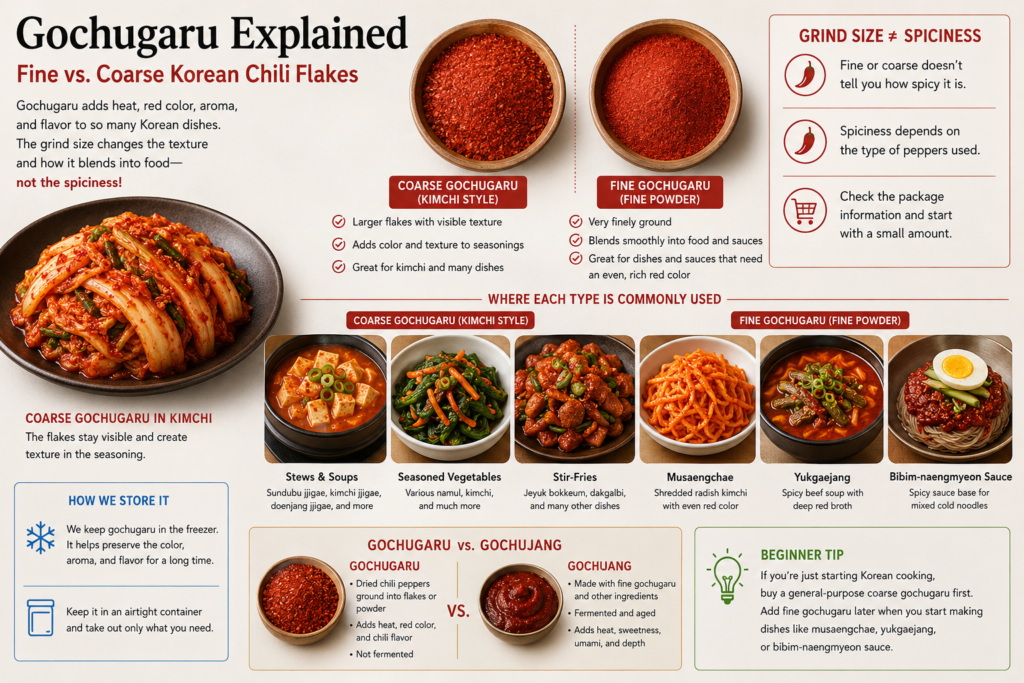
Learn how we use fine and coarse gochugaru at home, what to check when buying Korean chili flakes, and how we store them in the freezer.
Coarse Gochugaru Is Our Everyday Choice at Home
At a Korean grocery store, you may see gochugaru labeled “for kimchi,” “for gochujang,” “fine,” or “coarse.” If you are just starting to cook Korean food, you might wonder whether you need a separate bag for every dish.
At home, we generally use coarse gochugaru unless a dish calls for a finer texture. It is an everyday ingredient for stews, seasoned vegetables, and stir-fries as well as kimchi.
We sometimes choose fine gochugaru for musaengchae, yukgaejang, and bibim-naengmyeon sauce. The choice depends on how we want the chili particles to blend into the food and how noticeable they should be in the finished dish.
Fine and coarse describe the grind size first. Heat level is a separate characteristic to check.
Grind Size Changes How Gochugaru Blends into Food
Gochugaru is made by grinding dried red chili peppers. It adds red color, chili aroma, and flavor as well as heat.
With coarse gochugaru, the small pieces of chili are visible and tend to remain more noticeable in the food. Fine gochugaru is ground into smaller particles, making it useful for distributing chili evenly through sauces and broth. This does not mean it dissolves completely in water; the difference is in how noticeable the particles are in the finished dish.
| Characteristic | Coarse gochugaru | Fine gochugaru |
|---|---|---|
| Appearance | Relatively distinct pieces of ground chili. | Smaller, more finely ground particles. |
| In food | Chili particles remain visible in the seasoning. | When mixed well, it helps coat food evenly with color and seasoning. |
| How we use it at home | Kimchi and everyday stews, seasoned vegetables, and stir-fries. | Musaengchae, yukgaejang, and bibim-naengmyeon sauce. |
| What to remember | It is not limited to kimchi. | A finer grind is not necessarily hotter. |
Grind sizes vary between products, so two bags labeled “coarse” may not look exactly alike. Check any product photos or suggested uses on the package as well.
Coarse Gochugaru Is Useful Beyond Kimchi
Look closely at napa cabbage kimchi, and you can see chili particles among the cabbage leaves and shredded radish. Coarse gochugaru is widely used in this kind of kimchi seasoning.
A bag labeled “for kimchi” does not have to be used only for kimchi. If it is plain gochugaru, you can also use it in stews, stir-fries, and seasoned vegetables. Just distinguish plain chili flakes from a prepared kimchi seasoning mix containing several ingredients.
In our kitchen, coarse gochugaru is a basic ingredient used across different dishes. We do not reach for separate products for every soup, stew, and stir-fry.
In kimchi, garlic, salted seafood, other seasonings, and the stage of fermentation also shape the flavor. Our guide to kimchi explores the varieties and how they change as they ferment.
We Also Use Fine Gochugaru for Radish and Cold Noodle Sauce
Fine gochugaru may bring gochujang-making to mind. It is used for that purpose, but we buy prepared gochujang rather than make it ourselves. We use fine gochugaru in other dishes.
For musaengchae, a seasoned shredded radish dish, we sometimes use fine gochugaru to distribute the red color and seasoning evenly over the radish. In yukgaejang, a spicy beef soup, we use it to blend into the seasonings and broth.
Bibim-naengmyeon sauce is another example. At home, we build the chili flavor of this spicy cold noodle sauce around fine gochugaru rather than relying mainly on gochujang. We combine it with the other seasonings to adjust the heat and color.
That does not mean we make every sauce with gochugaru. We use yangnyeom gochujang, a seasoned gochujang sauce, for bibimbap. Different dishes call for different flavors and textures. Our guide to using gochujang offers examples of that approach.
Nor must musaengchae or yukgaejang always be made with fine gochugaru. These are examples from our kitchen. Other households and recipes may use a different grind or combine more than one.
Do Not Judge Heat by Grind Size or Redness Alone
Fine gochugaru is not necessarily hotter than coarse gochugaru. Particle size and heat level are different characteristics. Depending on the peppers used, a finely ground product can be mild, while a coarse one can be hot.
A vivid red color does not necessarily mean more heat either. Check for a heat indication on the package. When using an unfamiliar product, begin with a little less rather than adding the full recipe quantity all at once.
After mixing it in, taste it with the broth, vegetables, or other ingredients you will actually eat. Adding more gochugaru simply to deepen the red color can also increase the heat and chili aroma.
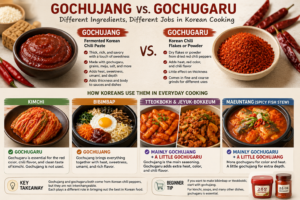
Substituting a different chili seasoning changes the result too. Gochujang adds sweetness, saltiness, and thickness along with heat. Our comparison of gochujang and gochugaru explains the differences to consider when substituting.
Check the Grind and Intended Use Before Buying
If you want to try a range of Korean dishes, a bag of coarse gochugaru for general cooking can be a useful starting point. If your first recipe is a sauce that calls for fine gochugaru, choose accordingly. You do not need large bags of both types from the beginning.
English labels may say “Gochugaru,” “Korean Red Pepper Flakes,” or “Korean Red Pepper Powder.” Rather than relying on the name alone, check for “Fine” or “Coarse,” product photos, and suggested uses.
A Korean brand does not necessarily mean the peppers were grown in Korea. If you want a product made with Korean-grown peppers, check the stated origin of the peppers rather than relying on the brand name or package design.
A product labeled “Chili Powder” at a general grocery store is not necessarily the same ingredient. Some are seasoning blends containing other spices. Crushed red pepper used on pizza can also differ in texture, aroma, and heat, so an equal amount may not produce the same result.
Consider the dish you plan to make, the grind size, any heat indication, and how much you expect to use. Our guide to essential Korean ingredients covers other basics to keep alongside it, such as soy sauce and sesame oil.
We Keep Our Gochugaru Sealed in the Freezer
At home, we keep gochugaru tightly sealed in the freezer and take out what we need. Because we use each bag over several cooking sessions, preserving its color and aroma matters to us as well as its heat.
If you buy a large quantity, dividing it into smaller containers is another option. Use a clean, dry utensil to take out a portion, then seal the remaining gochugaru properly. Check any specific storage instructions on the package too.
When choosing your first gochugaru, picture the food you want to make. Will it be an everyday ingredient for stews and stir-fries, or will you use it in a sauce where you want the particles to be less noticeable? That makes the choice easier. Then, as you cook with the same product, you can learn how much suits your taste.