Ssamjang vs. Gochujang: What Is the Difference?
Learn how these Korean pastes differ in ingredients, flavor, spice level, and cooking uses—and how they’re actually used with Korean BBQ and vegetables.
Ssamjang and Gochujang May Look Similar, but They Are Not the Same
If you are new to Korean food, the jang section of a Korean grocery store can be confusing.
There is gochujang.
There is doenjang.
And there is ssamjang.
Gochujang and ssamjang can be especially confusing because both are thick pastes, and gochujang can actually be one of the ingredients used to make ssamjang.
So it is natural to wonder:
“What exactly is the difference between ssamjang and gochujang?”
“If ssamjang contains gochujang, aren’t they basically similar?”
“Can I use gochujang instead of ssamjang with samgyeopsal?”
“Can I substitute ssamjang when a recipe calls for gochujang?”
The simplest distinction is this:
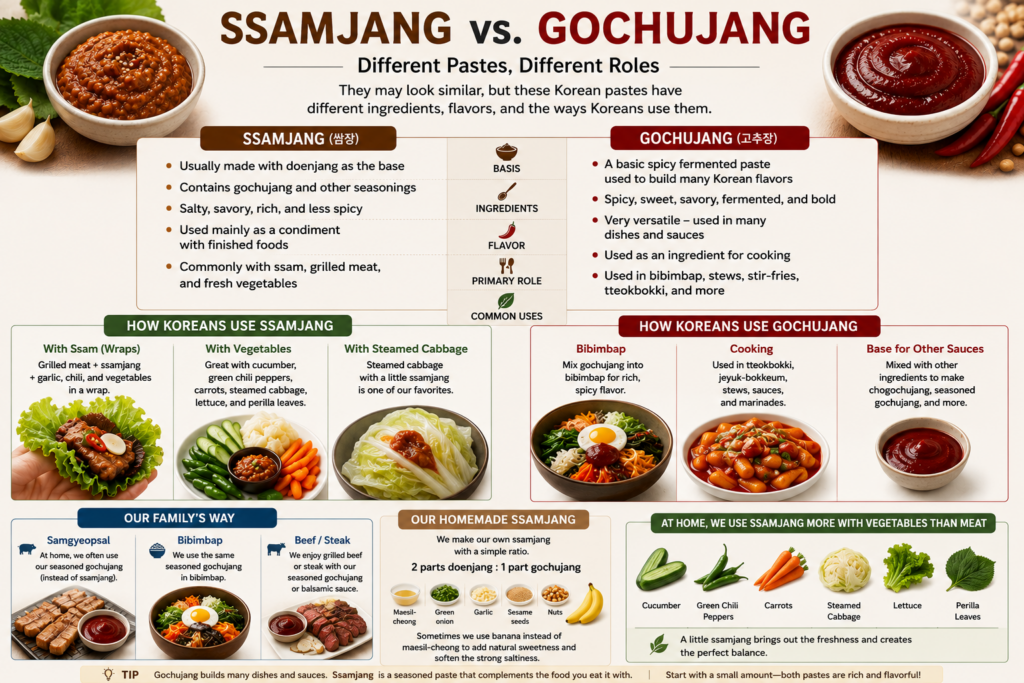
Gochujang is a basic fermented jang used to build the flavors of many Korean dishes and seasonings, while ssamjang is a seasoned paste typically made with doenjang, gochujang, and other ingredients for eating with ssam, grilled foods, and vegetables.
In other words, gochujang can be an ingredient in ssamjang, but ssamjang and gochujang are not the same thing.
And in actual Korean homes, the ways these pastes are used can also vary according to the family’s taste and what is being served.
Understanding this difference makes it much easier to know why several similar-looking pastes can have very different jobs on a Korean table.
What Is the Biggest Difference Between Ssamjang and Gochujang?
Here is a simple mobile-friendly comparison.
Gochujang
- A basic Korean fermented jang
- Made with gochugaru, grains, meju powder, salt, and other ingredients
- Adds heat, sweetness, saltiness, umami, and fermented depth
- Can be mixed directly into bibimbap
- Used in seasonings for foods such as tteokbokki and jeyuk-bokkeum
- Can be used in some stews
- Can become an ingredient in other seasonings such as chogochujang and ssamjang
Ssamjang
- A seasoned paste usually made with doenjang as a base
- Commonly combines doenjang, gochujang, and other seasonings
- May include garlic, sesame oil, sesame seeds, and ingredients that add sweetness
- Gets much of its salty, savory, fermented character from doenjang
- Usually less spicy than gochujang
- Commonly eaten with ssam, grilled meat, and fresh vegetables
- Generally used as a condiment with finished food rather than as a basic jang for building many different dishes
So the most important difference is not simply color or heat.
Gochujang is a basic jang that can help build many different dishes and seasonings. Ssamjang is a seasoned paste in which different ingredients are combined for a particular way of eating.
What Is Ssamjang Made From?
Ssamjang is commonly made with doenjang as the base and gochujang as another important ingredient.
The exact ingredients and proportions can vary by household, recipe, and commercial product.
Common additions may include:
- doenjang
- gochujang
- garlic
- sesame oil
- sesame seeds
- ingredients that add sweetness
The important point is that ssamjang is not simply gochujang with a few extra ingredients mixed into it.
Doenjang provides much of the salty, savory, earthy fermented character that defines ssamjang.
Gochujang can add color, some heat, sweetness, and additional fermented depth.
Garlic, sesame oil, sesame seeds, and other ingredients can create still more layers of flavor.
The result tastes quite different from eating gochujang by itself.
For a closer look at this seasoned paste, see what ssamjang is and how Koreans eat it.
What Does Gochujang Do in Ssamjang?
The fact that ssamjang can contain gochujang does not make ssamjang a type of gochujang.
Gochujang is one part of the mixture.
If doenjang creates much of ssamjang’s savory and salty foundation, gochujang can add heat, sweetness, color, and another layer of fermented flavor.
Then garlic, sesame oil, sesame seeds, and other seasonings change the flavor again.
Together, they create something different from either doenjang or gochujang on its own.
This is also a useful example of how jang works in Korean cooking.
Korean fermented pastes are not always used separately.
Different jang and seasonings can be combined to create a new flavor for a particular food or way of eating.
Is Ssamjang Less Spicy Than Gochujang?
In general, yes. Ssamjang tends to be less spicy than gochujang.
Ssamjang is usually made with a larger proportion of doenjang than gochujang, and other non-spicy ingredients are also added.
Garlic, sesame oil, sesame seeds, and sweetening ingredients can all become part of the mixture.
As a result, the chili heat is usually less pronounced than when you eat gochujang on its own.
But this does not mean:
Ssamjang = mild gochujang.
The salty, savory, fermented character of doenjang is a major part of ssamjang’s flavor.
Different products and homemade recipes can also have different ratios of doenjang and gochujang, so sweetness, saltiness, and heat can vary.
The better way to remember the difference is this:
Ssamjang is generally less spicy than gochujang, but it is a different seasoned paste—not simply a milder version of gochujang.
Why Is Gochujang Used in Cooking While Ssamjang Is Usually Eaten as a Condiment?
One of gochujang’s most important characteristics is its versatility.
You can mix it into bibimbap.
You can combine it with other ingredients to build the seasoning for tteokbokki or jeyuk-bokkeum.
It can be used in some stews.
Add vinegar and sweetness, and it can become chogochujang.
Combine it with doenjang and other seasonings, and it can become part of ssamjang.
Gochujang, therefore, is not simply one finished dipping sauce.
It can be a starting point for building many different Korean flavors.
If you are new to the paste itself, how gochujang tastes and how Koreans use it explains its flavor and everyday uses in more detail.
Ssamjang usually has a different role.
It is commonly eaten with food after the food has been cooked.
You normally do not spread ssamjang over samgyeopsal before grilling it.
Instead, you grill the meat first and then dip a cooked piece into a little ssamjang or put a small amount inside a ssam.
Ssamjang is therefore better understood as a seasoned paste already balanced for eating with finished foods rather than a basic jang used to build many different dishes.
How Is Ssamjang Commonly Eaten With Samgyeopsal?
Samgyeopsal is one of the easiest foods for understanding the role of ssamjang.
At a Korean BBQ restaurant, ssamjang is a familiar condiment served with grilled pork belly.
You can dip a properly grilled piece of samgyeopsal into a little ssamjang.
Or you can put the meat on lettuce or a perilla leaf, add a small amount of ssamjang and other ingredients you like, and eat the wrap in one bite.
You do not need much ssamjang.
Its salty and concentrated flavor can easily overpower the meat and vegetables if you add too much.
And ssamjang is not mandatory for every bite.
You can try the meat on its own first.
Then try another piece with salt.
Then add a little ssamjang.
Finally, try it inside a ssam.
These combinations are part of the larger experience of what makes Korean BBQ different.
The same piece of grilled meat can taste quite different depending on what you eat with it.
But We Eat Samgyeopsal a Little Differently at Home
The way we eat samgyeopsal at home is somewhat different from what you commonly see at a Korean BBQ restaurant.
Because samgyeopsal contains a lot of fat, it can start to feel rich and heavy as we continue eating.
At home, instead of using regular gochujang or ssamjang with samgyeopsal, we often use our own seasoned gochujang.
We prepare it ahead of time by mixing gochujang with maesil-cheong (Korean plum syrup), sesame oil, and a small amount of makgeolli, and then letting the mixture mature before using it.
When I make a ssam, I use about half a teaspoon or less of this seasoned gochujang.
I prefer using only a small amount so that the seasoning does not overpower the meat and vegetables.
If I am not making a ssam, I may simply dip the grilled samgyeopsal lightly into the seasoned gochujang.
This is different from the more familiar restaurant practice of eating samgyeopsal with ssamjang.
It is our family’s way of eating it, not a general rule for how Koreans eat samgyeopsal.
That distinction is important.
Korean food has familiar patterns, but individual families can still develop their own ways of using the same ingredients.
We Use Our Seasoned Gochujang With Other Foods Too
The seasoned gochujang we make at home is not only for samgyeopsal.
We also use it with bibimbap.
Instead of adding plain gochujang, we add some of our seasoned gochujang, mix the bibimbap, taste it, and add more only if needed.
We also use seasoned gochujang with grilled beef or steak.
At home, we may eat steak with our seasoned gochujang or with balsamic sauce.
Again, this should not be understood as the standard Korean way to eat steak.
It is simply one of our family’s preferences.
But these examples demonstrate something important about gochujang.
Gochujang can be eaten as it is, but it can also serve as a base for creating another seasoning adjusted to a particular food or personal preference.
Why Don’t We Use Ssamjang With Marinated Galbi?
At home, we normally do not add ssamjang when we eat marinated galbi.
Marinated galbi already has plenty of sweet and savory seasoning in the meat itself.
Adding another strong paste can make the seasoning feel excessive and may cover some of the flavor already built into the galbi.
For us, additional ssamjang is simply unnecessary.
This is a useful reminder that even though ssamjang is closely associated with Korean BBQ, it does not need to accompany every kind of grilled meat.
Whether you want it can depend on how the meat is seasoned, what else is on the table, and your own preference.
At Home, We Use Ssamjang More Often With Vegetables Than Meat
Ssamjang is strongly associated with Korean BBQ, but it is not only for meat.
In our home, we actually use ssamjang more often with vegetables than with meat.
We like to eat a small amount with foods such as:
- cucumber
- green chili peppers
- carrots
- steamed cabbage
- lettuce
- perilla leaves
We do not cover the vegetables with ssamjang.
We simply dip them lightly into a small amount.
Fresh cucumber, green chili peppers, and carrots are crisp and relatively clean in flavor, so a little salty, savory ssamjang gives them a strong contrast.
We especially enjoy ssamjang with steamed cabbage.
Steaming makes cabbage softer and brings out some of its natural sweetness.
A little ssamjang works very well with that mild sweetness.
This is one reason it is too limiting to think of ssamjang simply as “a sauce for samgyeopsal.”
How Do We Make Ssamjang at Home?
Ready-made ssamjang is easy to buy, but in our home, we prefer making it ourselves.
Our approximate basic ratio is:
2 parts doenjang : 1 part gochujang
We then add ingredients such as:
- maesil-cheong
- green onion
- garlic
- sesame seeds
- nuts
Sometimes we use banana instead of maesil-cheong.
Banana and nuts are not standard ingredients that every Korean household adds to ssamjang.
They are simply part of how we adjust ssamjang for our own table.
Ssamjang can be quite salty because doenjang makes up a large part of the mixture.
Since we use ssamjang mostly with vegetables, we do not want the salty flavor to become too strong.
Banana adds natural sweetness and a soft texture that blends easily into the paste, helping the strong saltiness feel milder.
Nuts add nuttiness and texture and help create a more balanced flavor.
Green onion, garlic, and sesame seeds add additional layers of flavor.
The result is a homemade ssamjang that works particularly well with the vegetables we eat.
Why Do We Prefer Homemade Ssamjang?
Commercial ssamjang is convenient, and Korean restaurants commonly serve their own version.
But at home, we prefer the ssamjang we make ourselves.
It is not simply because it is homemade.
We can adjust it to match both our taste and the foods we actually eat.
Because we use ssamjang more often with vegetables than with meat, controlling the strong salty flavor is especially important to us.
We can adjust the ratio of doenjang to gochujang.
We can adjust the sweetness.
We can use maesil-cheong or sometimes banana.
We can change the amount of green onion, garlic, sesame seeds, and nuts.
For us, ssamjang is not necessarily one fixed flavor that must always taste exactly the same.
It is a seasoned paste that can be adjusted for the food and the people eating it.
Can You Use Gochujang Instead of Ssamjang?
There is no rule saying that you cannot eat gochujang with grilled meat or vegetables.
If you enjoy it, you can.
We even use our own seasoned gochujang with samgyeopsal at home.
But that does not mean gochujang and ssamjang taste the same or perform the same role.
Plain gochujang gives you its own combination of chili heat, sweetness, saltiness, umami, and fermented depth.
Ssamjang brings the salty, savory character of doenjang together with gochujang and other seasonings.
So there is an important distinction between:
“Can I eat this with the food?”
and
“Can I substitute it and expect the same result?”
You can certainly choose gochujang according to your preference, but you should not expect it to taste like ssamjang.
Can You Use Ssamjang Instead of Gochujang in Cooking?
Again, it is not a simple one-for-one substitution.
Imagine replacing the gochujang in bibimbap with the same amount of ssamjang.
You would not only be adding gochujang.
You would also be adding doenjang and the other seasonings already present in the ssamjang.
The same problem applies to dishes such as tteokbokki or jeyuk-bokkeum.
Using ssamjang in place of gochujang can change the overall balance of the dish.
Ssamjang and gochujang may share some ingredients, but their finished flavors and culinary purposes are different.
The important question is not whether both are thick Korean pastes. It is what each paste is supposed to contribute to the food.
The same principle applies to the difference between gochujang and gochugaru, which also play different roles even when they appear in some of the same dishes.
How Can You Tell Ssamjang and Gochujang Apart at the Store?
Gochujang, doenjang, and ssamjang can sometimes be sold in similar-looking containers.
Do not rely only on package color or appearance.
The easiest solution is to check the name.
Gochujang — 고추장
Ssamjang — 쌈장
You can also look at the ingredient list.
Ssamjang may contain ingredients related to both doenjang and gochujang, along with garlic, sesame oil, sesame seeds, sweetening ingredients, or other seasonings.
Products can vary in saltiness, sweetness, and heat.
Gochujang also varies by product in sweetness, saltiness, heat, and fermented character.
Trying one brand does not tell you exactly what every gochujang or every ssamjang tastes like.
Which Should a Beginner Buy First: Gochujang or Ssamjang?
It depends on what you want to eat or cook.
If you are preparing Korean BBQ at home and want to make ssam with lettuce or perilla leaves, ready-made ssamjang is convenient.
You can also eat it with vegetables such as cucumber or green chili peppers.
If you want to cook a wider range of Korean foods such as bibimbap, tteokbokki, or jeyuk-bokkeum, gochujang is the more fundamental ingredient.
Gochujang can also become an ingredient in other seasonings, including ssamjang.
So if you plan to explore Korean cooking more broadly, it has a very wide range of uses.
The better question is not:
“Which one is better?”
It is:
“What do I want to make or eat?”
Frequently Asked Questions
Are Ssamjang and Gochujang the Same?
No.
Gochujang is one of Korea’s basic fermented jang.
Ssamjang is a seasoned paste typically made with doenjang, gochujang, and other ingredients for eating with ssam, grilled foods, and vegetables.
Does Ssamjang Contain Gochujang?
It commonly does.
Ssamjang is usually made with doenjang as the base and gochujang as another ingredient, along with additional seasonings.
The exact ingredients and proportions can vary.
Is Ssamjang Less Spicy Than Gochujang?
Generally, yes.
Ssamjang usually contains a larger proportion of doenjang than gochujang, along with other non-spicy ingredients.
As a result, it is generally less spicy than eating gochujang on its own.
But ssamjang is not simply mild gochujang. It has its own salty, savory, fermented character and different culinary uses.
Can I Use Ssamjang Instead of Gochujang?
Not as a simple one-for-one substitute.
Ssamjang contains doenjang and other seasonings, so its flavor is different from gochujang.
Can I Eat Gochujang Instead of Ssamjang With Korean BBQ?
Yes, if that is what you prefer.
But ssamjang is the more familiar condiment served with grilled meat and ssam at Korean BBQ restaurants.
At home, our family often uses our own seasoned gochujang with samgyeopsal instead.
Is Ssamjang Only for Meat?
No.
It can also be eaten with fresh vegetables and different kinds of ssam.
At home, we actually use ssamjang more often with vegetables such as cucumber, green chili peppers, carrots, steamed cabbage, lettuce, and perilla leaves.
Is Ssamjang Used for Cooking?
Its most familiar role is as a condiment eaten with finished foods, especially grilled meat, ssam, and vegetables.
Gochujang has a much broader role as a basic ingredient for cooking and for building other seasonings.
Can I Make Ssamjang With Gochujang?
Yes.
Gochujang is commonly one of the ingredients used to make ssamjang.
Doenjang is usually the base, with gochujang and other seasonings added.
At home, we use roughly two parts doenjang to one part gochujang and add maesil-cheong, green onion, garlic, sesame seeds, and nuts. Sometimes we use banana instead of maesil-cheong.
Once You Understand Their Roles, the Difference Becomes Easy
At first, gochujang and ssamjang can look similar.
Both are thick pastes, and ssamjang can even contain gochujang.
But their roles are different.
Gochujang is a basic fermented jang used to build the flavors of many Korean dishes and seasonings.
It can be used with bibimbap, in seasonings for tteokbokki and jeyuk-bokkeum, in some stews, and as a starting ingredient for other sauces and seasoned pastes.
Ssamjang combines doenjang, gochujang, and other seasonings into a paste designed primarily to complement ssam, grilled foods, and vegetables.
And how people use them can vary at home.
At a Korean BBQ restaurant, eating samgyeopsal with ssamjang is familiar.
In our home, however, we often eat samgyeopsal with our homemade seasoned gochujang, while we use ssamjang more frequently with vegetables such as cucumber, green chili peppers, carrots, and steamed cabbage.
We also adjust our homemade ssamjang to fit the way we eat it.
We use roughly two parts doenjang to one part gochujang and add ingredients such as maesil-cheong, green onion, garlic, sesame seeds, and nuts. Sometimes we use banana instead of maesil-cheong to make the strong salty flavor feel milder.
This is not how every Korean family makes or eats ssamjang.
But that is also part of understanding Korean jang.
There are familiar traditional roles, while families can adapt seasonings to their own foods and tastes.
Gochujang is a basic jang that can build many different flavors. Ssamjang is a seasoned paste that combines several flavors for the foods you eat it with.