Bulgogi vs. Galbi: What Is the Difference?
Compare bulgogi and galbi by cut, seasoning, texture, and cooking style, with our family’s experiences and tips for choosing your first meal.
We Make Bulgogi More Often at Home and Choose Galbi When Eating Out
If you know bulgogi and galbi as sweet and savory Korean beef dishes, you may wonder which to choose from a menu. Both can use soy sauce-based seasoning, but the shape of the meat, its texture, and the dining experience differ.
At home, we make bulgogi more often. Thinly sliced beef is easy to cook with onions in a pan and serve with rice. When we go out for beef, however, we often choose galbi. We can enjoy the ribs at a restaurant without the work of grilling them at home or having the cooking smell linger indoors.
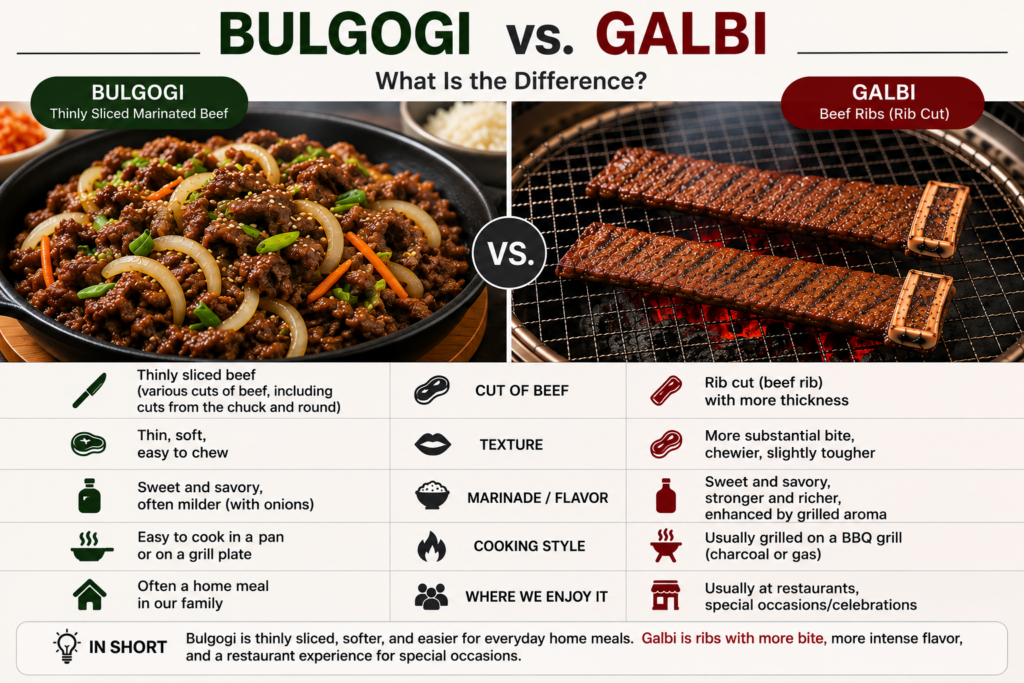
To tell the two dishes apart, look first at the form of the meat and how it is cooked, rather than the color of the marinade. Bulgogi generally uses thinly sliced meat, while galbi uses meat from the rib section.
This article compares soy sauce-seasoned beef bulgogi with grilled beef galbi. Pork bulgogi and pork galbi also exist, so check the type of meat when ordering. Galbi-jjim, or braised ribs, and galbitang, or rib soup, are cooked differently from the grilled galbi discussed here.
Bulgogi Uses Thin Slices, While Galbi Refers to a Rib Cut
Bulgogi does not name one particular cut of meat. Different cuts can be sliced thinly for the dish. At home, we make it with thinly sliced sirloin. The thin slices combine well with the seasoning and are easy to cook alongside vegetables such as onions.
Galbi refers to ribs and the surrounding meat. The meat may be butterflied into a long strip attached to a bone, or cut thinly across the bones, as with LA galbi. Boneless rib meat, called galbisal, is another option, so visible bones alone are not enough to identify it.
To me, thinly sliced bulgogi generally feels softer and easier to chew. Galbi has a more substantial bite. This does not mean that galbi is always tough or bulgogi is always tender. Thickness, the condition of the meat, and how it is cooked all affect the texture.
| What to Compare | Beef Bulgogi | Grilled Beef Galbi |
|---|---|---|
| Form of the meat | Generally uses thinly sliced beef | Uses rib meat prepared in several different ways |
| Seasoning | Commonly has a sweet and savory soy sauce-based seasoning | Can be unmarinated saeng galbi or marinated yangnyeom galbi |
| Cooking method | Cooked in a pan or on a grill plate, or served as a hot pot | Cooked on a grill plate, grate, or similar surface |
| Eating experience | Thin slices and vegetables are easy to enjoy with rice | Offers a substantial meat texture and grilled aroma |
Compare Bulgogi With Marinated Galbi When Looking at Seasoning
Bulgogi and yangnyeom galbi can share ingredients such as soy sauce, sweeteners, and garlic. That does not mean one fixed marinade is used identically for both. Proportions, sweetness, and saltiness vary among households and restaurants.
Galbi also comes as saeng galbi, which is not marinated. Here, “saeng” does not mean that you eat it raw. The meat is grilled, with more emphasis on the beef’s own flavor than on a sweet and savory marinade. If you think all galbi is seasoned like bulgogi, saeng galbi may be different from what you expect.
When I eat both saeng galbi and yangnyeom galbi in one meal, I start with saeng galbi. I prefer tasting the beef itself before moving on to the marinated ribs. This is my preference, not a required order.
For a closer look at saeng galbi, yangnyeom galbi, and LA galbi on a menu, see my guide to choosing Korean galbi.
Similar Soy Sauce Seasonings Taste Different in a Pan and on a Grill
The yangnyeom galbi I eat at restaurants often tastes more intense to me than our homemade bulgogi. I feel that the aroma from grilling adds to the marinade’s flavor. This does not mean every galbi marinade is stronger than every bulgogi seasoning.
We put plenty of onion in our bulgogi. As the beef and onions cook together, they release moisture, and the seasoning mixes with the vegetables. We also make our own seasoning and keep it a little less sweet. Prepared this way, our bulgogi tastes more gently seasoned to me than grilled yangnyeom galbi.
Bulgogi does not always come with plenty of liquid, either. At home, we sometimes cook it until very little liquid remains. At other times, we add more broth and eat it as bulgogi-jeongol, a hot pot. We add glass noodles to the hot pot and enjoy how they absorb the seasoned broth.
When ordering bulgogi, look at the photos and description. A plated meat dish and a hot pot with broth and vegetables offer different meals. My guide to bulgogi explains the two styles in more detail.
Convenience at Home and the Pleasure of Eating Out Also Shape Our Choice
One reason we make bulgogi often is that it is easy to cook in a pan and serve with rice. We do not need a special grill, and the beef and vegetables cook together to become the main dish.
We sometimes prepare galbi at home in a pan or an air fryer too. Still, we find the lingering smell of cooking the meat and marinade indoors bothersome. If we are choosing between the two, we are therefore more likely to make bulgogi at home and order galbi at a restaurant.
Galbi also brings back memories of family meals out. We went to galbi restaurants for occasions such as birthdays and graduations. Grilling the meat and tasting the side dishes felt different from an ordinary meal at home. For me, galbi is connected with those occasions as well as its flavor.
Our habits with rice differ too. At home, bulgogi feels like a natural main dish to serve with rice, and I do not feel that we always need doenjang-jjigae, or soybean paste stew, alongside it. With galbi, rice and doenjang-jjigae are a familiar combination.
There is no rule that galbi must be eaten with doenjang-jjigae. I think a combination I have often experienced at restaurants has simply become comfortable and familiar. Where and with whom we have eaten a dish can influence what we choose.
For Your First Choice, Think About the Texture and Meal You Want
When introducing someone to Korean beef dishes, I often recommend bulgogi first. Thin slices with sweet and savory seasoning are easy to enjoy with rice. My wife recommends galbi. She prefers the flavor and texture of grilled ribs and the restaurant experience.
Choose according to the meal you want today. The following suggestions are a starting point; check the menu or ask the staff how the dish is served.
| The Meal You Want | What to Look For and Check |
|---|---|
| Thin slices of seasoned beef to eat with rice | Look for beef bulgogi and ask whether it arrives fully cooked. |
| Meat, vegetables, and glass noodles in broth | Check the ingredients and ordering size for bulgogi-jeongol. |
| The flavor of beef without a sweet marinade | Look for unmarinated beef saeng galbi. |
| Sweet and savory seasoning with grilled meat aroma | Check how beef yangnyeom galbi is served and whether there is a minimum order. |
Some restaurants cook bulgogi at the table. Galbi may be grilled by the staff or arrive already cooked. Rather than assuming that you will do the grilling based on the dish’s name, ask, “Does it come fully cooked?” or “Will the staff grill it for us?”
If ordering portions and tabletop grilling are unfamiliar, how to eat Korean BBQ for the first time walks through the meal.
Start by deciding whether you want thin slices of seasoned beef or the texture and grilled flavor of a rib cut. Then check whether the galbi is unmarinated or marinated, or whether the bulgogi is pan-cooked or served as a hot pot. Those details make the differences useful when choosing your meal.