Kimchi: Korea’s Most Famous Fermented Food Explained
Learn how kimchi varies by vegetable, seasoning, and fermentation, with our family’s preferences for fresh kimchi, tangy baek kimchi, and home storage.
The Same Kimchi Can Taste Best at Different Times
My wife and I prefer the same kimchi at different stages. I like it before it has fermented very much, while the cabbage still has a crisp texture and a relatively fresh flavor. My wife prefers it further along, with more sourness.
The same container of kimchi can hold something one person wants to eat now and another would rather leave a little longer.
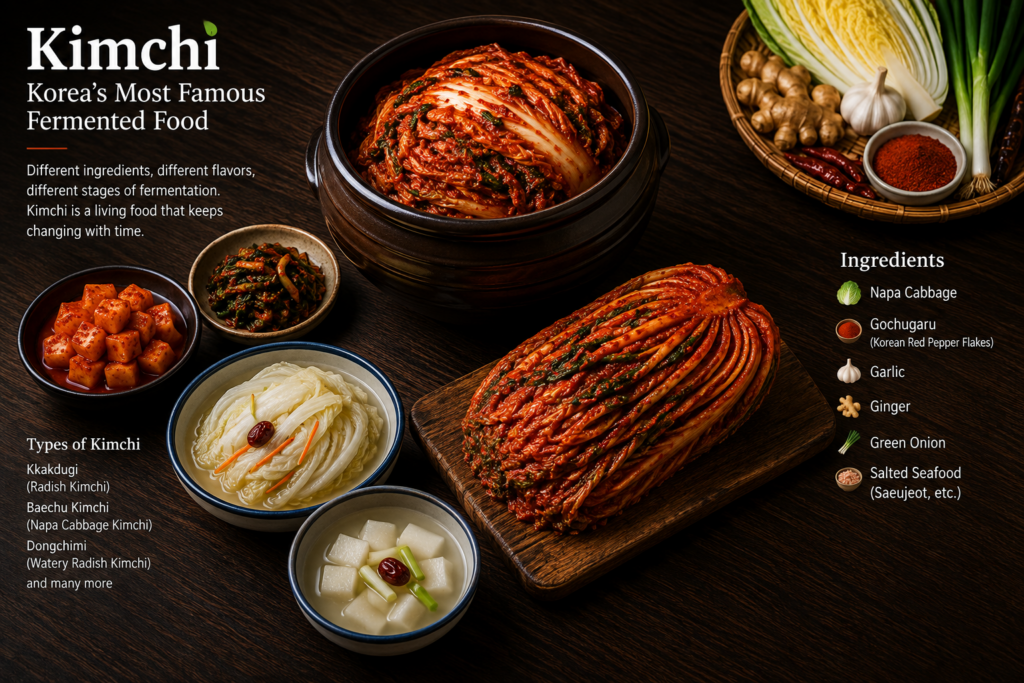
If you are new to kimchi, you may picture a red, spicy, sour cabbage side dish. But kimchi can also be made with radish, cucumber, young radish greens, mustard greens, green onions, and other vegetables. Its seasoning and stage of fermentation change the flavor too.
To understand kimchi, consider the vegetable, how fermented it is, and what you eat it with. One taste does not represent every kind.
How Do Napa Cabbage Kimchi, Kkakdugi, and Baek Kimchi Differ?
Kimchi is a category of vegetable foods prepared with salt and seasonings and fermented. Some forms are eaten soon after preparation, while others are enjoyed well fermented. Not every kimchi starts out sour, and not every kimchi is red.
Comparing a few familiar varieties makes the differences easier to see.
| Variety | Main ingredient and form | What to notice |
|---|---|---|
| Baechu kimchi | Napa cabbage prepared with seasoning | The different textures of the thick stems and leaves, and sourness that develops with fermentation |
| Kkakdugi | Cubed radish kimchi | A firm crunch that differs from cabbage |
| Chonggak kimchi | Small radishes with their leafy tops | The contrasting textures of the radish and greens |
| Yeolmu kimchi | Young radish greens and stems | The leafy texture and how it works with noodles or rice |
| Oi-sobagi | Cucumbers slit and stuffed with seasoning | The cucumber’s crunch and the filling |
| Baek kimchi | Napa cabbage kimchi without the red chili-powder seasoning | The cabbage and liquid, and acidity that develops as it ferments |
| Dongchimi | Radish water kimchi | The radish texture and refreshing liquid served with it |
Seasoning varies by household and product, even within one variety. Baek kimchi does not necessarily exclude every pungent or spicy ingredient, so check the ingredients if heat is a concern.
Rather than memorizing many names, start by comparing different vegetables, such as cabbage kimchi and kkakdugi, or different seasonings, such as red cabbage kimchi and baek kimchi.
Seasoning and Fermentation Contribute Different Flavors
Napa cabbage kimchi is generally prepared by salting the cabbage, rinsing and draining it, and adding seasoning. That seasoning may include gochugaru, garlic, ginger, green onions, radish, fish sauce, or salted seafood. The exact combination varies by household.
Gochugaru, Korean chili flakes, contributes red color and heat. The increasing sourness as kimchi matures is connected with fermentation. Heat and sourness are different qualities.
In newly prepared kimchi, the vegetables and seasoning can have relatively distinct flavors. As fermentation progresses, the acidity, aroma, and texture change. How quickly that happens depends on the kimchi, its ingredients, and storage conditions such as temperature.
Thinking about heat and fermentation separately can help you find what you enjoy. Lightly fermented kimchi can still be spicy, while kimchi without gochugaru can become sour.
Geotjeori, Lightly Fermented Kimchi, and Mugeunji Are Different Ideas
Geotjeori consists of vegetables mixed with seasoning and eaten relatively soon afterward. It can be made with napa cabbage or other leafy vegetables. The appeal is the fresh vegetable texture and newly mixed seasoning.
Lightly fermented cabbage kimchi can describe kimchi prepared for storage that has not yet fermented very far. Although both may be eaten soon after preparation, not every freshly made kimchi is called geotjeori.
Mugeunji is kimchi aged for a long time under suitable conditions. It generally has deeper acidity and a developed, aged flavor. Simply leaving kimchi for a long time does not automatically make it mugeunji.
Instead of treating geotjeori as a required first stage on the way to mugeunji, consider how the food was prepared and what kind of flavor it is intended to offer.
My wife’s preferences and mine are not judgments about which stage is better. We simply enjoy different points in the changing flavor of kimchi served as banchan.
Kimjang Seasoning Carries Familiar Household Flavors
Kimjang is the tradition of preparing and sharing large quantities of kimchi for winter. Salting cabbage and preparing the seasoning could become work shared among family members or neighbors.
The seasoning is not the same in every home. Some households use salted shrimp or fish sauce. Others use more distinctly flavored fermented seafood such as hwangseogeo-jeot or myeolchi-jeot. Kimjang seasoning made with those fermented fish ingredients is familiar to me too.
These differences show why kimchi cannot be described only as spicy and sour. The seafood seasoning, amounts of garlic and ginger, sweetness, and saltiness can make two batches of cabbage kimchi taste different.
Vegetables being the main ingredient does not necessarily make kimchi vegetarian. Fish sauce, salted seafood, and sometimes fresh seafood such as oysters may be included. Check the label or ask the restaurant if vegetarian ingredients matter to you.
Our article on Korean seasonal food explores kimjang’s connection with the calendar. Here, it helps to remember that kimjang does not mean one fixed recipe: familiar household seasonings are part of the preparation.
We Now Make or Buy Smaller Amounts
We make some of our kimchi and buy some. We also often make baek kimchi at home. My wife likes it much more than I do. I think part of the reason is that she enjoys its slightly tangy taste.
In Korea, we stored kimchi in a kimchi refrigerator. In the United States, we use a regular refrigerator.
In our experience, kimchi becomes sour more quickly in the regular refrigerator we use now. This does not mean every regular refrigerator behaves the same way. The kimchi and storage conditions can differ, but in our household this affects how much we prepare.
We make or buy smaller amounts as we need them instead of preparing a large supply at once. Refrigerating kimchi does not hold its flavor exactly as it was on the first day, so we adjust the quantity to the pace at which we eat it.
Since moving to the United States, we have made our other banchan ourselves, while continuing to both make and buy kimchi. An everyday food does not always have to be obtained in the same way.
We discuss fermented foods more broadly and the changes in our household in our Korean fermented food story.
Fermented Kimchi Can Become a Cooking Ingredient
Well-fermented kimchi can be eaten as banchan or used in dishes such as kimchi jjigae, kimchi fried rice, and kimchi pancakes. Its acidity and seasoning combine with other ingredients to shape the finished dish.
We use well-fermented kimchi for kimchi jjigae at home. The lightly fermented flavor I prefer in a side dish does not have to be the flavor we want in a stew.
Our kimchi jjigae article explores cooking kimchi with other ingredients in more detail. The point here is that the way you want to use kimchi can change as its flavor develops.
Sourness alone does not tell you whether kimchi is in good condition. Using it in cooking means using properly stored kimchi, not trying to make spoiled food usable by heating it.
If Your First Taste Felt Unfamiliar, Compare One Thing at a Time
When trying kimchi, it can help to change one feature at a time instead of switching the variety, fermentation stage, and accompanying food all at once.
- If sourness felt unfamiliar, look for less fermented kimchi.
- If the heat of red seasoning was uncomfortable, check the ingredients in baek kimchi or dongchimi.
- If you did not enjoy the cabbage texture, compare it with a radish kimchi such as kkakdugi.
- If kimchi tasted strong on its own, try a small amount with rice or another mild food.
Our article on why Koreans eat kimchi so often explores its place alongside different meals.
I prefer less fermented kimchi, while my wife enjoys it more fermented. Even people who eat it regularly look for different flavors in the same food. Getting to know kimchi is about discovering the varieties and stages you enjoy.