
Korean-Style Boiled Beef Shank (Suyuk): How We Make It at Home
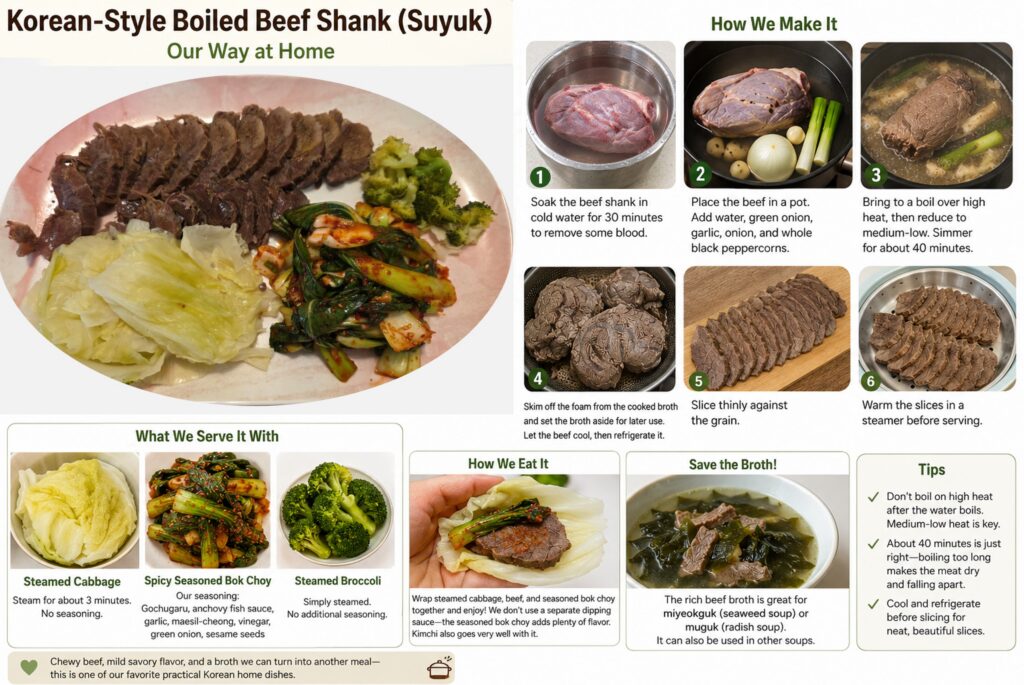
Learn how we make Korean beef suyuk at home with beef shank, steamed cabbage, seasoned bok choy, and a flavorful broth we save for soup.
How We Make Tender-Chewy Beef Suyuk at Home
Suyuk is a familiar Korean dish made by gently boiling meat and serving it sliced. It can be made with either beef or pork, and Koreans enjoy it both at home and in restaurants.
For me, suyuk is also a food I have known since childhood. It can be served at Korean set-menu restaurants, and in the past it was often prepared for guests at family celebrations. It is also a dish you may encounter at funeral gatherings or traditional markets, where it can be enjoyed with makgeolli, Korean rice wine.
I still remember eating suyuk with makgeolli during a visit to the Korean Folk Village. Memories like this make suyuk feel like more than simply boiled meat to me. It is one of those familiar traditional foods that has long been part of Korean meals, gatherings, and special occasions.
At our home, we make suyuk about once a month, usually as a main dish for dinner. The version we are sharing here is made with arongsatae, a Korean beef shank cut.
Why We Use Arongsatae for Suyuk
For beef suyuk, we usually use arongsatae (아롱사태), a cut from the beef shank.
We can find it at Korean markets, and in the U.S., we also buy beef shank at Costco. For two people, we usually prepare about 450 g (1 lb). We prefer a piece with a reasonable amount of fat rather than one that is extremely lean.
What we like most about arongsatae is its texture. The meat becomes tender when cooked, while the connective tissue running through it gives each slice a pleasantly chewy, slightly springy texture.
The flavor itself is mild, savory, and clean.
It may seem that boiling beef longer would always make it better, but that is not how we prepare it. If the meat cooks for too long, too much fat can render out and the meat can become overly soft and begin to fall apart. We prefer to keep some of the characteristic chewiness of the beef shank.
Soak the Beef in Cold Water First
Before cooking, we soak the whole piece of beef shank in cold water for about 30 minutes to draw out some of the blood.
We do not cut the meat before boiling it.
Place the whole piece in a pot and add enough water to completely cover the beef. We add one whole green onion, garlic, onion, and whole black peppercorns to the water.
We do not add ginger, and we do not season the cooking water with salt or soy sauce.
When we make pork suyuk, we sometimes do things a little differently. We may add mirin (cooking wine) and doenjang to help reduce the pork aroma. For this beef suyuk, however, we keep the cooking liquid simple.
Start on High Heat, Then Simmer Gently
We begin cooking the beef over high heat.
Once the water comes to a boil, we reduce the heat to medium-low, somewhere between medium and low, and continue cooking for about 40 minutes.
At home, we mainly use cooking time to judge when the beef is ready.
One important point for us is not to keep the meat boiling aggressively over high heat. We also avoid cooking it much longer than necessary. Too much heat or excessive cooking can cause the meat to lose too much fat and become overly soft.
After cooking, we skim off the foam and impurities from the broth.
Including the 30-minute soaking time, the entire process takes about 1½ hours. The actual cooking and preparation time, excluding the soaking, is about one hour.
Cool the Beef Before Slicing
We do not slice the beef immediately after taking it out of the pot.
When it is still very hot, the meat is too soft to slice neatly. Instead, we let it cool for a while and then refrigerate it before slicing.
Once chilled, we slice the beef thinly against the grain.
Before serving, we place the sliced meat briefly in a steamer to warm it again.
This extra step makes it easier to cut clean, attractive slices while still serving the suyuk warm.
Our Way of Eating Suyuk: Steamed Cabbage and Seasoned Bok Choy
The way we serve suyuk at home is a little different from the more common Korean style.
In Korea, suyuk is often eaten with lettuce or perilla leaves and ssamjang. Kimchi is also a common accompaniment.
At our home, however, we like to eat our beef suyuk with steamed cabbage and spicy seasoned bok choy.
We steam the cabbage for about three minutes and do not season it.
For the bok choy, we wash it thoroughly and gently toss it with a gochugaru-based seasoning.
For the seasoned bok choy, we use:
- 4 Tbsp gochugaru
- 3 Tbsp Korean anchovy fish sauce
- 1 Tbsp minced garlic
- 2 Tbsp maesil-cheong (Korean plum syrup)
- 1 Tbsp vinegar
- A little chopped green onion or scallion
- A little sesame seed
We do not prepare a separate dipping sauce. The seasoned bok choy itself provides plenty of seasoning for the beef.
We place a slice of suyuk and some seasoned bok choy on a piece of steamed cabbage and wrap them together.
The mild beef, soft cabbage, and spicy, savory bok choy complement one another very well.
We sometimes eat suyuk with kimchi as well. It can also be enjoyed on its own or with rice.
We Save the Beef Broth, Too
One of the best parts of making beef suyuk is that the cooking broth does not go to waste.
After simmering the beef, the broth develops a deep beef flavor. At our home, we usually save it and use it later to make miyeokguk (Korean seaweed soup) or muguk (Korean radish soup).
Sometimes we shred a little of the boiled beef and add it to the soup as well.
This makes beef suyuk especially practical for home cooking. One cooking session gives us both a main dish and a flavorful broth that can become another meal.
When we make pork suyuk, on the other hand, we normally discard the cooking liquid rather than saving it for soup.
Leftover Suyuk Is Easy to Use Again
About 450 g (1 lb) of beef shank can sometimes be a little more than the two of us finish in one meal.
We refrigerate any leftovers and warm them again later. We can serve them again as suyuk or add pieces of the beef to a soup.
That versatility is another reason we consider suyuk a practical home-cooked dish.
A Korean Food We Make When We Miss It in America
In Korea, there are many opportunities to eat suyuk.
It can be found at Korean set-menu restaurants and can also be ordered for delivery. Traditionally, it has been served to guests at celebrations and other gatherings. It is also a food Koreans may encounter at funeral gatherings and traditional markets.
I still remember eating suyuk with makgeolli at the Korean Folk Village.
For many Koreans, experiences like these make suyuk a familiar food connected not only with everyday meals but also with gatherings and hospitality.
In the U.S., we do not find suyuk restaurants as easily as we did in Korea. When we want to eat it, making it at home is often the easiest solution.
Fortunately, beef shank is relatively easy to find here, and the cooking method itself is quite simple.
Simple Cooking, but Timing Matters
At first glance, suyuk may seem like one of the simplest dishes possible: put beef in water and boil it.
But the kind of suyuk we enjoy is not meat that has been cooked until it becomes extremely soft.
We want to preserve some of the chewy texture of the beef shank and its connective tissue, along with the mild, savory flavor of the meat.
We start over high heat, reduce the heat to medium-low once the water boils, and cook the beef gently for about 40 minutes.
We then cool and refrigerate the meat before slicing it and briefly steam the slices before serving.
Eating the beef wrapped in steamed cabbage with spicy seasoned bok choy is our own slightly different way of enjoying a familiar Korean dish.
We get meat and vegetables in the same bite, can use leftovers in another meal, and can save the flavorful beef broth for miyeokguk or muguk.
Chewy beef, a mild savory flavor, and a broth we can turn into another meal—this is the kind of practical Korean home cooking we enjoy.
That is why beef suyuk continues to find its way onto our dinner table about once a month.

Comments 0
Be the first to leave a comment.