
Soy-Glazed Pork Back Ribs: Two Ways We Enjoy Pork Ribs at Home
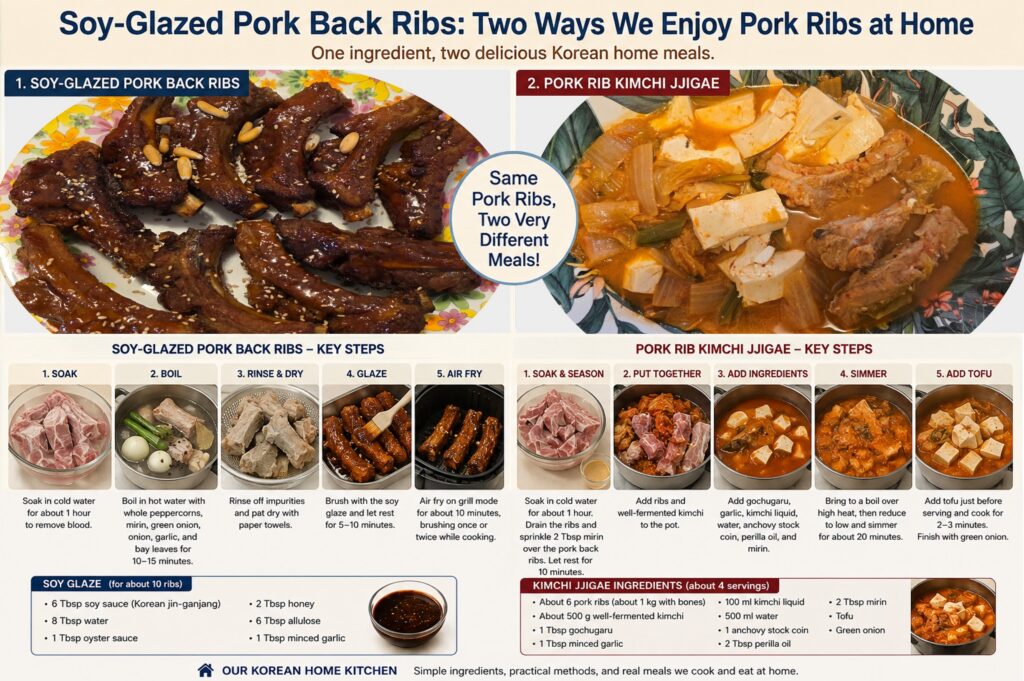
See how we turn pork back ribs into two Korean home meals: sweet and savory soy-glazed ribs and a rich kimchi jjigae with well-fermented kimchi.
Sweet and Savory Glazed Ribs and a Deep, Flavorful Kimchi Jjigae
Pork back ribs are not something we cook only one way in our home. We often prepare a larger batch at once, then divide it between two very different dishes. Some become sweet and savory soy-glazed ribs, while the rest can go into a pot of kimchi jjigae with well-fermented kimchi.
When we lived in Korea, we were more accustomed to using pork ribs in kimchi jjigae. The soy-glazed version came later, after we moved to the United States.
The idea was inspired by combining two flavors I already enjoyed: American-style BBQ that I had tried in the U.S. and the sweet and savory glaze often used for Korean-style seasoned chicken. I experimented with soy sauce, oyster sauce, honey, and allulose and brushed the mixture over partially cooked pork ribs before grilling them.
That became the soy-glazed pork back ribs we now make at home.
The glazed ribs feel a little more special, almost like something we might order when eating out, while the kimchi jjigae feels much more like familiar Korean home cooking. What I like about pork ribs is that one affordable ingredient can become two completely different meals.
How We Prepare the Pork Ribs
We use regular pork back ribs that are easy to find at supermarkets. In the United States, we often buy them at Costco, and we have not noticed any significant difference between the ribs we buy here and those we used in Korea.
For the soy-glazed ribs, we usually prepare about 10 individual ribs, similar to the amount shown in our photo.
First, we soak the ribs in cold water for about one hour to draw out some of the blood.
Then we put the ribs into hot water with whole peppercorns, mirin, green onion, onion, garlic, and bay leaves and boil them for about 10 to 15 minutes. This helps reduce the pork odor while partially cooking the meat before it goes into the air fryer.
After boiling, we rinse away any impurities from the surface of the ribs and pat them dry with paper towels.
The ribs are now ready for the glaze and the final cooking step.
Our Soy Glaze for Pork Ribs
For about 10 ribs, we use:
- 6 Tbsp soy sauce (Korean jin-ganjang)
- 8 Tbsp water
- 1 Tbsp oyster sauce
- 2 Tbsp honey
- 6 Tbsp allulose
- 1 Tbsp minced garlic
We simply combine everything to make the glaze.
The honey and allulose provide the sweetness, while the soy sauce brings saltiness and the oyster sauce adds another layer of savory flavor.
We do not add sesame oil to this sauce.
Grilling the Ribs in the Air Fryer
We brush the boiled and dried ribs generously with the prepared soy glaze and let them sit for about 5 to 10 minutes.
Then we cook them using the grill mode on our air fryer for about 10 minutes. Because air fryers vary in temperature and power, we pay more attention to the surface of the ribs than to an exact temperature.
While they cook, we brush them with the glaze once or twice more.
The repeated glazing gives the ribs a glossy surface and builds up more flavor as they cook. Once they are finished, we sprinkle sesame seeds over the top. We sometimes add a few pine nuts as a garnish simply because we like the way they look on the finished dish.
Since this is pork, we make sure the ribs are fully cooked before eating them. At the same time, we try not to boil them for too long during the first cooking step. Overboiling can make them too soft and take away some of the slightly chewy texture we enjoy.
Sweet, Salty, and Simply Delicious
The simplest Korean expression for the flavor of these ribs would probably be dan-jjan—a satisfying combination of sweet and salty.
There is the saltiness of soy sauce, the sweetness of honey and allulose, and the savory depth of oyster sauce. The whole peppercorns used during boiling also leave a very subtle peppery note.
We prefer the meat with a little bite rather than so soft that it completely falls off the bone.
Pork ribs are relatively inexpensive and easy to find, but once they are glazed, grilled, and arranged on a plate, they feel a little more like restaurant food than an ordinary home meal.
We usually serve them as the main dish for dinner with rice, basic Korean banchan, and a soup or guk.
Leftovers can be refrigerated and reheated in the microwave. Because the dish is not spicy, it can also be an approachable choice for children or for people who are not accustomed to spicy Korean food.
Making Kimchi Jjigae with the Same Pork Ribs
When we buy pork ribs, we do not have to use the entire package for soy-glazed ribs.
We often prepare them at the same time and divide them, using some for the glazed ribs and some for kimchi jjigae.
In Korea, using pork ribs in kimchi jjigae was actually more familiar to us. If the glazed ribs feel like a slightly special dinner, pork rib kimchi jjigae is closer to an everyday Korean home meal.
For about four servings, we use approximately six pork ribs, or around 1 kg including the bones.
We use about 500 g of kimchi, measured without the kimchi liquid. Well-fermented kimchi works particularly well because its stronger flavor develops beautifully as the stew cooks.
What We Put in Our Pork Rib Kimchi Jjigae
For about four servings, we use:
- About 6 pork ribs, approximately 1 kg including the bones
- About 500 g well-fermented kimchi
- Tofu
- Green onion
- 1 Tbsp minced garlic
- 1 Tbsp gochugaru
- 100 ml kimchi liquid
- 500 ml water
- 1 anchovy stock coin
- 2 Tbsp perilla oil
- 2 Tbsp mirin
We do not use gochujang in this kimchi jjigae.
As with the ribs for the soy-glazed version, we first soak the ribs in cold water to draw out some of the blood. However, we do not boil the ribs before making the stew.
Instead, after soaking them, we sprinkle 2 tablespoons of mirin over the ribs and leave them for about 10 minutes.
How We Make Our Pork Rib Kimchi Jjigae
We place the prepared pork ribs and well-fermented kimchi together in a pot.
Then we add the gochugaru, minced garlic, kimchi liquid, water, anchovy stock coin, and 2 tablespoons of perilla oil.
We bring everything to a boil over high heat. Once it begins boiling, we reduce the heat to low and let the stew cook for about 20 minutes.
Because the pork ribs and kimchi cook together from the beginning, the flavor from the meat naturally works its way into the broth. Compared with an ordinary pork kimchi jjigae, the ribs give the stew a somewhat deeper and richer flavor.
Just before serving, we add the tofu and cook it for another 2 to 3 minutes, just long enough to heat it through.
We finish the stew with green onion.
For us, the exact texture of the ribs is less important here than it is with the glazed version. We simply want the meat to become soft enough to eat comfortably while its flavor enriches the stew.
We serve the kimchi jjigae hot with rice.
Which One Should You Try First?
Although both dishes begin with the same pork ribs, the finished meals are very different.
The soy-glazed ribs feel more special because of their sweet and savory glaze and glossy grilled surface. They are a good choice when we want a dinner that feels a little different from our usual home meals.
Pork rib kimchi jjigae, on the other hand, is warm and familiar Korean home cooking. Well-fermented kimchi and pork create a deeper broth that goes especially well with a bowl of rice.
For someone trying these dishes for the first time, we would probably recommend the soy-glazed pork ribs first. The soy-based sweet and savory flavor is approachable even for someone who is not accustomed to kimchi or spicy Korean food.
But if you already enjoy kimchi, we would definitely recommend the pork rib kimchi jjigae as well. It is similar to other versions of pork kimchi jjigae, but the ribs add their own richness to the broth.
One Ingredient, Two Very Different Home Meals
Pork ribs are relatively affordable, easy to find in the United States, and versatile enough to become very different dishes.
When we buy them, we can prepare a larger batch at once and then decide how we want to use them.
Some can be brushed with a sweet and savory soy glaze and grilled for a dinner that feels a little more special. Others can simmer with well-fermented kimchi for a comforting Korean home meal.
The Korean ingredients we use, including well-fermented kimchi, perilla oil, and anchovy stock coins, are easy for us to find at Korean markets in the United States.
If you try the soy-glazed ribs first and enjoy them, you might use the same pork ribs for kimchi jjigae the next time.
Preparing one ingredient and turning it into two completely different meals is one of the practical ways we cook at home.

Comments 0
Be the first to leave a comment.