What Is Banchan? A Beginner’s Guide to Korean Side Dishes
Learn what banchan means, recognize Korean side dishes by their ingredients and cooking methods, and discover the favorites we eat at home.
I Enjoy Jeotgal, While My Wife Likes Namul and Tofu
Our table reflects more than one person’s preferences. I enjoy myeongran-jeot, salted pollock roe, and ojingeo-jeot, seasoned salted squid. A small amount adds plenty of flavor to a bite of rice. I also enjoy the little kick that chili peppers bring to stir-fried anchovies. My wife likes namul and tofu, so seasoned vegetables and tofu dishes appear regularly on our table too.
Even when we sit down to the same meal, we reach for different dishes. One bite of rice might go with a little jeotgal, another with vegetables or tofu. We do not eat equal amounts of every banchan or finish one dish before moving to the next.
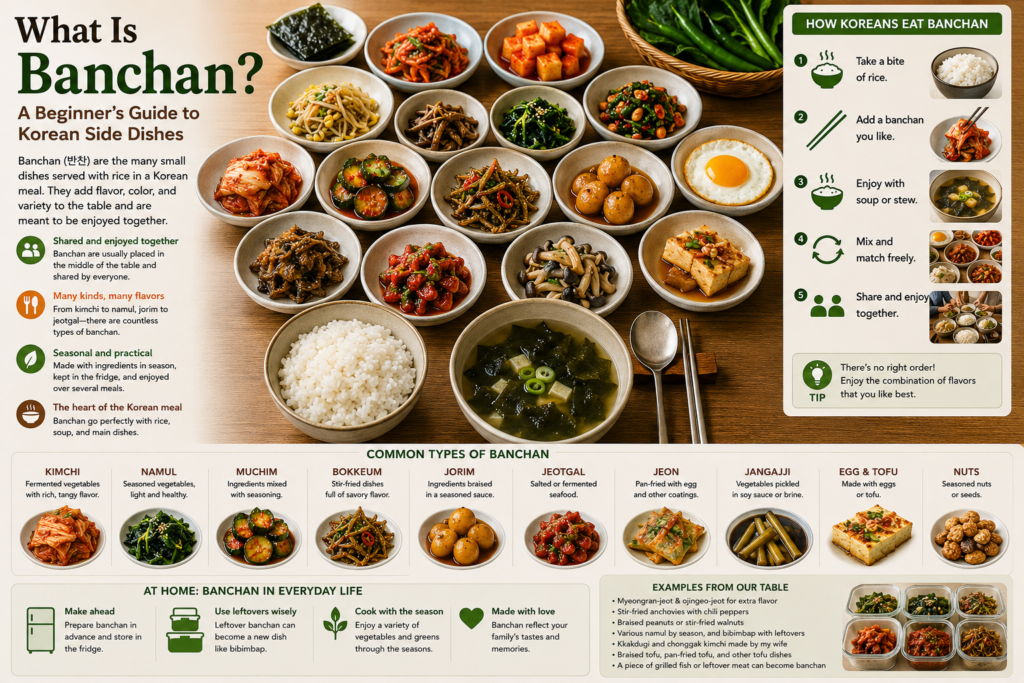
Banchan is not the name of one particular food. It describes the role of various foods eaten alongside rice. Recognizing the ingredients and cooking methods makes those small dishes easier to understand.
Banchan Means More Than Small Vegetable Dishes
Banchan is usually translated as “side dishes.” But imagining a few vegetables beside a main course gives only part of the picture. Along with kimchi and namul, fish, meat, eggs, tofu, and nuts can all become banchan.
Gim, or dried seaweed, is a simple example. It does not need to be stir-fried or braised to serve as banchan with rice. Grilled fish can be the centerpiece of a meal or something eaten in smaller amounts alongside other foods. A dish does not have to come on a tiny plate to count as banchan.
Consider the ingredients, how they were prepared, and how the food is eaten with rice. The background to this style of meal is explored in why Korean meals have so many side dishes.
Muchim, Bokkeum, and Jorim Give You Clues About Preparation
Korean dish names often combine an ingredient with a preparation method. Oi-muchim is cucumber tossed with seasoning, while myeolchi-bokkeum is a stir-fried anchovy dish. Learning a few recurring words can help you recognize unfamiliar banchan.
Muchim means ingredients tossed or mixed with seasoning. Seasoned cucumber, bellflower root, and spinach are examples.
Bokkeum refers to stir-fried dishes. Anchovies, fish cakes, and nuts can all be prepared this way.
Jorim refers to ingredients simmered in seasoned liquid as it reduces. Braised potatoes, tofu, and meat are familiar examples.
Jeon and buchim describe foods cooked in a pan with oil, such as zucchini jeon, pollock jeon, or pan-fried tofu.
Namul refers to prepared vegetables and greens, often seasoned after blanching or stir-frying. Spinach, soybean sprouts, and bracken fern are common examples.
These categories overlap. Spinach that has been blanched and tossed with seasoning can be both namul and muchim. Meanwhile, dubu-jorim and dubu-buchim both use tofu, but the cooking methods differ.
A preparation word does not tell you exactly how spicy a dish will be. Muchim may use salt or soy sauce, or it may include chili flakes and vinegar. Jorim can be primarily soy sauce-based or made with a spicy seasoning.
The Same Ingredient Can Become Different Banchan
Tofu, which my wife enjoys, is a good example in our home. We usually serve pan-fried tofu with a soy sauce-based seasoning, and we also use soy sauce as the base for braised tofu. The ingredients may be similar, but adding seasoning to pan-fried tofu gives a different eating experience from simmering the tofu in the sauce.
We eat nuts as banchan too. Peanuts simmered in a soy-based sauce or stir-fried walnuts turn something you might think of as a snack into an accompaniment to rice. Stir-fried anchovies and nut dishes are regulars on our table these days.
For anchovies, I prefer the small ones, especially when they are crisp. Even within myeolchi-bokkeum, the size of the anchovies and how they are cooked can make a difference to what someone enjoys.
Namul varies with the ingredient as well. Spinach, soybean sprouts, and bracken fern can all be prepared as namul, but their softness and chew are quite different. Because my wife likes namul, we have eaten many kinds made with vegetables and greens available through the seasons.
Less familiar ingredients can also become muchim. Dotori-muk, or acorn jelly, is one example. In our homemade dotori-muk muchim story, we share how we make and season it at home.
Kimchi, Jangajji, and Jeotgal Have Different Characters
Kimchi, jangajji, and jeotgal can all appear as banchan, but they are different foods. If you are trying them for the first time, start by finding out what they are made from.
Kimchi uses vegetables such as napa cabbage or radish prepared with salt and seasonings. Its flavor develops as it ferments. Crunch, sourness, and heat vary with the type and stage of fermentation.
Jangajji uses vegetables preserved in soy sauce, brine, fermented pastes, or other seasoned mixtures. Saltiness, tanginess, and sweetness depend on the preparation.
Jeotgal uses seafood or roe that is salted and often fermented. Many varieties are strongly flavored and eaten in small amounts with rice.
The myeongran-jeot and ojingeo-jeot I enjoy can change the flavor of a bite of rice with just a small amount. If you eat a large mouthful on its own, the salt or seasoning may be the first thing you notice. Trying a little with rice makes its role as banchan easier to understand.
My wife and I have different kimchi preferences too. I am not particularly fond of kkakdugi, or cubed radish kimchi, while she enjoys both kkakdugi and chonggak kimchi, made with small whole radishes and their greens. Even within one category of banchan, people prefer different ingredients and textures.
For more about varieties and how fermentation changes the flavor, see our guide to kimchi.
A Vegetable Dish May Contain More Than Vegetables
A name and appearance cannot reveal every ingredient. Seasoned vegetables may contain fish sauce or another seafood-based seasoning, and kimchi may include jeotgal. The fish cakes in eomuk-bokkeum are made from processed fish.
A dish without red seasoning is not necessarily mild, either. Stir-fried anchovies, for example, can include chili peppers that add heat.
If you follow a vegetarian diet or need to avoid an ingredient, ask about the seasonings and cooking ingredients as well as the main ingredient. Learning what an unfamiliar dish contains is more useful than relying on its appearance alone.
Learn One Banchan at a Time
You do not need to learn every name when several banchan arrive. If you enjoy something, ask about its ingredient and preparation. Was it the tofu, the soy sauce seasoning, or the crisp texture that appealed to you? Noticing the difference can help you choose another dish to try.
In our home, banchan is not a fixed list. There are familiar anchovy and nut dishes, along with the namul and tofu my wife enjoys. The table changes with our preferences and the ingredients we can find.
For practical questions about eating, sharing, or asking for more at a restaurant, see how to eat Korean banchan. For now, recognizing one familiar ingredient and learning about one unfamiliar dish is a good place to begin.