
Korean-Style Blue Crab Soup: A Taste of Home in America
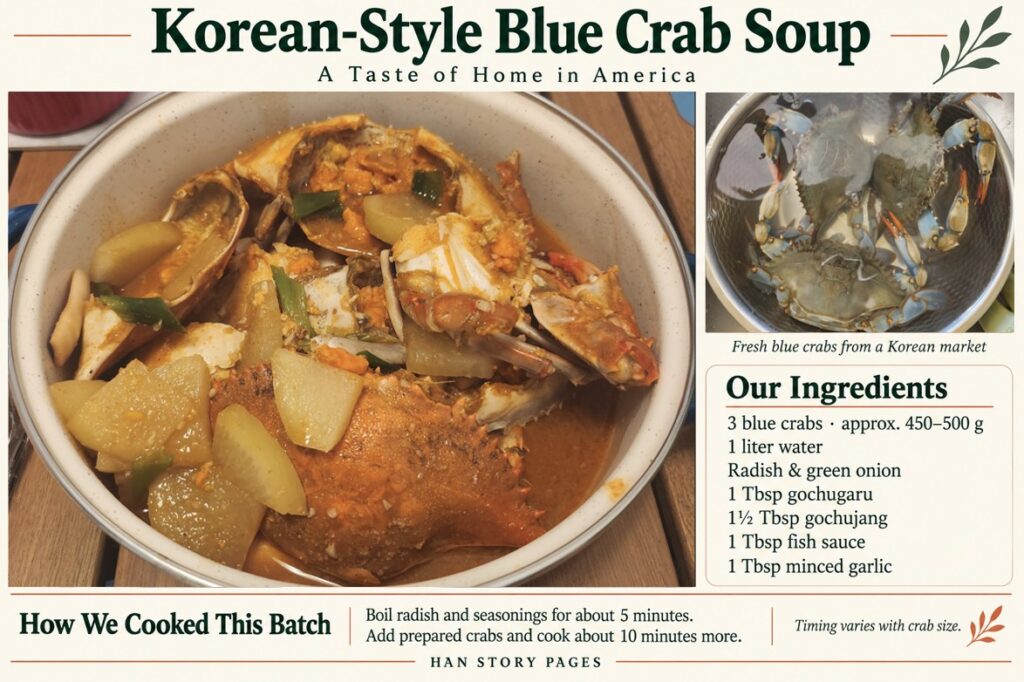
See how we make Korean-style blue crab soup with fresh blue crabs, radish, gochugaru, and gochujang, served with rice and everyday side dishes.
Missing the Crab Soup I Loved in Korea
When I lived in Korea, kkotgetang—Korean crab soup—was a meal I always looked forward to. We made it at home and also visited restaurants that specialized in it. I especially enjoyed the roe-filled female crabs we ate in spring.
After moving to the United States, I had trouble finding the crabs I used to eat at the markets where I shopped. I missed that familiar soup, with pieces of crab and radish in a spicy broth.
Then I spotted live blue crabs at a Korean market. They were smaller than the large Korean crabs I remembered, but I wanted to try cooking them with the seasonings we used at home. What interested me most was the broth: would these crabs give us something close to the flavor I missed?
Finding Live Blue Crabs at a Korean Market
I bought three female blue crabs and cooked them the same day. From memory, they weighed approximately 450–500 grams altogether. They seemed a little less expensive than the Korean crabs I used to buy, although I did not record the exact price.
Their size was noticeably different. I was accustomed to larger crabs in Korea, and these looked small by comparison. Still, being able to buy them live and fresh made me eager to try them.
To prepare them, we scrubbed the shells with a brush, lifted off the top shells, and removed the gills. We then cut each body in half. The crabs contained plenty of roe, so we kept the roe-filled top shells to cook along with the bodies.
Making the Broth with Radish and Korean Seasonings
We used plain water rather than a separate stock. The vegetables were simple: Korean radish and green onion, with minced garlic added to the seasoning.
These are the ingredients we used for this pot.
| Ingredient | Amount |
|---|---|
| Blue crabs | 3, approximately 450–500 g in total |
| Water | 1 liter |
| Korean radish | Sliced; amount not measured |
| Green onion | Chopped; amount not measured |
| Gochugaru (Korean red pepper flakes) | 1 Tbsp |
| Gochujang (Korean red pepper paste) | 1½ Tbsp |
| Fish sauce | 1 Tbsp |
| Minced garlic | 1 Tbsp |
The crab weight is an estimate from memory, and we did not measure the radish or green onion. This is a record of the soup we made at home, including the quantities we did measure.
Gochugaru and gochujang gave the broth its red color and heat, while fish sauce supplied seasoning. To my taste, the finished soup was relatively mild. It had enough heat to enjoy with rice without overwhelming the crab flavor, although someone less accustomed to spicy food might find it hotter.
Cooking the Radish Before Adding the Crabs
We started with 1 liter of water, the sliced radish, gochugaru, gochujang, fish sauce, and minced garlic in the pot. We stirred to dissolve the gochujang as the water heated.
Once the broth began boiling, we cooked it for about five minutes before adding the crabs. The halved bodies and roe-filled top shells went into the same pot. We cooked them for about ten minutes more and included the prepared green onion in the soup.
Those times describe this particular batch of three small crabs. Different crab sizes and cooking setups may need more time, so I would not treat ten minutes as a fixed cooking time for every pot.
By the time the soup was ready, the shells had turned orange-red, and the crab, radish, and green onion sat together in the reddish broth. Even without a separate stock, the soup had the familiar crab flavor I had hoped for.
Familiar Broth and Delicious Roe, but Difficult Legs
The broth was the part that brought back the strongest memories. To me, it tasted very similar to the kkotgetang I enjoyed in Korea. Using a different crab had still brought us surprisingly close to that familiar meal.
The roe was another highlight. All three crabs were female, and there was plenty to enjoy. The meat in the bodies was also reasonably easy to pick out and eat.
The legs were more challenging. Compared with the larger Korean crabs I remembered, these had smaller legs with shells that felt hard to crack. Getting the meat out took more effort, which was the main disappointment.
For this meal, I enjoyed the broth, body meat, and roe more than the legs. That distinction matters to me: the soup satisfied my craving, even though eating the crab itself was a somewhat different experience.
Eating It with Rice and Banchan
We served the blue crab soup with rice and banchan, the side dishes that accompany many of our meals. I ate the crab meat and roe, enjoyed spoonfuls of broth, and also mixed rice into the soup.
If you are unfamiliar with this style of meal, my guide to eating Korean banchan explains how side dishes fit alongside rice and the main dish. I also discuss the names used for Korean soups and stews in the difference between guk, tang, and jjigae.
These blue crabs were smaller than the crabs I used to eat, and their legs were harder to manage. Still, sitting down to that familiar broth helped me enjoy a taste of home.
Now, when I visit the Korean market, I look to see whether larger blue crabs are available. They have been difficult to find, but I would happily make this soup again. A slightly larger crab might give us more accessible meat to enjoy along with the broth and roe that made this first attempt worthwhile.
Comments 0
Be the first to leave a comment.