
Beef and Mushroom Stir-Fry: Our Korean-Chinese Fusion Dinner
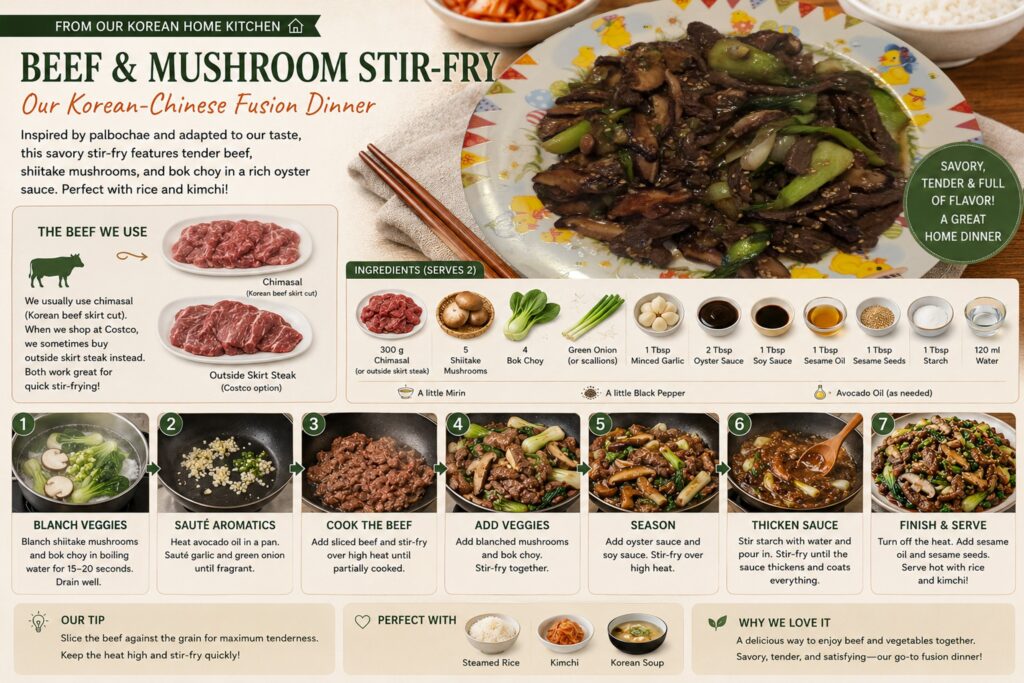
See how we make beef and mushroom stir-fry with shiitake mushrooms, bok choy, and oyster sauce for a savory Korean-Chinese fusion dinner.
A Beef and Mushroom Stir-Fry Inspired by Palbochae
Beef and mushrooms are ingredients that work especially well together. Tender beef, aromatic shiitake mushrooms, and crisp bok choy make it easy to enjoy meat and vegetables together on one plate.
The beef and mushroom stir-fry we make at home is not a traditional Korean dish. It is closer to a Korean-Chinese fusion dish that my wife adapted to our taste after getting the idea from palbochae, a Chinese-style stir-fry commonly served in Korean Chinese restaurants.
Instead of using the variety of seafood and vegetables typically found in palbochae, we keep ours simpler, focusing on beef, shiitake mushrooms, and bok choy, with oyster sauce providing most of the savory flavor.
It feels a little like having Chinese food at home, which makes it different from many of our usual Korean meals. At the same time, when we serve it with rice, kimchi, and sometimes a soup or jjigae, it fits naturally into our dinner table.
A Dinner Dish We Make About Once Every Three Weeks
We make this dish about once every three weeks.
One of the things we like most about it is that we can eat plenty of vegetables along with the beef. Compared with simply cooking beef by itself, adding shiitake mushrooms and bok choy gives the dish more variety in both flavor and texture.
We both enjoy it, and we usually serve it as a main dish for dinner. White rice and kimchi are natural sides, and sometimes we also have a Korean soup or jjigae with the meal.
It is also a dish we can serve when we have guests. A generous platter looks inviting, and because it already combines meat and vegetables, we do not need several different main dishes.
We Usually Use Chimasal for the Beef
For two servings, we use about 300 g of chimasal, a Korean beef skirt cut.
Chimasal is the cut we usually choose for this dish. When we shop at Costco in the United States, however, we sometimes buy outside skirt steak instead. Both work well when sliced thinly for a quick stir-fry.
The important part is how we slice the beef. We look at the direction of the grain and cut it thinly against the grain. This helps keep the meat tender after stir-frying.
Before cooking, we lightly sprinkle the beef with mirin (맛술), a Korean cooking wine, which helps reduce the meat’s strong or unwanted odor. We do not leave it to marinate for a long time; the beef is cooked soon afterward.
This is quite different from bulgogi, where the beef is typically marinated in a seasoned sauce. We also do not add sugar, oligosaccharide syrup, allulose, or another sweetener to this dish.
The finished dish is less sweet than bulgogi and focuses more on the tender beef and the savory flavor of oyster sauce.
Shiitake Mushrooms and Bok Choy Work Especially Well
For two servings, we use about five large fresh shiitake mushrooms and four bok choy.
Other mushrooms can certainly be used, but we think shiitake mushrooms work particularly well in this dish. Their distinctive aroma adds another layer of flavor to the beef, and we also like their pleasantly chewy texture.
If fresh shiitake mushrooms are difficult to find, button mushrooms are an easy substitute. Enoki mushrooms can also be used.
We add bok choy partly because we want plenty of vegetables in the dish, but also because it pairs naturally with beef. Its texture provides a nice contrast to the tender meat and chewy mushrooms.
We usually buy fresh shiitake mushrooms and bok choy at a Korean grocery store.
Ingredients for Two Servings
This is approximately what we use when making the dish for two:
- 300 g chimasal (Korean beef skirt cut), or outside skirt steak
- 5 large fresh shiitake mushrooms
- 4 bok choy
- Green onion or scallions
- 1 Tbsp minced garlic
- 2 Tbsp oyster sauce
- 1 Tbsp soy sauce
- 1 Tbsp sesame oil
- 1 Tbsp sesame seeds
- 1 Tbsp starch
- 120 ml water
- A little mirin
- A little black pepper
- Avocado oil, as needed
We do not add sugar or any other sweetener.
Oyster sauce is the main seasoning in this dish. You do not need many specialty Korean seasonings to make it, but oyster sauce is an important ingredient for the flavor we are trying to achieve.
We Blanch the Mushrooms and Bok Choy First
One important step in the way we make this dish is that we do not put the raw shiitake mushrooms and bok choy directly into the stir-fry.
Instead, we briefly blanch them in boiling water and then drain them well.
Vegetables and mushrooms can release quite a bit of moisture when stir-fried. Briefly blanching and draining them first helps reduce the amount of water they release later in the pan.
We blanch the stems and leaves of the bok choy together rather than separating them.
Stir-Fry Quickly Over High Heat
We start by adding a generous drizzle of avocado oil to a pan. Then we stir-fry the garlic and green onion or scallions first.
Once they become fragrant, we add the thinly sliced beef.
We do not completely cook the beef at this stage. When it is partially cooked, we add the blanched and drained shiitake mushrooms and bok choy.
Once everything has started to cook together, we add 2 tablespoons of oyster sauce and 1 tablespoon of soy sauce.
We keep the heat high.
This dish works better when stir-fried quickly over high heat rather than cooked slowly over low heat. If the heat is too low, the vegetables and mushrooms can release more water, changing the texture and consistency of the stir-fry.
The actual stir-frying takes about 5 to 10 minutes, although washing, slicing, blanching, and preparing all the ingredients brings our total preparation and cooking time to around an hour.
A Starch Slurry Gives the Sauce Its Body
We mix 1 tablespoon of starch with 120 ml of water to make a starch slurry.
After the oyster sauce and soy sauce have coated the beef and vegetables, we pour the slurry into the pan and continue cooking over high heat.
As the slurry cooks, the sauce thickens and begins to cling naturally to the beef, shiitake mushrooms, and bok choy, giving the finished dish its glossy appearance.
We do not want a large amount of liquid left in the pan. We prefer just enough thickened sauce to lightly coat all the ingredients.
Getting the seasoning balanced is also important. My wife pays particular attention to getting the overall seasoning right when she makes this dish.
Sesame Oil and Sesame Seeds Go in Last
Once everything is cooked and the sauce has reached the consistency we want, we finish the dish with 1 tablespoon of sesame oil and 1 tablespoon of sesame seeds.
We do not use the sesame oil for stir-frying at the beginning. Adding it at the end helps preserve its aroma.
The sesame seeds also go in at the end.
We do not add hot peppers or spicy seasonings. Just a little black pepper is enough. The main flavors are the tender beef and savory sauce rather than heat.
A Very Different Beef Dish from Bulgogi
When people outside Korea think of Korean beef dishes, bulgogi is often one of the first foods that comes to mind.
This dish also uses thinly sliced beef, but it is quite different from bulgogi.
We do not marinate the beef in a sweet soy-based sauce, and we do not add sugar. Instead, oyster sauce provides the main seasoning, and we quickly stir-fry the beef with plenty of shiitake mushrooms and bok choy over high heat.
To us, it tastes less sweet than bulgogi, with a softer, more savory character. The aroma and chewy texture of the shiitake mushrooms and the freshness of the bok choy make it quite different from eating beef alone.
Our Korean-Chinese Fusion Dish at Home
We would not describe this beef and mushroom stir-fry as a traditional Korean dish.
From the beginning, it was inspired by palbochae and adapted to suit the way we like to eat at home.
But that is also part of what makes home cooking interesting for us.
Home cooking does not have to mean preparing only traditional Korean dishes. Sometimes we eat something from another cuisine, like the idea behind it, and adapt it with ingredients we can easily find and flavors we enjoy.
That is how this dish naturally became part of our regular dinner rotation.
It gives us a slightly different, Chinese-inspired flavor, but when we eat it with rice and kimchi, it still feels comfortable and familiar at our table.
Most of all, we like that it gives us an easy way to enjoy beef and vegetables together.
Tender beef, aromatic and chewy shiitake mushrooms, crisp bok choy, and a savory oyster sauce come together in one satisfying plate.
For anyone looking for a different way to enjoy beef and plenty of vegetables in the same meal, this is one of our favorite Korean-Chinese fusion dishes to make at home.

Comments 0
Be the first to leave a comment.