How Do Koreans Eat? A Guide to Korean Dining Culture
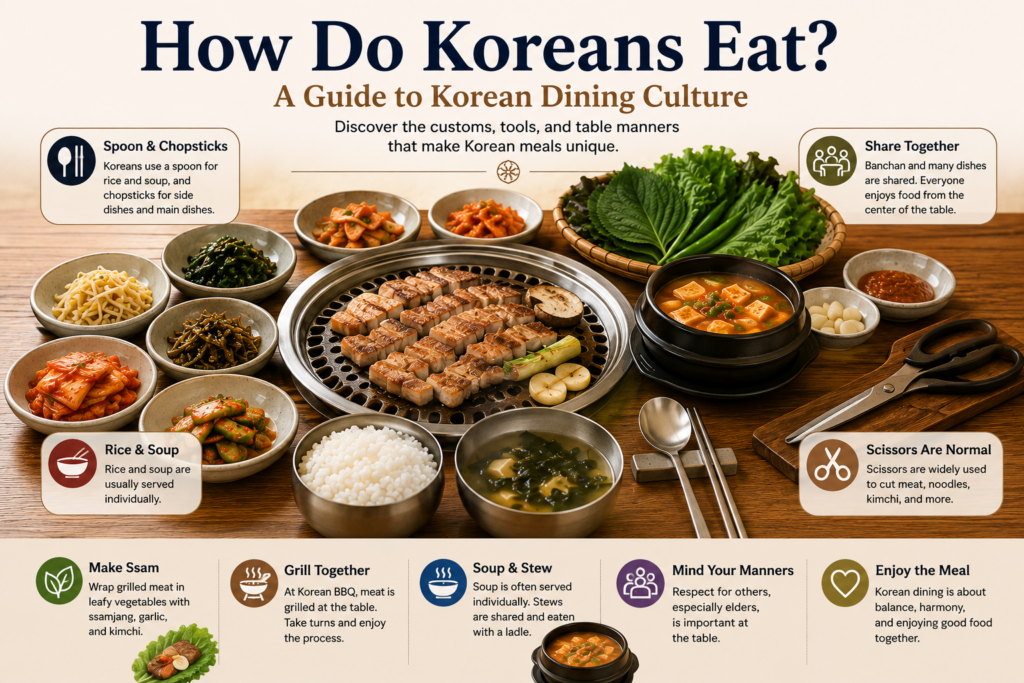
Learn how Koreans eat, from using a spoon and chopsticks and sharing banchan to Korean BBQ, dining etiquette, ordering, tipping, and restaurant customs.
What Should You Know First About the Korean Table?
For first-time visitors, the way Koreans eat can feel just as unfamiliar as the food itself.
Rice and soup may be served individually, while banchan and some main dishes are shared. Meat may be grilled directly at the table. A spoon and chopsticks are both used during the meal, and you may even see scissors beside the grill.
At first, it can seem as though there are many rules.
In reality, Korean dining becomes much easier once you understand a few basic ideas:
- Rice and soup are often served individually
- Banchan and some main dishes are commonly shared
- Both a spoon and chopsticks are used
- Some restaurants expect you to call the staff when you need something
- Payment is often made at the counter
- Tipping is generally not expected
You do not need to perform every custom perfectly. Watching the people around you and understanding the basic flow of the meal is usually enough.
How Do Koreans Use a Spoon and Chopsticks?
Koreans commonly use both a spoon and chopsticks during a meal.
It is often explained that the spoon is for rice and soup, while chopsticks are for banchan and other solid foods. That is a useful starting point, but actual eating habits can be more flexible.
In my own case, I may eat plain rice with either a spoon or chopsticks depending on the meal.
For bibimbap or fried rice, however, I use a spoon. With soup or stew, I do not follow a strict rule for the solid ingredients. If something is easy to pick up, I may use chopsticks. If it is easier with a spoon, I use the spoon.
That is how the two utensils work in everyday life: not as rigidly separated tools, but as two practical options used together.
Korean chopsticks are often made of metal, which can feel unfamiliar if you are used to wooden chopsticks.
There is a longer story behind why Koreans use metal chopsticks and why Koreans use both a spoon and chopsticks.
If metal chopsticks feel difficult at first, do not worry. Even at a Korean table, the goal is simply to use whichever utensil works naturally for the food you are eating.
Should You Lift Your Rice Bowl?
In Korea, rice and soup bowls are normally left on the table while eating.
For me, this has always felt so natural that I never really thought about why we do not lift the bowl.
When I first noticed people in some other East Asian countries eating while holding the rice bowl in one hand, it looked quite unfamiliar to me.
Koreans generally bring the spoon or chopsticks to the food rather than lifting the bowl toward the mouth.
Younger Koreans also still commonly eat this way.
As a visitor, however, you do not need to worry about making a small mistake. It is enough to notice how the people around you eat.
How Do Koreans Eat Banchan?
Banchan (반찬) are small dishes served as part of the meal.
They are usually placed in the center of the table and shared rather than treated as appetizers that must be finished before the main dish arrives.
You may eat rice with kimchi, then try a vegetable side dish, then return to rice and another food. Banchan remain part of the meal from beginning to end.
At many restaurants, basic banchan can also be refilled.
For me, asking for more banchan in Korea has always felt completely normal. I rarely thought of it as a special request.
That does not mean every dish can be refilled for free. A larger or more expensive side dish, such as a substantial fish dish, may not be included in free refills.
Traditionally, I have more often asked the staff directly when we needed more banchan. Self-service stations have become more common, however, and some restaurants now let customers refill certain side dishes themselves.
The exact system varies by restaurant.
If you want a more detailed guide to this part of the meal, see how to eat Korean banchan.
How Do You Eat Shared Dishes?
Many Korean dishes are placed in the center of the table for several people to share.
Banchan, grilled meat, jeon, bossam, stews, and hot pots may all be shared depending on the meal.
Rice and many soups, on the other hand, are usually individual.
If serving tongs, chopsticks, or a ladle are provided, use them. You may also transfer food onto your own small plate before eating.
Among family and friends, moving a side dish closer to someone or asking another person to pass it is completely natural.
These small actions are part of the practical rhythm of a shared meal.
There is also a broader cultural story behind why Koreans share food at the table and why eating together has social meaning in Korea.
Who Grills the Meat at Korean BBQ?
At Korean barbecue restaurants, the meat may be cooked by restaurant staff or by the customers themselves.
When customers handle the grill, there is no single rule about who must do it.
With family or friends, people may take turns. Sometimes the person who is best at grilling naturally ends up doing more of the work.
At company dinners in the past, I also experienced a culture in which younger employees were more likely to take care of the grill.
That kind of expectation has become less rigid, but it was quite familiar in older workplace dining culture.
When I eat Korean barbecue with my family, I usually do the grilling myself.
The important thing for a first-time visitor is simply to see whether the restaurant staff starts cooking the meat. If they do not, customers may be expected to handle it.
Once the meat is cooked, it is often cut into bite-sized pieces and shared.
How Do You Eat Ssam?
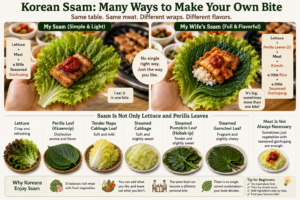
Ssam (쌈) means wrapping food, often grilled meat, in a leafy vegetable such as lettuce or perilla leaf.
A typical ssam might include grilled meat, a small amount of ssamjang, and perhaps garlic, kimchi, or another accompaniment.
There is no requirement to put every ingredient into every wrap.
In fact, smaller wraps are usually easier to eat.
The main idea is to combine the meat, sauce, and fresh leaf in a way that tastes good to you.
If you want to learn more about the leaves, fillings, and different ways Koreans make them, see my guide to Korean ssam.
Why Are Scissors Used at Korean Restaurants?
Food scissors are extremely common in Korean restaurants.
They are especially familiar at Korean barbecue restaurants, where grilled meat can be cut directly on the grill.
But their use is not limited to meat.
I also use scissors for foods such as naengmyeon and kimchi. At home, food scissors are a normal kitchen tool for us as well.
Jeon is a little different in my experience. Rather than cutting it with scissors, I am more likely to tear off a piece with chopsticks.
I have heard that foreign visitors can be surprised to see scissors placed on a dining table, but for Koreans their presence can feel completely ordinary.
The scissors are simply another practical eating tool.
How Do Koreans Eat Soup and Stew?
Soup and stew are common parts of Korean meals.
Soup is often served in an individual bowl, while some stews or hot pots may be placed in the center of the table and shared.
A spoon is useful for broth, but there is no need to follow a complicated rule for every solid ingredient.
I may use chopsticks for something that is easy to pick up and a spoon for something that is not.
Rice may be eaten separately, alternated with soup, or added directly to certain soups.
Dishes such as seolleongtang, gukbap, and haejangguk are often eaten with rice added to the soup, but personal preference still matters.
For a more detailed explanation of the distinctions among Korean soups and stews, see the guide to guk, tang, and jjigae.
What Should You Know When Eating With Older People?
Traditional Korean dining etiquette has long reflected respect for age.
When I was a child, we were expected to wait until an older person began eating before we started. A child who picked up a spoon or chopsticks first could be scolded.
We also naturally learned to use both hands when giving or receiving something, including drinks, in more formal situations.
Today, these customs feel less strict than they did when I was young.
The level of formality varies greatly depending on whether you are eating with close friends, family members, coworkers, or older people in a formal setting.
As a visitor, you do not need to memorize every traditional rule.
Basic respect and observing the people around you are usually enough.
How Do Koreans Pour and Receive Alcohol?
Traditional Korean drinking etiquette includes several customs related to age and formality.
When pouring or receiving a drink from someone older, people may use both hands. You may also see someone lightly support one wrist with the other hand.
In some situations, a younger person may turn slightly away when drinking in front of an older person.
These customs still exist, but they are not followed with the same level of formality in every group.
A casual meal among friends can be very relaxed.
For visitors, it is usually better to observe the atmosphere than to worry about performing every gesture perfectly.
Should You Stick Chopsticks Into Rice?
It is better not to place chopsticks or a spoon upright in a bowl of rice.
This can resemble the way food is presented during Korean memorial rituals.
For that reason, standing utensils vertically in rice is generally avoided during an ordinary meal.
When you are not using your spoon or chopsticks, simply place them on the table or on a utensil rest if one is provided.
How Do You Order at a Korean Restaurant?
Restaurant ordering in Korea has changed significantly.
When I was younger, ordering directly from a staff member was the normal way to order.
Later, call buttons became common on restaurant tables. I remember thinking they were very convenient because there was no need to keep trying to catch a server’s attention.
Today, tablet ordering systems and kiosks are much more common as well.
The exact system depends on the restaurant.
If there is a call button, using it is normal. If there is no button, do not be afraid to call the staff when you are ready.
For visitors from cultures where calling a server directly can feel rude, this can take some adjustment. In Korea, it is generally a normal part of restaurant service.
If the menu itself feels confusing, this guide explains how to read a Korean restaurant menu.
You May Need to Get Water or Banchan Yourself
Some restaurants operate self-service stations.
You may be expected to get your own:
- Water
- Extra plates
- Utensils
- Certain banchan
This has become more common over time.
If the staff does not bring water or refill a side dish immediately, look around before assuming something is wrong. There may be a self-service area nearby.
Watching other customers usually makes the system easy to understand.
How Do You Pay After a Meal?
In many Korean restaurants, customers pay at the counter when they are ready to leave.
For me, this is one of the most natural parts of eating at a Korean restaurant.
When several people eat together, one person may pay for the whole meal, or the group may settle the amount among themselves afterward. Splitting costs has also become very common.
The exact method depends on the group.
For a first-time visitor, the simplest rule is this:
If no one brings the bill to your table, look for the payment counter near the entrance or exit.
If you want a broader start-to-finish guide, see what to expect on your first Korean restaurant visit.
Do You Need to Tip in Korea?
In ordinary Korean restaurants, tipping is generally not expected.
You normally pay the listed amount and leave.
I lived most of my life in Korea without developing any habit of tipping at restaurants. I do not remember tipping at ordinary restaurants there.
After moving to the United States, tipping was one of the restaurant customs I had to adjust to, and to be honest, I still sometimes find the American tipping system complicated.
The Korean system feels much simpler to me: pay the stated price at the counter, and there is usually no additional percentage to calculate.
There may be unusual situations in hotels or tourism-related services, but for ordinary restaurant dining, visitors generally do not need to tip.
Three Practical Things First-Time Visitors Should Remember
If this is your first time eating at a Korean restaurant, you do not need to memorize a long etiquette list.
I would remember three practical things.
First, do not be afraid to call the staff when you are ready to order or need something. If there is a call button, use it.
Second, when you finish eating, look for the counter. In many Korean restaurants, that is where you pay.
Third, you generally do not need to leave a tip at an ordinary restaurant.
Those three small differences can make a Korean restaurant feel much less confusing for someone visiting for the first time.
The Best Way to Learn Korean Dining Culture
The easiest way to learn Korean dining culture is to observe the table rather than memorize rules.
Notice which foods are individual and which are shared.
Watch how people move between their spoon and chopsticks.
See whether restaurant staff grill the meat or customers do it themselves.
Look for a call button, a self-service station, or a payment counter.
Koreans themselves do not behave exactly the same way in every restaurant.
A formal meal, a barbecue restaurant, a casual bunsik shop, and a quick lunch can all have different rhythms.
The goal is not to imitate every action perfectly.
It is simply to understand enough of the meal that you can relax and enjoy it.
Frequently Asked Questions About Korean Dining Culture
Do Koreans eat rice with a spoon?
Yes, a spoon is commonly used for rice, but actual habits are flexible. I personally use either a spoon or chopsticks for plain rice depending on the meal.
Is it rude to lift your rice bowl in Korea?
Traditionally, Korean rice and soup bowls remain on the table. Visitors, however, do not need to worry excessively about a small mistake.
Are banchan refills free?
Many basic banchan can be refilled without additional charge, but this varies by restaurant and by the type of side dish.
Do Koreans share all their food?
No. Rice and many soups are individual, while banchan, grilled meat, hot pots, and other dishes may be shared.
Do you have to grill your own meat at Korean BBQ?
It depends on the restaurant. Staff may grill it, or customers may be expected to cook it themselves.
Why do Koreans use metal chopsticks?
Metal chopsticks are a familiar feature of Korean dining. Stainless steel is especially common today, although other materials are also used.
Is it rude to eat before an older person?
Traditionally, younger people waited for older people to begin eating first. Today, the degree of formality depends on the situation and generation.
Do you need to tip in Korea?
Generally, no. Tipping is not standard at ordinary Korean restaurants.
The Most Important Thing to Remember When Eating in Korea
Korean dining has its own habits, but most of them become intuitive after a few meals.
Use your spoon and chopsticks in whatever way works naturally for the food.
Share dishes when they are meant to be shared.
Do not hesitate to call the staff.
Pay attention to whether water or banchan are self-service.
And when the meal is finished, look for the counter rather than waiting automatically for someone to bring a check.
These are practical habits, not a test of whether you understand Korean culture perfectly.
If you make a small mistake, it is usually not a problem.
What matters much more is that you enjoy the meal, show basic respect, and pay attention to how the restaurant works.
After a few Korean meals, a table that first seemed full of unfamiliar rules usually begins to feel much simpler.