Why Do Koreans Use Both a Spoon and Chopsticks?
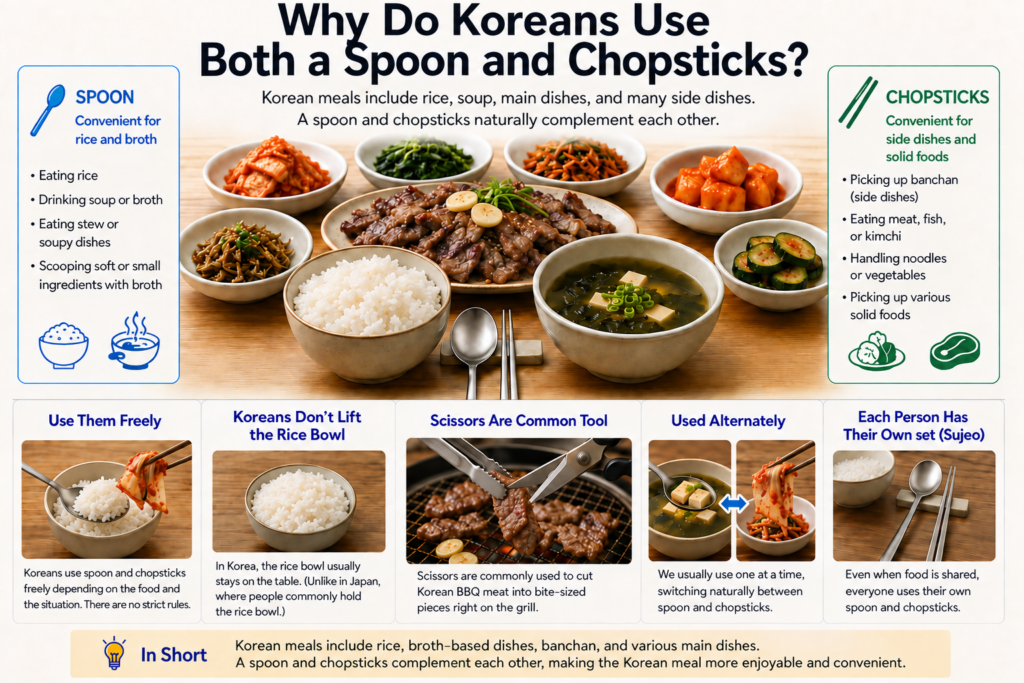
Learn why Koreans use a spoon and chopsticks together, how they switch between rice, soup, and side dishes, and which utensil feels easier for each bite.
Rice, Soup, and Side Dishes Share the Same Table
When you sit down at a Korean restaurant, you will often find a spoon and a pair of chopsticks at your place. If you expected to eat everything with chopsticks, the spoon might leave you wondering which utensil to use for each dish.
A Korean meal can bring together rice, soup or stew, meat, fish, and several side dishes. Some foods are easier to scoop, while others are easier to pick up. A spoon and chopsticks each help with different parts of the meal.
Having both utensils does not mean there is a strict rule for every food. You can switch according to the bite you want to eat. I do not consciously decide which utensil to use every time I reach for something.
A Spoon Is Especially Useful for Broth
The spoon’s role becomes clear when you eat the broth in a Korean soup. You might have a spoonful of miyeokguk, or seaweed soup, eat some rice, and then return to the soup. Small pieces of other ingredients can come along in the same spoonful.
A spoon is also convenient for gukbap, a dish that brings rice and soup together. It lets you scoop up rice, broth, and small pieces of meat in one bite. At a Korean table, the spoon is an everyday utensil used throughout the meal.
The same applies to jjigae, or Korean stew. If you want broth with small pieces of crumbled tofu, a spoon makes that easy. If you want to pick out a larger piece of meat or a mushroom from the same bowl, you can switch to chopsticks.
Guk, tang, and jjigae are different categories of food, but a spoon is useful for eating the broth in all three. My guide to the differences between guk, tang, and jjigae explains their names and how they are served.
Chopsticks Help You Pick Up Side Dishes and Larger Pieces
Chopsticks are useful when you want a particular piece of food: a slice of kimchi, a little seasoned vegetable, or a piece of grilled meat. You can use them to pair a side dish with rice or separate small pieces of fish.
They are also commonly used for noodles. You might lift the noodles with chopsticks, then reach for a spoon to taste the broth. Even within a single dish, you may use both utensils.
Side dishes do not have to be eaten only with chopsticks. Food that crumbles or slips away may be easier to eat with a spoon. Once you have served some onto your own plate, you can choose whichever utensil suits its size and texture.
For ideas on tasting different side dishes and eating them with rice, see my guide to how to eat Korean banchan.
I Use Either Utensil for Rice, but a Spoon for Bibimbap and Fried Rice
I eat plain rice with either a spoon or chopsticks. It varies. Sometimes I want to scoop it up with a spoon; other times, I pick up some rice with the chopsticks I am already using for side dishes.
For bibimbap and fried rice, I use a spoon. With rice and smaller ingredients mixed together, taking a spoonful is the most comfortable way for me to eat them. That is my habit, rather than a rule everyone has to follow.
I do not assign a particular utensil to the solid ingredients in soup or stew, either. If a piece is easy to pick up, I use chopsticks. If it is difficult to grasp, or I want some broth with it, I use a spoon. Even with tofu, my choice can change depending on whether it is a large piece or has broken into smaller bits.
| Food or Bite | What I Usually Use and Why |
|---|---|
| Plain rice | Either a spoon or chopsticks, depending on what feels convenient. |
| Bibimbap or fried rice | A spoon, to scoop up the rice and mixed ingredients together. |
| Broth in guk, tang, or jjigae | A spoon, to hold the liquid. |
| Meat or larger pieces that are easy to grasp | Chopsticks, to pick up the piece I want. |
| Small or crumbled ingredients that are difficult to grasp | A spoon, to scoop them up with some broth. |
In Korea, people generally leave their rice bowls on the table while eating. That does not mean rice must always be eaten with a spoon. Where the bowl stays and which utensil you choose are separate parts of the meal.
Use the Utensils in Turn
Although a spoon and chopsticks are provided together, people generally do not hold both in the same hand while eating. To have some broth, you put down your chopsticks and pick up your spoon. To pick up a side dish, you set down the spoon and reach for your chopsticks.
Switching may feel a little awkward at first. But you do not need to alternate after every bite. You can eat several spoonfuls of rice and soup before using your chopsticks for a side dish. There is no sequence to count or pattern to maintain.
When setting a utensil down, use the utensil rest if one is provided. Otherwise, place it neatly in the space set aside for your utensils.
You may also notice that both utensils are metal. I discuss the feel of stainless steel utensils and their practical advantages in why Koreans use metal chopsticks.
Keep Personal Utensils Separate from Serving Utensils
Even when side dishes or a large pot of food are shared, each person has their own spoon and chopsticks. Sharing food does not mean sharing the utensils you eat with.
If a communal dish comes with a ladle, tongs, or serving chopsticks, use those to transfer food to your own bowl or plate. Then eat with your personal spoon or chopsticks. A ladle moves food from the pot to your bowl; your spoon carries it from your bowl to your mouth.
For example, after serving some shared jjigae into your own bowl with a ladle, you can eat the broth with your spoon and pick up larger pieces with your chopsticks. If serving utensils are not available, you can ask the staff for them.
My guide to sharing food at a Korean table explains how individual portions and shared dishes fit into the same meal.
A Spoon Has a Place at Korean BBQ, Too
At a Korean BBQ restaurant, chopsticks may be the first utensil you notice people using to eat meat and side dishes. But once rice and doenjang jjigae, or soybean paste stew, arrive, a spoon becomes useful as well. During the same meal, you pick up grilled meat and scoop up stew broth.
The tongs and scissors beside the grill have different jobs from your personal eating utensils. Tongs help move and grill the meat, while scissors cut larger pieces into manageable bites. Some tools on the table are for preparing or serving the food.
If you are new to Korean dining, you do not need to memorize how every utensil works at once. Start by looking at the food in front of you: would it be easier to scoop up or pick up?
Koreans use a spoon and chopsticks together because a single meal includes foods with different textures and forms. As you move between rice, side dishes, and broth, the utensil in your hand may change. Choose the one that makes your next bite comfortable, and the rhythm of the meal will begin to feel natural.