Korean Street Food: What Should You Try in Korea?
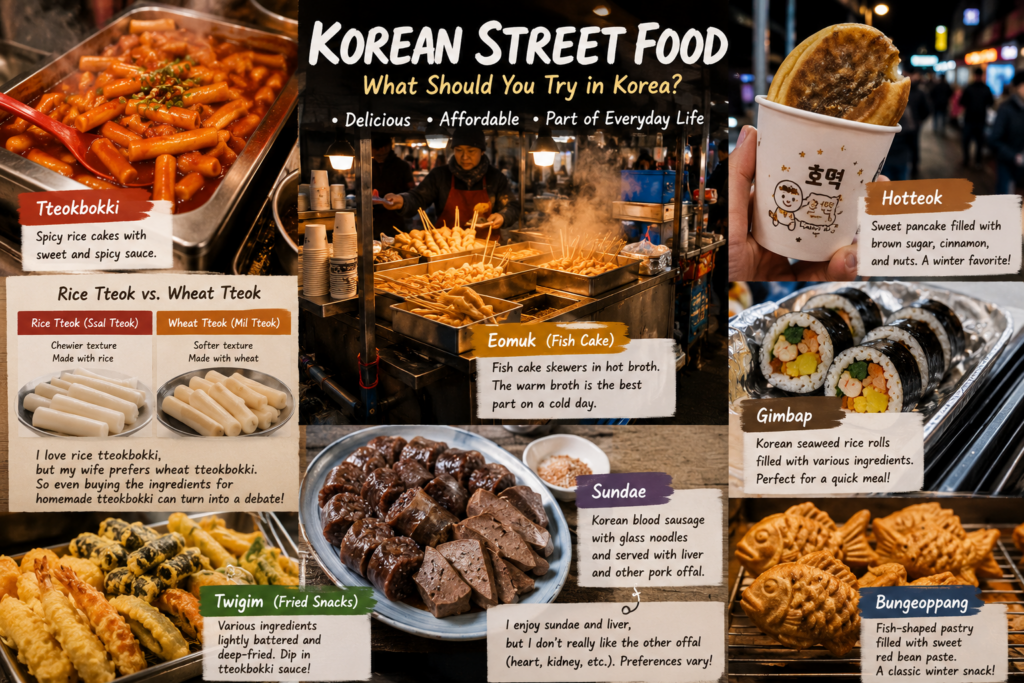
Explore Korean street food through everyday favorites, from rice and wheat tteokbokki to fried squid, sundae, fish cakes, and sweet snacks.
Even the Same Tteokbokki Can Divide Opinions
When you first look into Korean street food, names such as tteokbokki, eomuk, sundae, and hotteok appear again and again. Knowing the famous dishes, though, does not tell you which ones you will enjoy.
My wife and I have different preferences even when it comes to tteokbokki. I prefer rice tteok, while she prefers wheat tteok. When we buy ingredients to make it at home, we sometimes disagree about which kind to choose.
Sundae is another example. I eat the liver served alongside it, but I do not particularly enjoy the other organ meats. Being familiar with a Korean food does not mean liking everything that comes with it.
If you are trying Korean street food for the first time, I suggest sampling different flavors and textures to discover your own preferences, rather than trying to get through every famous dish.
Look Beyond Outdoor Stalls to Markets and Bunsik Shops
The term “street food” might make you picture carts or stalls along a sidewalk. In Korea, you can find many of the same foods in small shops inside traditional markets and at neighborhood bunsik restaurants.
Bunsik shops serve casual snacks and simple meals. Their menus may include tteokbokki, fried snacks, sundae, gimbap, and ramyeon. These can be foods you eat quickly on the go or order as a sit-down meal.
At a market, you might sit on a small stool, eat standing up, or take your food away. Pojangmacha, covered stalls or tent-style eating places, also vary. Some sell simple bunsik, while others serve drinks and accompanying dishes in the evening.
You do not need to find an outdoor cart to experience these foods. Look at what a market stall or neighborhood shop serves and whether you can eat there.
With Tteokbokki, Notice the Texture as Well as the Heat
Tteokbokki consists of tteok simmered in a spicy, sweet sauce. Fish cakes, green onions, or boiled eggs may be included. The sweetness, heat, and amount of sauce vary by shop.
The red sauce may catch your attention first, but the texture of the tteok can make a big difference to how much you enjoy the dish. Two common types are ssaltteok, made primarily from rice, and miltteok, made from wheat flour.
I like the distinctive chewiness of rice tteok. My wife prefers wheat tteok. We can be eating the same dish while looking forward to different textures.
If you do not enjoy the texture of the first tteokbokki you try, you do not have to assume that every version will be the same. Next time, check which type of tteok the shop uses. Our guide to tteokbokki explores the ingredients, sauce, and different versions in more detail.
The heat also varies considerably. Sweetness does not mean a dish is mild, so ask before ordering if you are sensitive to spicy food. Our article on understanding Korean spice levels can help you make sense of those differences.
I Like Dipping Fried Squid and Gimmari in Tteokbokki Sauce
Twigim, the fried snacks sold at bunsik shops, can include squid, sweet potato, vegetables, gimmari, and dumplings. Gimmari usually consists of glass noodles wrapped in seaweed, coated in batter, and fried.
My favorites are fried squid and gimmari. When I eat them with tteokbokki, I dip them into the sauce.
Eaten on its own, twigim lets you enjoy the crisp coating and the ingredient inside. Dipping it into tteokbokki sauce adds sweetness and heat, while the sauce changes the texture of the coating as it soaks in.
Some shops cut up the fried snacks and mix them with the sauce before serving. If you would like to taste them crisp first, ask whether you can have them separately.
Try one piece on its own and another with a little sauce. You can experience two versions of the same snack without ordering another dish.
Eomuk Comes With the Comfort of Warm Broth
Eomuk is made from processed fish paste mixed with other ingredients. At street stalls, you may see flat pieces folded onto long skewers and kept in hot broth.
Alongside spicy tteokbokki or crisp fried snacks, eomuk offers a softer texture and warm broth. On a cold day outdoors, that warmth becomes part of the experience.
Some places let customers help themselves to broth, while others serve it for you. Some vendors count the empty skewers to calculate the bill afterward, but not every stall works that way.
Check how the stall handles ordering and payment, and leave your empty skewers where the vendor directs you.
You Can Enjoy Sundae Without Liking Every Accompaniment
Sundae is often described in English as Korean blood sausage. The kind commonly found at bunsik shops contains glass noodles and other ingredients, giving it a different texture from a typical meat sausage. Ingredients and preparation vary by type.
An order may come with liver or other pork organ meats. I eat sundae and liver, but I do not particularly like the other organ meats. Enjoying the sundae does not mean enjoying every accompaniment.
If this is your first time, consider the sundae and the pieces beside it separately. An unfamiliar-looking accompaniment does not have to determine what you think of the sundae itself.
If you do not want organ meats, you can ask, “내장 빼고 주세요” — “Please leave out the organ meats.” If you would like liver as the only accompaniment, ask, “간만 같이 주세요” — “Please include only liver with the sundae.” Whether the shop can adjust the order will vary.
Sundae may be served with salt or a regional seasoning, and some people dip it into tteokbokki sauce. Try a little and see which way you enjoy it.
Gimbap and Ramyeon Can Turn a Snack Into a Meal
Gimbap is made by rolling rice and various fillings in seaweed, then slicing the roll. It works well as food to take away or eat on the go, and it can also be ordered with other dishes at a bunsik shop.
Gimbap and ramyeon are a familiar combination. Alternating between the rice and fillings of gimbap and the hot broth of ramyeon makes a simple meal. Gimbap is also eaten alongside tteokbokki.
Our guide to gimbap explores the fillings and varieties. Here, it helps to remember that gimbap can be both a convenient snack and part of a fuller meal.
If you want to avoid heat, check the filling. Basic gimbap tastes different from versions containing hot peppers or spicy seasonings.
For Something Sweet, Look for Hotteok or Bungeoppang
I like eomuk, hotteok, and bungeoppang. They were familiar foods I ate regularly, rather than treats reserved for special occasions.
Hotteok is a filled dough snack pressed flat and cooked on a griddle. A familiar sweet filling includes sugar, cinnamon, and nuts or seeds. Take care with the first bite: even when the outside seems cool enough, the melted sugar inside can still be very hot.
Bungeoppang is made by cooking batter and filling in a fish-shaped mold. Ordinary bungeoppang does not contain fish. Sweet red bean paste is a familiar filling, but custard and other versions are also available.
Both hotteok and bungeoppang bring colder weather to mind. Roasted sweet potatoes and chestnuts are also associated with winter. Availability depends on the vendor and season, so you may not find the same stalls throughout the year. Our article on how Korean food changes with the seasons explores that connection further.
You may also encounter snacks such as Korean corn dogs with cheese fillings or potato coatings. Familiar bunsik and newer snacks coexist within Korean street-food culture.
Start With Different Flavors in Manageable Portions
For your first order, think about the kind of food you feel like eating.
- For something spicy and sweet, look at tteokbokki and twigim.
- For warm broth and a softer texture, consider eomuk.
- For a simple meal, try gimbap or gimbap with ramyeon.
- For a sweet snack, see whether hotteok or bungeoppang is available.
- To explore a less familiar texture, try a small portion of sundae.
If you are visiting with others, you can share a few dishes. Check the portion sizes and add more as you go, leaving room to taste something else.
Confirm prices, payment methods, and whether you pay before or after eating at the stall. There is no need to assume that street food is always inexpensive or that every vendor accepts only cash.
Just as my wife and I choose different tteok for tteokbokki, people can remain fond of different versions of familiar foods. There is no single correct way to enjoy Korean street food. Try a few things and find the foods and combinations you want to return to.