What Is Korean Food? A Beginner’s Guide to Korean Flavors, Meals, and Food Culture
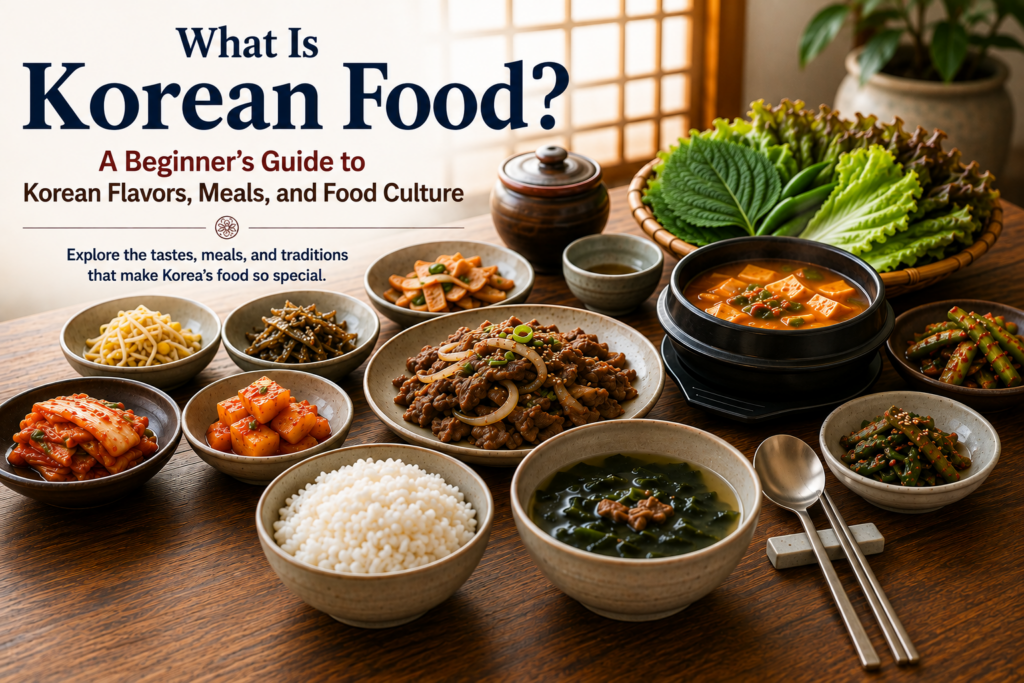
Learn how a Korean table comes together, from rice, kimchi, and banchan to fermentation, soups and stews, balanced flavors, and beginner-friendly dishes.
Understanding the Korean Table
Korean food is much more than kimchi, bulgogi, bibimbap, and tteokbokki.
To understand Korean food, it helps to look beyond individual dishes and first understand how a Korean meal comes together.
A typical Korean table may include rice, soup or stew, kimchi, and several side dishes. Fish, meat, tofu, or eggs may be added, while some dishes are served individually and others are placed in the center of the table to share.
For someone experiencing Korean food for the first time, the table can seem surprisingly busy.
Why are there several side dishes? Why are rice and soup often served together? Why does kimchi appear so often? And why are some dishes shared while others are not?
Once you understand these basic ideas, Korean food becomes much easier to explore.
Korean cuisine is not simply a collection of recipes. It reflects a way of eating shaped by Korea’s seasons, ingredients, history, and everyday life.
What Does Korean Food Mean?
In Korea, Korean food is commonly called hansik (한식).
Hansik includes traditional dishes, but Korean food is not frozen in the past. It also includes eating habits that have developed over time and continue to change.
Of course, not every Korean eats in the same way. Meals vary by family, generation, region, season, and occasion. A quick weekday lunch may look very different from a holiday meal or a large family gathering.
If you are curious about what Koreans really eat at home, everyday Korean meals are often much simpler and more varied than the elaborate tables visitors may see in restaurants or online.
Still, several elements appear frequently:
- Rice
- Soup or stew
- Kimchi
- Banchan, or side dishes
- Vegetables
- Meat, fish, tofu, or eggs
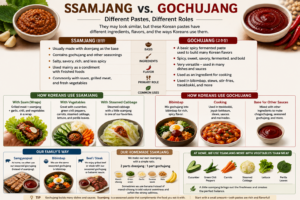
- Seasonings such as doenjang, ganjang, and gochujang
These foods are often best understood together rather than as completely separate dishes.
What Does a Typical Korean Table Look Like?
Rice has traditionally been at the center of a Korean meal.
A bowl of rice is often accompanied by soup or stew, kimchi, and several banchan. Depending on the meal, there may also be tofu, eggs, fish, meat, or another main dish.
Growing up in Korea, this basic structure felt very ordinary to me.
At home, rice and soup were usually part of the meal. When we had a jjigae, or stew, we sometimes skipped the soup. Kimchi was always on the table, and there were usually around five or six side dishes.
That does not mean five or six new dishes were prepared for every meal.
Most of the banchan were already in the refrigerator and were eaten over several meals. One or two freshly prepared dishes might be added to what we already had.
There were also many days when we did not have meat or fish. In my childhood home, that was probably true about half the time. On those days, something like kimchi jjigae or doenjang jjigae could easily become the center of the meal.
This everyday reality is quite different from the idea that every Korean home meal is an elaborate feast.
The important point is not the exact number of dishes. It is how they work together.
Plain rice can soften the intensity of a salty side dish or a strongly flavored stew. Kimchi can add acidity and crunch. Mild vegetables can provide contrast.
This balance across the table is one of the basic ideas behind a Korean meal.
Why Are There So Many Side Dishes?
Small side dishes served with rice are called banchan (반찬).
They are not appetizers that need to be finished before the main food arrives. They stay on the table and are eaten throughout the meal.
Common everyday banchan can include kimchi, seasoned vegetables, braised beans or anchovies, tofu dishes, and other foods that keep well in the refrigerator.
One thing that can surprise international visitors is that the large number of banchan seen in some Korean restaurants is not necessarily what an ordinary family eats at home every day.
In my family, eight or ten side dishes were more likely on holidays or special occasions.
For normal meals, several basic banchan were kept in the refrigerator and eaten over multiple meals. A newly made vegetable dish or another side dish might be added, but we did not start from zero every time we sat down to eat.
My wife and I still eat in a similar way today.
This is one reason banchan are so practical in Korean home cooking. They provide variety without requiring an entirely new set of dishes at every meal.
If you are new to these shared dishes, my guide to Korean banchan looks more closely at the different types of side dishes and how they are eaten.
Why Does Kimchi Appear So Often?
Kimchi is probably the most internationally recognized Korean food.
But kimchi is much more varied than the familiar image of spicy napa cabbage.
Different vegetables, seasoning methods, seasons, and fermentation stages produce many kinds of kimchi. Some are spicy, while others are mild. Some are eaten fresh, while others become more sour and deeply fermented over time.
As kimchi ferments, it can also become an ingredient in other foods, including kimchi jjigae, kimchi fried rice, and kimchi pancakes.
Kimchi was always present on our family table when I was growing up, but that does not mean I always liked it.
As a child, I especially disliked spicy napa cabbage kimchi. I did not begin eating kimchi enthusiastically until I was nearly an adult.
Today, when I eat a Korean-style rice meal, I usually eat at least a little kimchi.
Even with pasta, curry, or noodles, I do not necessarily need kimchi. But if I am eating those foods at home, I often find myself putting kimchi on the table anyway.
That personal habit is one small example of how deeply kimchi can become connected with everyday eating without meaning that every Korean likes every kind of kimchi.
If you want to explore how kimchi changes with ingredients, fermentation, and time, see my guide to Korean kimchi.
Why Is Fermentation Important in Korean Food?
Fermentation is one of the important foundations of Korean cuisine.
Before modern refrigeration, preserving food through changing seasons was essential. Salting and fermentation made it possible to keep ingredients for longer periods and also created flavors that became central to Korean cooking.
Well-known examples include:
- Kimchi
- Doenjang, fermented soybean paste
- Ganjang, soy sauce
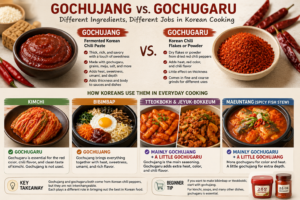
- Gochujang, fermented red chili paste
Today, these ingredients matter for much more than preservation.
Doenjang brings deep savory flavor to soups and stews. Ganjang seasons an enormous variety of dishes. Gochujang adds fermented depth as well as sweetness, saltiness, and heat.
For a beginner, understanding fermentation makes many Korean flavors much easier to recognize.
I explain the history, everyday role, and different forms of Korean fermented foods in more detail separately.
Is All Korean Food Spicy?
No.
This is one of the most common misconceptions about Korean food.
Some internationally famous Korean dishes are very spicy, which can make it seem as though Koreans eat intense chili heat at every meal.
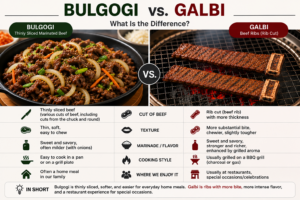
In reality, many foods are mild, including bulgogi, japchae, gimbap, galbitang, seolleongtang, gyeran mari, and many vegetable dishes.
And Koreans themselves have very different tolerances for spicy food.
I grew up in Korea, but I have never been especially good at eating very spicy food. My wife can handle considerably more heat than I can.
I have had several meals in Korean restaurants where dishes such as spicy stir-fried octopus or haemuljjim were simply too hot for me to enjoy comfortably. I no longer eat Buldak Bokkeummyeon, although I still eat Shin Ramyun and often add bean sprouts, an egg, and other ingredients.
So being Korean certainly does not mean automatically enjoying extremely spicy food.
If you are worried about heat, how spicy Korean food really is depends greatly on the dish, the restaurant, and the person eating it.
Why Is Rice So Important in Korean Food?
Rice has traditionally played a central role in Korean meals.
White rice is common, but Koreans also eat rice mixed with barley, beans, and other grains.
The importance of rice can even be seen in the Korean language.
Bap (밥) literally means cooked rice, but depending on the context, it can also mean a meal.
A familiar Korean expression is:
“Bap meogeosseoyo?” (밥 먹었어요?)
Literally, it asks, “Have you eaten rice?” But in daily conversation, it usually means simply, “Have you eaten?”
I heard and used this expression constantly while growing up. It could be used in the morning, afternoon, or evening, and people often understood it almost as a casual way of asking how someone was doing.
The other person might simply answer, “Yes, I ate,” and the conversation would continue.
Another expression shows the same connection between food and social relationships.
When Koreans unexpectedly meet an old friend and say goodbye, they often say something like:
“Let’s have a meal sometime.”
That does not always result in an actual meal. I have said and heard it many times without eventually meeting for dinner. In that situation, it often functions more like “Let’s see each other again.”
In my experience, people of my generation used these expressions very naturally. Younger Koreans may not use them quite as often, but bap still carries meanings that go beyond a bowl of rice.
Rice also plays an important role on the table itself.
Plain rice works naturally with spicy kimchi, salty banchan, grilled meat, or a strongly flavored stew.
Rather than thinking of rice as a simple side dish, it makes more sense to see it as one of the anchors of the Korean meal.
Why Are Soup and Stew So Common?
Soup and stew appear frequently in Korean meals.
Korean cuisine includes several categories of broth-based dishes, including guk (국), tang (탕), and jjigae (찌개).
Their differences cannot always be translated perfectly into English, but the way they are served can help beginners understand Korean meal culture.
In my family, guk was normally served in an individual bowl.
Jjigae, on the other hand, was often placed in the middle of the table and shared. That was already completely natural to me as a child.
Meals without soup or stew were relatively uncommon at home, although lunch was more likely to be an exception.
And hot soup was certainly not limited to winter.
We ate soups and stews during summer as well, and my wife and I still follow much the same pattern while living in the United States.
Some Korean soups are also connected with particular occasions. Miyeokguk, for example, is strongly associated with birthdays, while samgyetang is famously eaten during some of the hottest days of summer.
These examples show why Korean food is not always explained fully by ingredients alone. When and how a dish is eaten can matter just as much.
What Flavors Are Common in Korean Food?
It is difficult to describe Korean cuisine with one flavor.
Depending on the dish, you may encounter:
- Salty flavors
- Spiciness
- Sweetness
- Sourness
- Savory flavors
- Fermented flavors
- Nutty aromas from sesame oil and sesame seeds
But balance is often more important than any single flavor.
A strongly seasoned stew may be eaten with plain rice. A salty or spicy dish may sit beside mild vegetables. Fermented foods may be paired with fresh or lightly seasoned ingredients.
This is another reason a Korean meal makes more sense when you look at the table as a whole.
If you want to understand where many of these flavors come from, learning a few essential Korean ingredients makes the cuisine much easier to understand.
What Korean Foods Are Good for Beginners?
You do not need to try dozens of dishes to begin exploring Korean food.
A few approachable starting points include:
- Bibimbap
- Bulgogi
- Gimbap
- Japchae
- Samgyeopsal
- Kimchi jjigae
- Doenjang jjigae
If you are sensitive to spicy food, bulgogi, japchae, or gimbap can be easy places to begin.
If you want to understand the structure of a Korean meal rather than just one famous dish, try a meal that includes rice, soup or stew, kimchi, and a few banchan.
There is no single “best” first Korean dish. Different meals introduce different parts of Korean food culture.
If you are not sure what to try next, this practical guide explains how to start exploring Korean food step by step.
Useful Korean Food Words for Beginners
A few basic Korean words can make menus and meals easier to understand.
- Hansik (한식): Korean food or Korean cuisine
- Bap (밥): Cooked rice; can also mean a meal
- Guk (국): Soup
- Jjigae (찌개): A type of Korean stew
- Banchan (반찬): Side dishes eaten with rice
- Gogi (고기): Meat
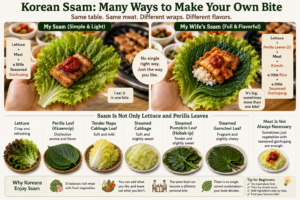
- Ssam (쌈): Food wrapped in a leafy vegetable
- Jang (장): A broad category that includes fermented sauces and pastes such as doenjang, ganjang, and gochujang
- Maewoyo (매워요): “It’s spicy”
- Masisseoyo (맛있어요): “It’s delicious”
You do not need to speak Korean to enjoy Korean food, but recognizing a few words can make the experience easier and more interesting.
The Easiest Way to Understand the Korean Table
When people first discover Korean food, it is natural to focus on famous individual dishes.
But Korean food becomes easier to understand when you ask a few additional questions.
What is this dish eaten with?
Is it usually served individually or shared?
When do people normally eat it?
What flavors or dishes balance it?
What role does it play in the meal?
Those questions help turn Korean food from a list of unfamiliar dish names into a food culture with its own everyday logic.
You do not need to memorize hundreds of Korean dishes.
Start by understanding the table.
There is often rice. There may be soup or stew. Kimchi and several banchan may be present. Some foods are mild, while others are strongly seasoned. Some are eaten individually, while others are shared.
Once that structure becomes familiar, individual Korean dishes become much easier to understand.
Frequently Asked Questions About Korean Food
Is all Korean food spicy?
No. Many Korean dishes are mild, and individual Koreans also have very different tolerances for spicy food.
What does hansik mean?
Hansik is the Korean word commonly used for Korean food or Korean cuisine.
Do Koreans really eat kimchi every day?
Kimchi is extremely common, but not every Korean eats it at every meal. Eating habits vary by person, family, generation, and type of meal.
Why do Korean restaurants serve so many side dishes?
Banchan are part of the meal rather than separate appetizers. They are eaten with rice and other dishes and add different flavors and textures. Restaurant tables may also include more banchan than an ordinary home meal.
What Korean food is good for beginners?
Bibimbap, bulgogi, gimbap, and japchae are approachable starting points. People who do not like spicy food have many other mild options as well.
Can vegetarians eat Korean food?
Yes, but ingredients should be checked carefully. Some dishes that appear vegetarian may contain anchovy broth, fish sauce, meat broth, or other animal-based ingredients.
Is Korean food healthy?
Korean cuisine includes vegetables, grains, fermented foods, seafood, and many other nutritious ingredients, but Korean food is too diverse to describe as uniformly healthy. Some dishes can also be high in sodium, sugar, fat, or refined carbohydrates.
Do Koreans eat rice with chopsticks?
Koreans traditionally use both a spoon and chopsticks. Rice and soup are commonly eaten with a spoon, while chopsticks are used for many banchan and other solid foods.