How to Eat Korean Banchan: Sharing, Refills, and Your First Bite
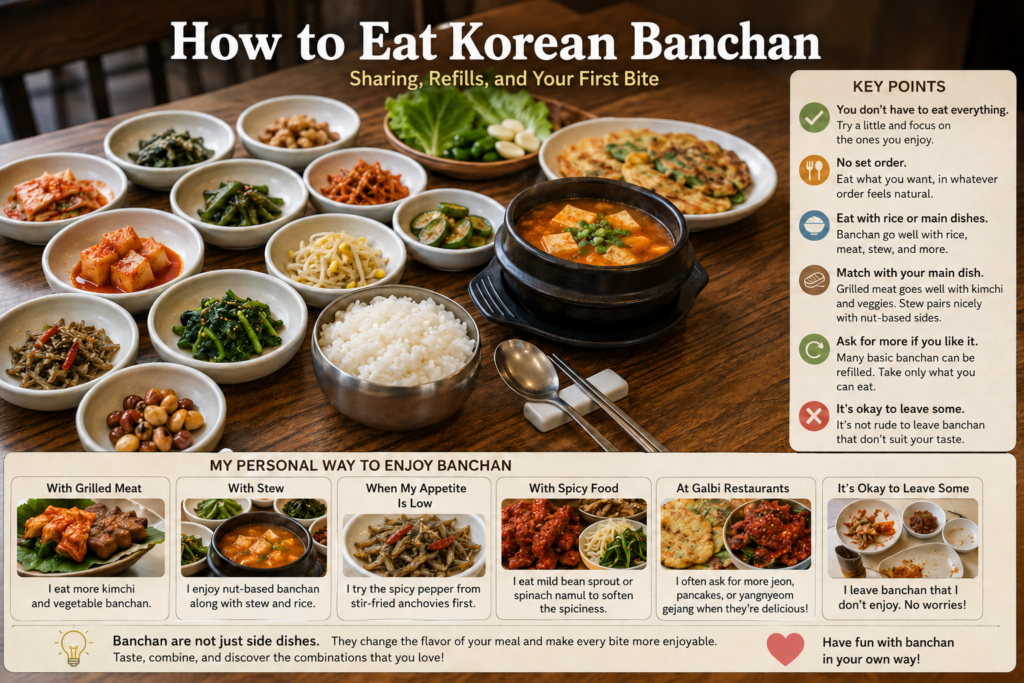
Learn how to eat Korean banchan, from pairing side dishes with rice to sharing plates, asking for refills, and leaving what does not suit your taste.
Start With One Small Taste
When small dishes begin filling your table before your order arrives at a Korean restaurant, you may wonder where to start. There might be kimchi, namul (seasoned vegetables), and stir-fried or braised side dishes. Depending on the restaurant, jeon (savory pancakes) or gyeran-jjim (steamed eggs) may appear too. Which should you eat first? Is the plate in front of you yours? Are you expected to finish everything?
Begin with a small taste of something familiar or something that catches your attention. If the flavor is strong, try it with rice. Once your main dish arrives, see how the side dish tastes alongside it. You do not need to finish one plate before trying another or work your way around the table in order.
Even I sometimes encounter banchan I cannot name or have never tried. If I am curious, I ask what it is made from and taste a little. Being Korean does not mean knowing every side dish and how it is prepared. For help recognizing dishes by their ingredients and preparation, see my guide to different types of Korean banchan.
Enjoy Banchan While You Wait and Throughout the Meal
Banchan is not an appetizer course you must finish before the main dish arrives. You can have a little while waiting for your meat or stew, then keep eating it throughout the meal.
You might taste a piece of kimchi while you wait, then eat another piece with grilled meat once it is ready. With a stew, you might have a spoonful of rice with seasoned vegetables, taste the stew, and choose a different side dish for your next bite. The same banchan can taste different depending on what you eat it with.
Start with a small amount of strongly seasoned dishes such as jangajji (pickled vegetables) or jeotgal (salted, fermented seafood). A large mouthful on its own may seem too salty, while a little with rice can taste just right. Try that combination before deciding whether you like it.
You do not need to put all the side dishes on your rice and mix everything together. Tasting them separately at first makes it easier to discover which ingredients and seasonings you enjoy. You can combine two or three favorites later.
Having many side dishes does not mean eating an equal amount of each. It gives you different flavors to choose from as you eat your rice and main dish. I explain more about this style of eating in why Korean meals come with so many side dishes.
The Plate in Front of You May Be for Everyone
At many Korean restaurants, each person receives a bowl of rice while the banchan is shared. A plate of kimchi directly in front of you may simply have been placed where there was room. Some restaurants serve individual portions of banchan, though, so take a moment to look at how the table is arranged.
If serving tongs or communal chopsticks are provided, use them. Transfer a small amount to your own plate if you have one. You can ask the staff for a small plate or serving utensils if needed. Depending on the restaurant and your companions, you may see people taking small bites from shared dishes with their own chopsticks. You do not have to eat that way yourself.
Take only what you intend to eat, and do not return food from your own plate or anything you have bitten into to a shared dish. If a plate is out of reach, ask someone nearby to pass it instead of stretching across the table. Moving a dish a little closer to someone else can make sharing easier too.
For more about how individual servings and shared dishes fit into the same meal, see my guide to sharing food at a Korean table.
My Choice of Banchan Changes With the Main Dish
When I eat meat, I tend to reach for more kimchi and vegetable side dishes. After several bites of meat, those different flavors make me ready for another piece. With a stew, I also enjoy side dishes made with nuts. Their nutty flavor and firm texture add variety between bites of rice and spoonfuls of broth.
I like namul with almost any main dish. When the meal is spicy, I especially enjoy mildly seasoned soybean sprouts or spinach. For me, these gentler flavors are a welcome change between bites of strongly seasoned food.
When I have little appetite, I sometimes eat the hot pepper pieces in myeolchi-bokkeum, or stir-fried dried anchovies, first. I find that their sharp heat wakes up my appetite. You do not need to follow my example if you are not used to spicy food. It is simply worth knowing that even a side dish that does not look red can contain hot peppers.
| What I am eating | Banchan I often choose and why |
|---|---|
| Grilled meat | Kimchi and vegetable side dishes give me different flavors between bites. |
| Rice and stew | Side dishes with nuts add a nutty flavor and a firmer texture. |
| Spicy food | I tend to choose mild soybean sprouts or seasoned spinach. |
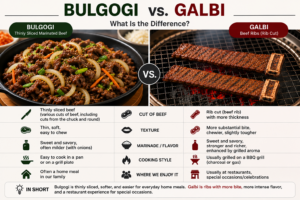
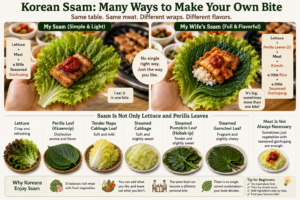
At a Korean BBQ restaurant, you do not need to put every side dish into a lettuce wrap. Try one piece of meat on its own, another with kimchi, and another with shredded scallions. For help with ordering and grilling as well, see how to eat Korean BBQ for the first time.
You Can Ask for More Without Knowing the Dish’s Name
Many restaurants offer refills of their basic banchan. If a favorite runs out, point to the plate and say, “Could we have a little more of this, please?” In Korean, you can say, “이것 조금 더 주세요.” Showing the dish makes the request clear even if you do not know its name.
I ask for more when I find a side dish I particularly enjoy. At a galbi restaurant, that might be jeon or yangnyeom gejang, crab marinated in a spicy sauce, both of which I do not eat often at home. Sometimes the side dishes make me want to return just as much as the meat does. If you are also choosing what kind of ribs to order, my guide to galbi explains the options.
A small serving dish does not automatically mean free refills. Special dishes or items ordered separately may cost extra. If you are unsure, ask, “Can we get more of this too?” or “Is there an extra charge?”
Some restaurants have a self-service station for banchan. Use the serving utensils provided, follow any instructions about plates, and take only what you expect to eat. Starting with a small portion and returning for more helps avoid leftovers.
The staff may take an empty dish away and bring it back filled, or add more to the dish already on your table. You do not need to decide how it should be done. Ask for the side dish you want and follow the restaurant’s lead.
You Can Leave What You Dislike, but Request Only What You Will Eat
Good manners do not require tasting every side dish or clearing every plate. It is unlikely that every dish served with a meal will suit your taste. I eat more of the ones I like, but I sometimes leave those I do not enjoy.
Take a small amount of an unfamiliar dish first. If its aroma or texture does not appeal to you, move on to something else. It is perfectly natural to return to one or two favorites more often. Leave enough for your companions and ask for more when needed.
There is a difference between leaving some of the banchan that came with your meal and ordering more than you can eat simply because refills are free. Add “Just a little, please” when asking for more, or take a small portion at the self-service station.
You can usually leave empty dishes on the table for the staff to collect. If the table is crowded, move them together to one side, but you do not need to carry them to another table or a serving area. At a self-service restaurant with a designated dish return, follow the instructions there.
For your first experience with banchan, a small taste followed by a bite with rice or your main dish is enough. As you discover what suits the meal and your appetite, those little plates begin to feel less unfamiliar and more like choices you look forward to making.