What Makes Korean BBQ Different?
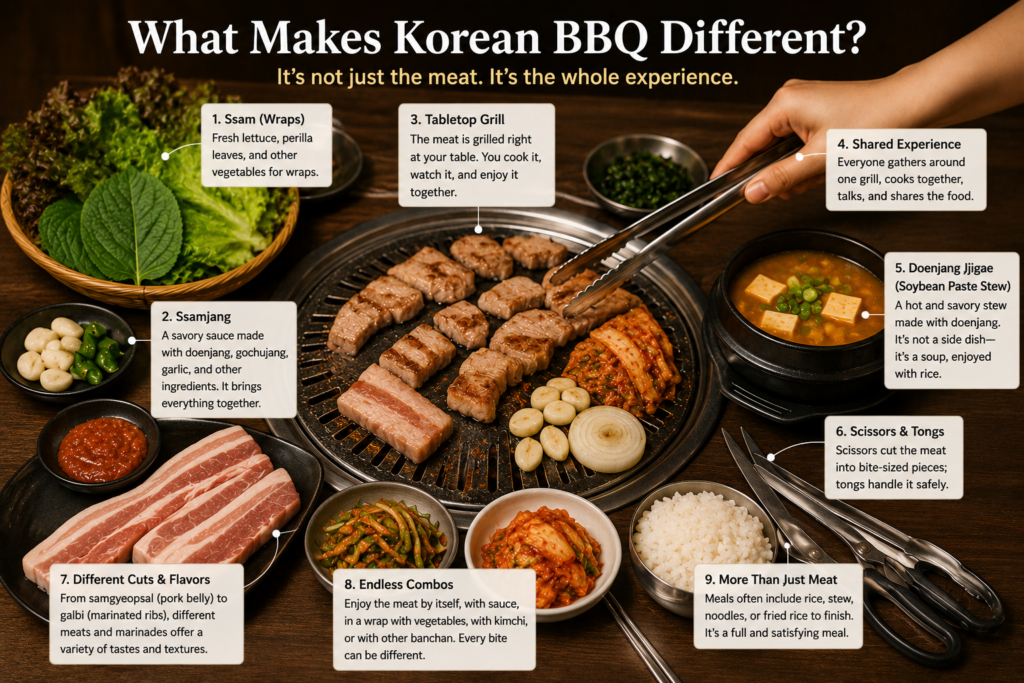
Discover what makes Korean BBQ different, from sharing a tabletop grill to banchan, lettuce wraps, and the personal rhythms of eating together.
A Memory of Waiting Around the Grill
When I think back to meals of samgyeopsal, Korean grilled pork belly, I remember more than the taste of the meat. I picture several people watching the same grill, waiting for the next pieces to be ready.
I prefer my pork thoroughly cooked. When eating with friends or coworkers, I would sometimes wait a little longer while the people around me began picking up pieces they considered ready. By the time I reached for the meat I had been watching, it was sometimes gone.
That felt especially disappointing during my student days, when I did not have much money to spend on eating out. A piece I had been waiting for could end up in someone else’s chopsticks.
Of course, pork needs to be safely cooked before anyone eats it. Even then, people have different preferences for how much longer to grill it and how quickly to eat. When everyone shares the meat on one grill, those small differences become part of the meal.
To understand Korean BBQ, it helps to look at both the meat itself and the way people share it.
Cooking and Eating Happen at the Same Table
At many Korean BBQ restaurants, the meat cooks on a grill in the center of the table. You watch it cook as the meal unfolds.
Someone turns the meat, cuts larger pieces with kitchen scissors, and adds another batch while people eat the pieces that are ready. Tongs and scissors are familiar tools in this process.
At some restaurants, staff handle the grilling from beginning to end. At others, diners cook for themselves. Whoever holds the tongs, the cooking and eating take place together.
This gives the meal a different pace from one where everyone receives a finished plate at the same time. You eat a little banchan, the small side dishes, and talk while waiting, then share the next pieces of freshly grilled meat.
Cooking at the table is not unique to Korea. What helps explain Korean BBQ is the combination of the grill, the surrounding side dishes and leafy vegetables, and the way people eat together.
One Shared Grill, Different Ways of Eating
Sharing a grill does not mean everyone eats in exactly the same way.
Some people take a piece as soon as it is ready, while others prefer to leave it a little longer. One person may eat meat on its own while another makes a leafy wrap as the next batch cooks.
Those differences were behind my memories of waiting longer and sometimes eating less. If each of us had been eating from an individual plate, the pace of the person beside me would not have mattered as much.
That does not mean every Korean BBQ meal is a competition for meat. The experience depends on the people and the occasion. But when the meat comes from one shared grill, what other people do naturally affects your meal too.
Our article on why eating together is important in Korea explores the broader culture of shared meals. At a BBQ restaurant, that connection takes shape around the grill.
Side Dishes Change the Flavor of Each Bite
Alongside the meat, you may find kimchi, seasoned green onions, pickled vegetables, garlic, and ssamjang. The selection varies by restaurant.
These are not a separate course you need to finish before the meat arrives. You can eat a little while waiting and continue enjoying them with the meat throughout the meal.
The same piece of samgyeopsal tastes different with a little salt than it does with seasoned green onions. Kimchi or pickled vegetables add acidity and crunch.
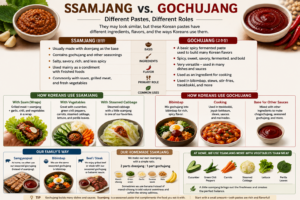
A small amount of ssamjang adds salty, savory depth. You can adjust how much you use with each bite, without coating all the meat in sauce. Our guide to ssamjang explains its ingredients and flavor.
At Korean BBQ, the flavor comes partly from the meat’s seasoning and partly from the combinations each person chooses, one bite at a time.
Ssam Lets You Build Your Own Bite
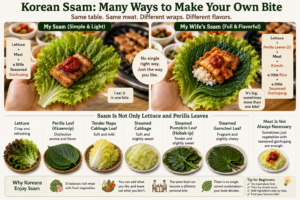
Place a piece of meat and a little ssamjang on lettuce or a perilla leaf, then wrap them together to make ssam. You taste the meat and vegetables in the same bite.
More ingredients do not necessarily make a better wrap. Meat and ssamjang may be enough, or you might add garlic or seasoned green onions. You do not have to wrap every piece of meat, either.
Mild lettuce and the distinctive aroma of perilla leaves bring different flavors to the same meat. Changing the leaf, the amount of sauce, or the accompanying side dishes lets you find combinations you enjoy.
The useful idea here is that each diner puts together their own bite. For the differences between the leaves and a closer look at making wraps, see our guide to Korean ssam with lettuce and perilla leaves.
Korean BBQ Includes Different Meats and Seasonings
Sweet marinated meat may be the first thing that comes to mind when you hear “Korean BBQ.” But grilling meat without a marinade is also common.
Samgyeopsal is a familiar example. After grilling it, you can adjust the flavor with salt, ssamjang, and side dishes.
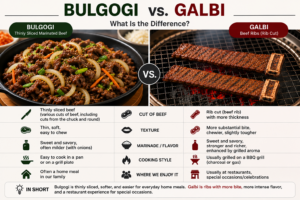
Galbi refers to beef or pork ribs and can be served marinated or unmarinated. Bulgogi usually uses thinly sliced marinated meat, but it is not always cooked on the same kind of grill used for samgyeopsal. Our guide to bulgogi explores this in more detail.
The cuts, seasoning, and cooking methods vary by restaurant and menu. Thinking of Korean BBQ as a single sauce or cooking method can leave out much of the variety you will encounter.
Rice or Cold Noodles Can Change the Course of the Meal
You might have rice and doenjang jjigae, soybean paste stew, while eating the meat. You might order naengmyeon, cold noodles, later in the meal. Some restaurants also offer fried rice to finish.
Rice and stew bring the meat and banchan together into a fuller meal. Cold noodles offer a change in temperature and flavor alongside warm, rich grilled meat.
Not every restaurant serves the same options, and there is no required order. You can also finish after eating the meat.
Even around the same shared grill, the meal takes a different course depending on what you add and when you order it.
You Do Not Need to Memorize Everything Before Your First Visit
Raw meat, tongs, and several side dishes arriving at once can feel unfamiliar. Start by checking whether the staff will cook for you, and ask if you are unsure.
Once the meat is ready, try a piece. Then explore different combinations with the banchan or make a small ssam. There is no need to put every ingredient into your first wrap.
For practical details about serving sizes, minimum orders, grilling, and side-dish refills, see our guide to how to eat Korean BBQ for the first time.
For me, Korean BBQ means going out for good meat and remembering the people who gathered around the grill with me. Perhaps that is why even a piece I waited a little too long to eat has stayed in my memory.