How to Eat Korean Food If You Don’t Like Spicy Food
Learn how to choose milder Korean dishes, ask for less spice, add sauces gradually, and adjust your meal when the food is hotter than expected.
Before Ordering, Ask Whether the Spicy Seasoning Can Be Adjusted
You may want to try Korean food but feel unsure when you see photos of kimchi, tteokbokki, and red stews. Instead of memorizing dish names, it helps to consider when the spicy seasoning goes into the food.
With bibimbap served with gochujang on the side, you can control how much you add. Tteokbokki or stew already cooked in spicy seasoning is harder to adjust once it reaches the table. You can also choose meat or soup prepared without spicy ingredients from the start.
I am Korean, but I do not handle very spicy food well. I ask for haemul-jjim to be made less spicy and add gochujang to bibimbap a little at a time. When you are concerned about heat, the first two questions to ask are “How spicy is it?” and “Can the seasoning be adjusted?”
Distinguish Mild Dishes From Dishes You Season Yourself
Samgyeopsal, or pork belly, and saeng-galbi, or unmarinated beef short ribs, have no spicy seasoning on the meat itself. You can enjoy the grilled meat with a little salt or wrapped in lettuce without adding spicy side dishes. Ssamjang and fresh chilies are optional additions.
Yangnyeom-galbi often uses a sweet and savory soy sauce-based marinade, but the word “marinated” alone does not tell you whether a dish is spicy. Check which seasoning the restaurant uses. My guide to saeng-galbi and yangnyeom-galbi explains what to look for on the menu.
Bibimbap works a little differently. How much control you have depends on whether the gochujang comes separately or is already on the rice. Asking for it on the side when you order saves you from trying to remove it later. Also check whether the namul, or seasoned vegetables, and other toppings already contain spicy seasoning.
| How the Food Is Prepared | What to Check Before Ordering or Eating |
|---|---|
| Meat grilled without spicy seasoning, such as samgyeopsal or saeng-galbi | Check the sauces and side dishes separately. |
| Bibimbap with gochujang you can add yourself | Ask whether the sauce can come on the side and whether the toppings are spicy. |
| Haemul-jjim or stir-fries seasoned after you order | Ask whether the restaurant can reduce the spicy seasoning. |
| Food already cooked in a spicy broth or sauce | Choose another dish if the heat cannot be adjusted. |
A clear soup is not automatically mild. Fresh chilies or spicy seasoning may still be added, so ingredients and preparation tell you more than color alone. I explain why color and heat do not always match in how spicy Korean food really is.
“Less Spicy” and “Not Spicy” Are Different Requests
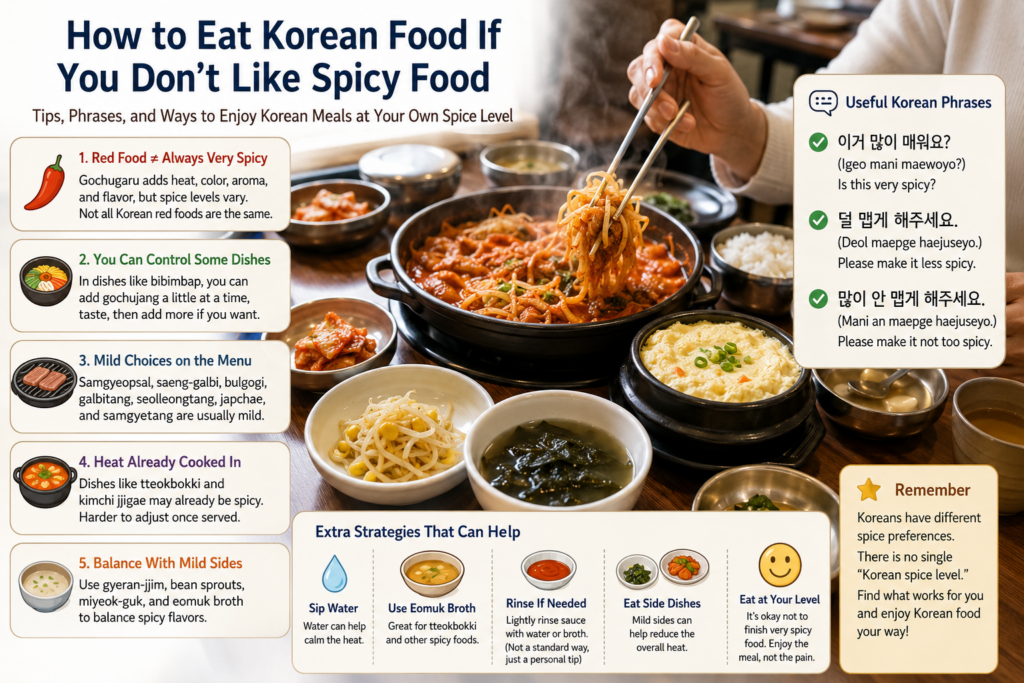
If you enjoy some heat, you can ask, “덜 맵게 해 주세요,” meaning “Please make it less spicy.” If you can barely tolerate spicy food, asking whether there is a dish that is not spicy communicates your needs more clearly.
A restaurant’s idea of “mild” or “a little spicy” may differ from yours. “Less spicy” means reducing the heat compared with the usual preparation; it does not mean removing all the heat.
| What You Want to Ask | Korean Phrase | English Meaning |
|---|---|---|
| Check the heat level | 이거 많이 매워요? | Is this very spicy? |
| Check whether it can be adjusted | 덜 맵게 할 수 있나요? | Can you make it less spicy? |
| Request the sauce separately | 고추장은 따로 주세요. | Please serve the gochujang separately. |
| Ask for a dish without heat | 안 매운 음식이 있나요? | Do you have a dish that is not spicy? |
Restaurants using sauces or broths prepared in advance may have limited room to adjust them. Ask when ordering, rather than after the food arrives. If the dish cannot be changed, look for another option you can comfortably enjoy.
I Add a Little Gochujang to Bibimbap, Taste It, Then Add More
When I eat bibimbap, I do not add a large amount of gochujang at the beginning. I mix in a little, taste it, and add more if I feel it needs it. When the sauce comes separately, you do not have to use the entire portion.
Once you mix it through the rice and vegetables, you cannot take it back out. An unfamiliar gochujang may taste different or be hotter than one you know, which is another reason to start with a small amount.
Gochujang adds sweetness and saltiness as well as heat. Too much can make the seasoning stand out more than the vegetables and other ingredients. My guide to gochujang explains its flavor and uses.
If gochujang is already on your bibimbap, see whether you can remove some before mixing. Removing the visible sauce will not remove spicy seasoning already in the toppings, though. The more you want to avoid heat, the more useful it is to request the sauce separately when ordering.
Haemul-Jjim Can Still Be Spicy for Me After I Ask for Less Heat
I enjoy haemul-jjim, a dish of seafood and bean sprouts in a thick sauce, but I am sensitive to intense heat. I ask for it to be made less spicy when ordering. I sometimes make the same request for haemul-tang, a seafood soup, if I think it may be too hot.
Even after that request, haemul-jjim can be quite spicy for me. If I am sweating and my nose is running, I do not try to eat a lot of the sauce. I focus on the seafood I wanted in the first place and eat fewer of the bean sprouts heavily coated in spicy seasoning.
The bean sprouts in haemul-jjim are different from a separate, mildly seasoned bean sprout side dish. The same ingredient can be spicy when tossed in the seafood dish’s sauce. Look at how it has been seasoned, not just what the ingredient is.
Eating less sauce does not make the seafood itself free of heat. I try a little, and if it is still uncomfortable, I stop. Asking for an adjustment when ordering and being able to finish the dish are two separate things.
I Alternate Spicy Food With Steamed Egg and Mild Side Dishes
A meal featuring something spicy, such as nakji-bokkeum, or spicy stir-fried octopus, may come with gyeran-jjim, mildly seasoned bean sprouts, or miyeok-guk. These are steamed egg, a vegetable side dish, and seaweed soup. What is served varies by restaurant, but when these foods are available, I alternate them with bites of the spicy dish.
The soft texture and relatively mild flavor of gyeran-jjim give me a break. I may also eat some bean sprouts or have a little seaweed soup. In this meal, steamed egg serves as an accompaniment to the spicy main dish.
The reverse can happen too. A relatively mild soup such as seolleongtang or galbitang may come with spicy kimchi and kkakdugi, or cubed radish kimchi. A mild main dish does not mean every side dish will be mild. Taste a little at first and choose the ones that suit you.
These combinations do not remove the heat from the spicy food itself. For me, they change the pace and flavors of the meal instead of leaving me eating the same strong seasoning continuously. My guide to eating Korean banchan explains more about tasting side dishes and pairing them with rice.
When Tteokbokki Is Hotter Than Expected, I Sometimes Remove Some Sauce
There are tteokbokki shops where I can eat comfortably and others where the heat makes it difficult. Having enjoyed a dish before does not guarantee that another version will be equally manageable.
If eomuk broth, or fish cake broth, comes with the tteokbokki, I sometimes have some between bites. When the rice cakes are still too spicy, I have also removed some of the sauce or briefly rinsed them in water or fish cake broth.
This is my own way of handling food that turns out to be too hot for me, rather than a standard Korean way to eat tteokbokki. If you do something similar, use water or broth in your own bowl, not a shared pot.
Removing sauce from the surface does not remove all the seasoning the rice cakes have absorbed. There is no need to expect the broth to eliminate the heat, either. If the food is still difficult to eat after a small adjustment, stop and choose something else.
I No Longer Try to Finish Food That Is Too Spicy for Me
Once, I kept eating nakji-bokkeum even though I knew it was too spicy for me. Afterward, my stomach felt uncomfortable for about a week. Since then, I have paid more attention to how comfortable I feel while eating than to finishing everything in front of me.
A dish someone else enjoys can still be too hot for you. Even if the people you are eating with encourage you to have more, you can say, “It’s a little too spicy for me,” and move on to rice or another dish.
You do not need to endure intense heat to enjoy Korean food. Ask whether the seasoning can be adjusted before ordering, and add sauces gradually when you control the amount. Once the food arrives, see what you can comfortably eat and leave what goes beyond that. The dishes and ordering choices that worked today can help you choose your next meal.