Why Do Koreans Share Food at the Table?
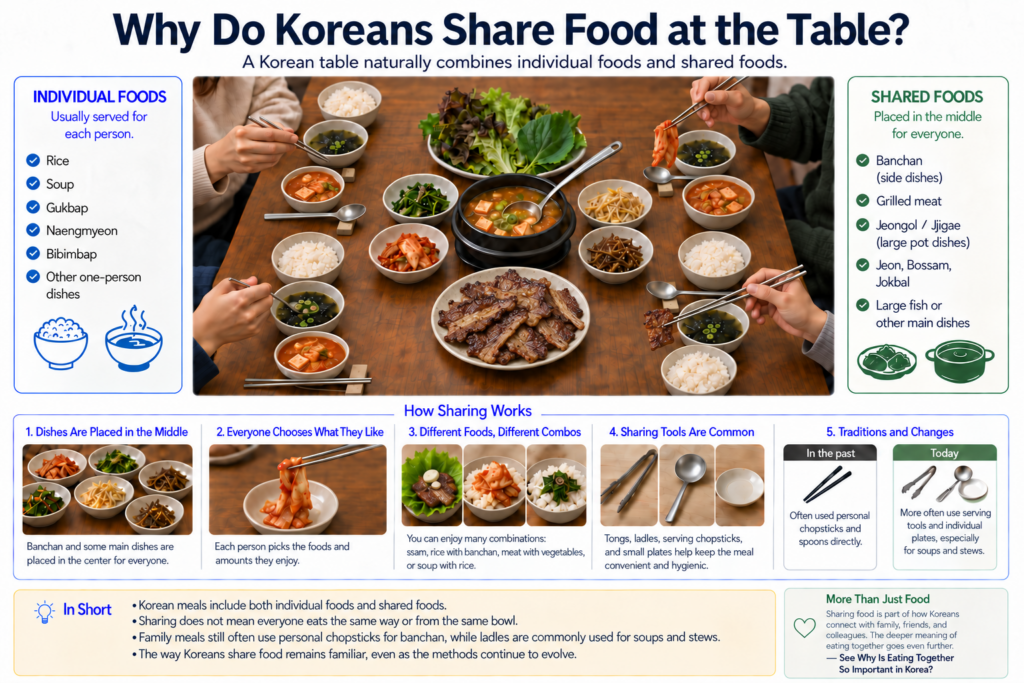
Learn why Koreans share food, which dishes are served individually, and how to use serving utensils and enjoy shared meals at a Korean table.
Individual Rice Bowls and Shared Dishes Sit Side by Side
If two people order a meal at a Korean restaurant and receive two bowls of rice but only one dish of kimchi, it may take a moment to work out what belongs to whom. The rice is usually individual, while the kimchi is often for both people. Meat on a large platter or a pot of jeongol in the center may also be shared.
This arrangement brings individual portions and shared food together. You eat from your own rice bowl, choose from the side dishes between you, and serve yourself some of the main dish from a larger plate.
Sharing food at a Korean table does not mean everyone eats everything from the same bowl. Looking at what your group ordered together and how it is served helps you tell individual portions from shared dishes.
Shared Side Dishes Let Everyone Choose Different Combinations
Placing banchan, or Korean side dishes, in the center means there is no need to divide an identical selection among everyone before the meal. Someone who likes kimchi can have a little more of it, while someone who prefers namul, or seasoned vegetables, can reach for those more often. Each person has their own rice and chooses the side dishes and amounts they enjoy.
I often eat kimchi and vegetable side dishes with meat, and I also enjoy nut-based side dishes when I have rice and stew. Even when the same banchan are on the table, what I reach for changes with the main dish.
Shared banchan are not a course that everyone must eat in equal portions. You choose a little of what you want while leaving enough for the other people at the table. The serving dishes may be shared, but the combination in each person’s next bite can be different.
For more on tasting banchan, pairing them with rice, and asking for refills, see how to eat Korean banchan.
Large Platters and Tabletop Grills Make Sharing Convenient
Foods served on large plates, such as bossam, or boiled pork, and jeon, or savory pancakes, are easy for several people to divide. Once the group agrees on a main dish, everyone can have some while eating their own rice or other food alongside it.
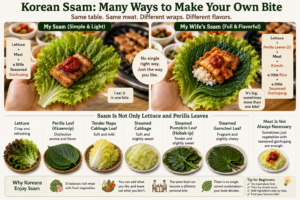
At Korean BBQ restaurants, the meat your group orders is often cooked on one grill. Instead of receiving a separate plate of cooked meat for each serving ordered, everyone shares the meat as it cooks. One person might wrap it in lettuce, while another adds just a little salt.
When I eat Korean BBQ with my family, I like having rice and doenjang jjigae, or soybean paste stew, alongside the meat. We cook the meat together, but each person can decide when to eat rice and which side dishes to pair with it.
A large pot of jeongol, a Korean hot pot, works in a similar way. You serve some of the simmering food into your own bowl and take more when you want it. For details on meat portions and grilling at a restaurant, see how to eat Korean BBQ for the first time.
A Dish’s Name Does Not Tell You Whether It Is Shared
Kimchi jjigae is not always a shared dish. It may arrive in a small earthenware pot for one person or in a larger pot for several people. Food without broth can also be shared when it is ordered on a large platter for the table.
The size and position of a dish offer clues, but how it was ordered matters too. Food in the center is not automatically communal, and a side dish in front of you is not necessarily yours alone. It may simply have been placed where there was room.
| Food on the Table | What to Check |
|---|---|
| Rice and soup served to each person | These are usually individual portions. |
| Bibimbap, naengmyeon, or gukbap ordered separately | Treat these as individual meals and ask before taking a taste. |
| Side dishes set out for several diners | Check the table arrangement to see whether they are shared. |
| A large platter of bossam or jeon, or a large pot of jeongol | If ordered for the group, serve yourself a portion. |
| Jjigae | Check whether it was ordered as an individual meal or a shared dish. |
If you are unsure, ask, “Is this for us to share?” Checking how that restaurant serves the food is more reliable than deciding from the dish’s name alone.
At Our Home, We Share Banchan and Broth Dishes Differently
When my family eats together at home, we sometimes use our own chopsticks to take kimchi or seasoned vegetables from shared dishes. But when a dish with broth is placed in the center, we use a ladle or another serving utensil to transfer it into our own bowls. The way we share food varies even within one meal.
At restaurants, you may see diners taking banchan with their personal chopsticks or using serving tongs and separate serving chopsticks. Practices vary with the restaurant and the people eating together, so neither arrangement should be treated as a rule for every Korean meal.
When serving utensils are provided, use them to transfer food, then eat with your own spoon or chopsticks. You can ask the staff for tongs, a ladle, or a small individual plate if you need one. A dish is still shared even when everyone serves their portion into a separate bowl.
For more on choosing between the two eating utensils, see why Koreans use both a spoon and chopsticks.
Decide What to Share When You Order
Several people ordering different dishes does not automatically make every dish communal. Each person may be ordering their own meal, or the group may be choosing several foods to try together.
For example, if two people order a bibimbap and a naengmyeon, you can ask, “Would you like to share a little of each?” If you agree to share, setting aside portions before you begin eating can make things easier. Check with the other person before reaching into their bowl.
When ordering a large dish together, discuss the amount and spice level as well. What feels pleasantly spicy to one person may be too strong for another. You can choose a main dish everyone is comfortable eating and order any additional food separately.
Sharing lets you taste several dishes, but you do not have to share the entire order. An individual meal plus something for the table is a natural combination too.
Make Room for Other People’s Choices
Place shared dishes where everyone can reach them comfortably. If a side dish is too far away, ask someone nearby to pass it instead of stretching across the table. You can also move a dish in front of you a little closer to someone who wants it.
Take a modest amount at first so others have a chance to try the food too. If only one piece remains, a simple “Would anyone like the last piece?” is a considerate way to check. Portions do not need to be exactly equal, but everyone should have a chance to choose.
Do not return food from your own plate, or anything you have already bitten into, to a shared dish. If you want to offer someone food, ask first and use a serving utensil if they would like some. Sharing something delicious works best when you also consider how much the other person wants to eat.
At a Korean table, sharing food brings individual places and communal dishes together. Keep track of your own rice and personal menu items, and serve yourself what you want from the dishes ordered for everyone. You can share the same food while enjoying different combinations and eating at your own pace.