Your First Korean Restaurant Visit: What to Expect from Start to Finish
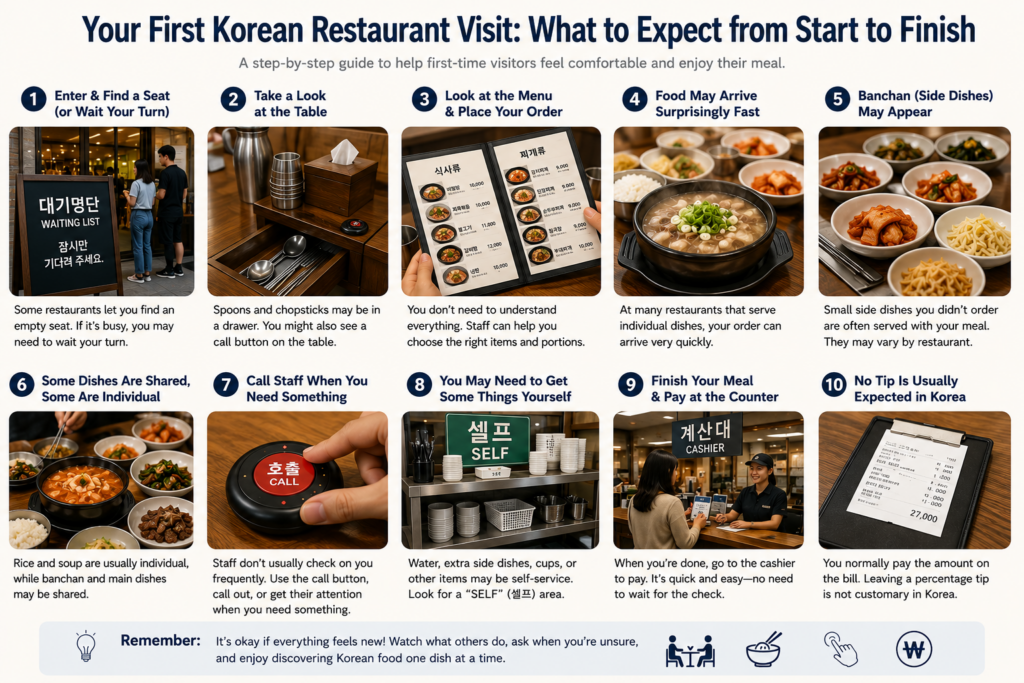
Learn what to expect on your first Korean restaurant visit, from seating and ordering to banchan, self-service, and paying at the cashier.
Start by Looking for the Restaurant’s Instructions
On your first Korean restaurant visit, the unfamiliar part may be how the meal works before you even taste the food. Can you sit at an empty table? Will someone bring water? Should you wait for the bill when you finish?
Restaurants in Korea do not all operate the same way. A gukbap restaurant serving soup with rice has a different rhythm from a Korean BBQ restaurant. Even places serving the same dishes may handle ordering and payment differently. Look for instructions near the entrance and at your table, and ask the staff about anything unclear.
Think of the visit as a simple sequence: find your seat, order and enjoy your food, then pay where the restaurant directs you. This guide walks through situations you may encounter at everyday restaurants in Korea.
Check at the Entrance Before Taking an Empty Table
If a staff member greets you, tell them how many people are in your group and follow them to your table. Some restaurants let customers choose their own seats, but an empty table is not always available. It may still need cleaning or be reserved for other guests.
If you see a waiting list, a ticket machine, or a tablet for joining the queue, read the instructions first. Some restaurants have you stand in line; others ask you to register a name or phone number. If you are unsure, tell the staff your group size and ask where to wait.
When there are no clear instructions and the staff look busy, a simple question such as “There are two of us. Where should we sit?” can help. Once seated, keep your belongings out of the aisle and neighboring seats. At a BBQ restaurant, you can also check for storage under the seat or a separate place for bags.
Look Around the Table for Water and Utensils
If you sit down and no one brings utensils, check for a drawer along the side or underneath the table. Some restaurants keep spoons, chopsticks, and napkins there or in a container on the table. A bare tabletop does not necessarily mean the staff have not started setting up your place.
Water is provided in several ways, too. A staff member may bring a bottle and cups, a water bottle may already be on the table, or you may need to help yourself. If you see 물은 셀프, meaning “water is self-service,” look for a water dispenser or container.
If there is a small call button on the table, use it when you need help. Staff at Korean restaurants may not repeatedly stop by to ask whether you need anything. When you do, press the button or catch a staff member’s attention and say “Jeogiyo” (저기요), meaning “Excuse me.”
The call button is not the same as an ordering screen. If the restaurant has a tablet for selecting dishes, follow its instructions. If orders are taken in person, decide what you would like and then call a staff member.
Check How Much to Order for Your Group
You do not need to understand every item on the menu before ordering. Start with a dish you want to try, then check whether it is an individual meal or something to share. When relevant, ask whether rice is included and whether there is a minimum number of servings for the first order.
Even I sometimes hesitate over small, medium, and large sizes at a restaurant I have never visited. I tell the staff how many people will be eating and ask which size would be suitable. A “medium” can mean different amounts depending on the dish and restaurant, so asking is easier than deciding from the label alone.
For help understanding ingredient names, cooking methods, and the units listed beside prices, see my guide to reading a Korean restaurant menu. If you need help communicating your choice or making a request, see how to order Korean food without speaking Korean.
Your Food May Arrive at Different Times
After you order, side dishes may arrive first, followed by rice, soup, or the main dish. If people at your table order different meals, one person’s food may arrive before another’s. Everything does not have to appear at once for the meal to begin.
You can try a little of the side dishes while waiting. If your food arrives hot, you can say a word to your companions and start eating while it is at its best. There is no fixed course sequence that requires you to finish the side dishes before eating the main dish.
Seolleongtang, a beef bone soup, and gukbap, soup served with rice, may arrive quickly because the broth has already been prepared. Naengmyeon, or cold noodles, can also come out surprisingly fast at some restaurants. That pace may feel ordinary to a Korean diner but unexpected on a first visit.
This does not mean all Korean food arrives immediately. A busy restaurant or a dish that takes longer to prepare may involve a wait. At a BBQ restaurant, the meat still needs cooking after it reaches the table. When food arrives, follow the staff’s guidance about whether it is ready to eat or needs more cooking.
Try a Little Banchan and Share the Communal Dishes
Even I do not know which banchan, or side dishes, will appear when I visit a restaurant for the first time. The selection may change with the season or include something the restaurant makes particularly well. I may recognize the main dish while finding an unfamiliar food on one of the small plates beside it.
When that happens, I taste a little and eat more if I like it. If I am curious about the ingredients, I ask someone at the table or a staff member. Being Korean does not mean recognizing every unfamiliar side dish. You do not have to finish something that does not suit your taste, either.
At many restaurants, each person receives their own rice and individual soup, while the banchan sit in the middle for everyone to share. Main dishes such as jjigae, jeongol, and grilled meat may also be shared. Other restaurants provide individual sets of side dishes, so look at the arrangement rather than assuming that everything in front of you is yours alone.
Use serving tongs or a ladle when provided, and take a little at a time. You can ask for a small personal plate if you need one. For more on tasting side dishes and asking for refills, see how to eat Korean banchan.
Follow the Instructions for Tabletop Cooking and Self-Service
Some dishes involve a little participation after they reach the table. Meat cooks on a grill, jeongol may continue simmering on a tabletop burner, and bibimbap is mixed before eating. If a dish is unfamiliar, ask the staff how to eat it rather than simply copying another table.
At Korean BBQ restaurants, staff may grill the meat for you, or you may cook it yourself. When raw meat arrives, first check who will be doing the grilling. My guide to eating Korean BBQ for the first time covers ordering, grilling, and finishing the meal.
If you need more water or side dishes, look for a self-service area. Some restaurants ask customers to get only their own water; others also provide certain banchan or small plates there. A “self-service” sign does not mean you must handle everything yourself.
Use the utensils provided at the self-service station, follow any instructions, and take only what you need. If you cannot find the side dish you want or are unsure whether there is an extra charge, ask the staff. Food served on a small plate is not automatically available in unlimited free refills.
Check Where to Pay When You Finish
I usually finish my meal, stand up, go to the cashier, pay, and leave. I do not normally wait for someone to bring the bill to my table. Paying at a counter near the exit is a common arrangement at everyday restaurants in Korea.
If an order slip has been left on your table, take it to the cashier. If there is no slip, point out where you were sitting or let the staff confirm your table. Check that the dishes and any extras match your order before paying.
Not every restaurant takes payment after the meal, however. You may order and pay at a kiosk first, pay through the ordering device at your table, or have a staff member handle payment at the table. If you already paid when ordering, you do not need to pay again before leaving.
| What You See or Are Told | What to Do |
|---|---|
| The ordering device asks for payment before your meal. | Follow the screen to complete your order and payment. |
| The restaurant directs you to pay at the counter after eating. | Go to the cashier when you finish. |
| A staff member handles payment at your table. | Check your order and follow their guidance to pay. |
| A designated dish return area is marked. | Return your dishes as instructed before leaving. |
At everyday restaurants in Korea, adding a percentage tip in the way customary in the United States is generally not expected. Pay the amount shown on your bill. If you are visiting a Korean restaurant in another country, follow that country’s payment and tipping customs.
You do not need to know every detail before your first visit. Check where to sit, look for instructions around the table, and ask the staff when you need help. Once you have experienced both the food and the way that restaurant works, your next visit will feel much more familiar.