How to Read a Korean Restaurant Menu
Learn to read Korean restaurant menus through ingredient names, cooking methods, portion sizes, meat weights, and what is included in a meal.
Read the Dish Name and the Details Beside the Price
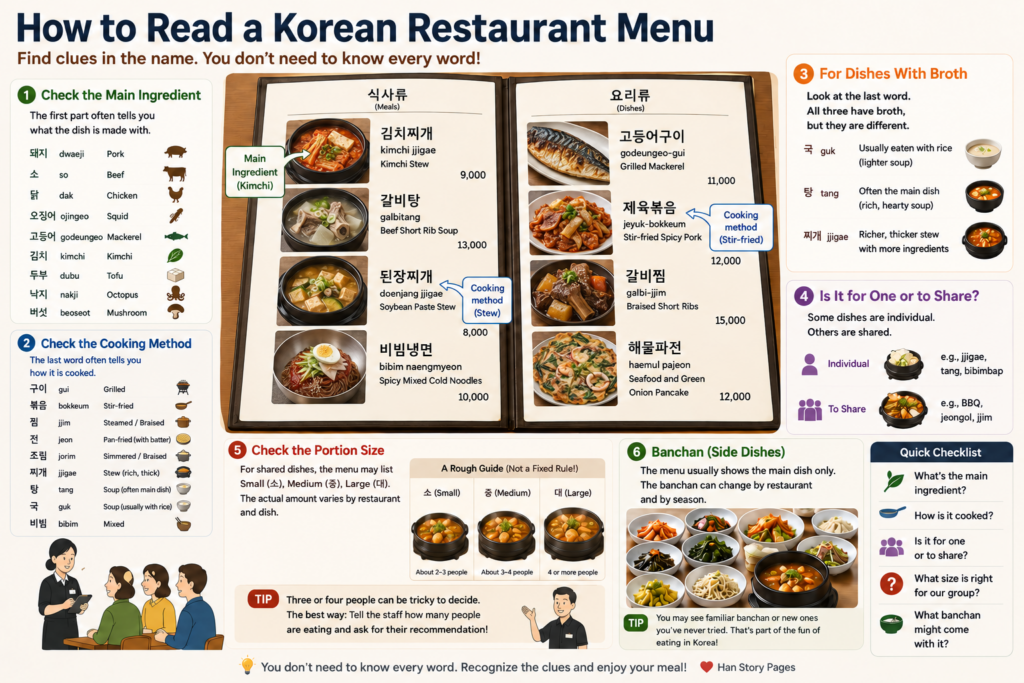
A Korean restaurant menu may present you with unfamiliar names such as kimchi jjigae, galbitang, jeyuk-bokkeum, and godeungeo-gui. Even if they appear in English letters, a romanized name alone may not help you picture the food.
Start by checking what the restaurant specializes in, then look for clues about ingredients and cooking methods. Next, check the serving units, weights, and sizes beside the prices. The key is to understand what the food is made with, how it is prepared, and how much food the listed price covers.
Being Korean does not mean I can work everything out from a menu. At an unfamiliar restaurant, I ask the staff which size suits our group. The main dishes may be familiar to me, while some of the banchan served alongside them are foods I have never seen before.
Start With the Restaurant’s Specialty
At a naengmyeon restaurant, mul-naengmyeon and bibim-naengmyeon may be the main choices. A seolleongtang restaurant may focus on that soup and a few related dishes. A samgyeopsal restaurant may list several pork cuts, while a galbi restaurant may offer saeng galbi alongside yangnyeom galbi. At a hanjeongsik restaurant or a place serving a wider range of Korean food, you may see meals combining rice, soup, and fish or meat.
A short menu is not unusual. A specialty restaurant may list variations of its main dish, portion sizes, and a few accompaniments. Before translating every name, finding out what people usually come there to eat can make choosing easier.
“Saeng galbi” is one example of why context matters. On a menu of ribs for grilling, it means unmarinated ribs, not ribs that you should eat raw. My guide to galbi explains how to choose between saeng galbi and yangnyeom galbi.
Break the Name Into an Ingredient and a Cooking Method
Many Korean dish names follow the pattern “main ingredient + cooking method or dish type.” Godeungeo-gui is grilled mackerel, and ojingeo-bokkeum is squid cooked with seasoning in a pan. Dubu-jorim tells you to expect tofu simmered in a seasoned liquid.
When an English menu gives only romanized Korean names, recognizing these ingredient words can help.
| Korean ingredient word | Romanized forms you may see | Meaning |
|---|---|---|
| 돼지 · 돼지고기 | dwaeji · dwaeji-gogi | Pork |
| 소 · 소고기 | so · sogogi | Beef |
| 닭 | dak | Chicken |
| 오징어 | ojingeo | Squid |
| 낙지 | nakji | Octopus |
| 고등어 | godeungeo | Mackerel |
| 두부 | dubu | Tofu |
| 버섯 | beoseot | Mushroom |
Once you recognize the ingredient, look at the end of the name. Grilled mackerel and mackerel simmered in seasoning offer different eating experiences. Kimchi jjigae, kimchi fried rice, and kimchi-jeon all contain kimchi, but they are very different dishes.
| Cooking term | Romanized form | What to expect | Menu examples |
|---|---|---|---|
| 구이 | gui | Food grilled, roasted, or cooked in a pan | Godeungeo-gui, saengseon-gui |
| 볶음 | bokkeum | Ingredients stir-fried or cooked together in a pan with seasoning | Jeyuk-bokkeum, ojingeo-bokkeum |
| 찜 | jjim | Food steamed or cooked with moisture and seasoning | Gyeran-jjim, galbi-jjim, agwi-jjim |
| 조림 | jorim | Ingredients simmered in seasoned liquid to absorb its flavor | Dubu-jorim, godeungeo-jorim |
| 전 | jeon | Food pan-fried using batter, egg, or similar preparations | Kimchi-jeon, haemul-pajeon |
These terms help you picture a dish, but not every name can be interpreted literally. Gamjatang contains pork backbone as a major ingredient, even though gamja means potato. Dakgalbi is also quite different from simply grilling a chicken’s ribs.
A dish name identifies a main ingredient rather than providing a complete ingredient list. A dish named after tofu or mushrooms may still use other ingredients in its broth or seasoning. If there is something you need to avoid, check separately.
Guk, Tang, Jjigae, and Bibim Tell You About the Dish’s Form
In names such as miyeok-guk, galbitang, and kimchi jjigae, guk, tang, and jjigae indicate dishes containing broth. Guk tends to have a generous amount of broth, while jjigae often places more emphasis on solid ingredients and concentrated seasoning. Some tang dishes, such as galbitang, form the centerpiece of a meal.
Those words alone do not tell you whether the dish is served individually or shared, or exactly how rich the broth will be. When reading a menu, start with the ingredient named before them and any accompanying photo. For a closer comparison, see the differences between guk, tang, and jjigae.
Bibim gives you a clue that ingredients are mixed with seasoning. Bibimbap combines rice with other ingredients, while bibim-naengmyeon involves mixing noodles with sauce. If mul-naengmyeon and bibim-naengmyeon appear together, begin with the distinction between noodles in cold broth and noodles mixed with a sauce.
Read cooking methods and spice levels separately. Bokkeum does not itself mean spicy, and bibim does not tell you how intense the heat will be. Look for chili symbols or descriptions, while remembering that the same dish can vary between restaurants. My article on how spicy Korean food really is explores those differences.
“One Serving” Is an Ordering Unit, and Meat Weight Matters
On a Korean BBQ menu, 1인분, or il-inbun, is a unit for ordering a portion of food. It does not mean that a finished individual plate will arrive for each person. If two people order two servings of samgyeopsal, they will often grill and share the meat together.
Bibimbap, seolleongtang, and sundubu jjigae served in an earthenware pot, on the other hand, are commonly ordered as individual meals. What “one serving” looks like at the table depends on the dish.
For meat, check the weight as well. If the menu says “samgyeopsal, one serving, 180 g,” two servings represent a listed weight of 360 g. This is an example of how to read the notation; actual serving weights vary by restaurant and cut. For cuts with bones, whether the weight includes the bones also affects how you interpret the amount.
Watch for wording such as “2인분 이상 주문,” meaning a minimum order of two servings. Check whether different cuts can be combined to meet that minimum and whether the same condition applies to additional orders.
“공깃밥 별도” means a bowl of rice is ordered and charged separately. Along with the number of servings and weight, checking whether rice or jjigae is included helps you understand the full order.
Small, Medium, and Large Do Not Equal Fixed Numbers of Diners
Shared dishes such as gamjatang, haemul-jjim, and jeongol may be offered as 소·중·대 or 小·中·大. These mean small, medium, and large, but the quantities are not standardized across restaurants.
I sometimes picture a small as roughly enough for two or three people, a medium for three or four, and a large for four or more. But I do not rely on those numbers when ordering. The balance of meat, seafood, vegetables, and broth can make the same size feel very different from one dish to another.
Groups of three or four can be especially confusing for me. With three people, I wonder whether a small will be enough or whether we need a medium. With four, I may hesitate between medium and large. Other dishes we plan to order also affect the decision.
When that happens, I tell the staff how many people are eating and what else we intend to order, then ask which size they suggest. Treat small, medium, and large as relative sizes within that restaurant, and check separately which amount suits your group.
For Jeongsik and Sets, Check What Is Included and How the Price Works
Jeongsik usually describes a meal built around a main dish with rice, soup, banchan, or other accompaniments. Ordering grilled fish by itself and ordering a grilled-fish jeongsik may bring different combinations of food.
A “set” bundles several foods or drinks together. Some sets are for one person, while others are shared, so the word alone does not tell you how many people they serve. Check whether the price is per person or for the entire set, and whether there is a minimum number of diners or portions.
| Menu notation | What to check |
|---|---|
| 1인 · 1인분 | Is the price per person or per portion ordered? |
| 2인 세트 | Is this a set designed for two people, and is the price for the whole set? |
| 2인 이상 주문 | Must you order for at least two people? |
| 공깃밥 별도 | Does rice need to be ordered separately? |
| 사리 추가 | Which extra ingredient, such as noodles or rice cakes, can you add, and at what price? |
| 점심특선 | When is the lunch special available, and what does it include? |
Several of these notes may appear together. For example, “grilled-fish jeongsik, price per person, minimum order for two people” does not mean two diners share one set at the displayed price. You need to order at least two people’s portions, so read the price basis and minimum order together.
Basic banchan may arrive with the meal without being listed individually on the menu. At a restaurant I have not visited before, I rarely know exactly which ones to expect. Some change with the season, and others are specialties of that restaurant, so the side dishes can feel less familiar to me than the main course. Still, a small plate is not automatically an included side dish; distinguish the basic accompaniments from separately ordered items.
Use the Translation and Photo Together, Then Ask About What Is Still Unclear
English terms such as soup, stew, and pancake may not fully convey a Korean dish’s appearance or how it is eaten. Looking at the Korean name, English description, and photo together can help you identify the main ingredients and amount of broth. Check separately which portion size the photo shows and whether the pictured side dishes are included.
When I visit a restaurant abroad where I cannot communicate easily, I search for its menu and food photos beforehand. I choose what I want, save a photo on my phone, and show it when ordering. I find this the easiest approach. When possible, prepare a photo from the restaurant you plan to visit along with the dish’s name.
Once you have chosen your food, the next step is to confirm quantities and any requests with the staff. My guide to ordering Korean food without speaking Korean covers using photos and short expressions to communicate.
Reading a menu does not require memorizing every Korean dish. Recognize the ingredients and cooking method, check how much food the price covers, and ask for information the menu does not provide. For the wider experience of arriving, eating, and paying, see what to expect on your first Korean restaurant visit.