What Do Koreans Really Eat at Home?
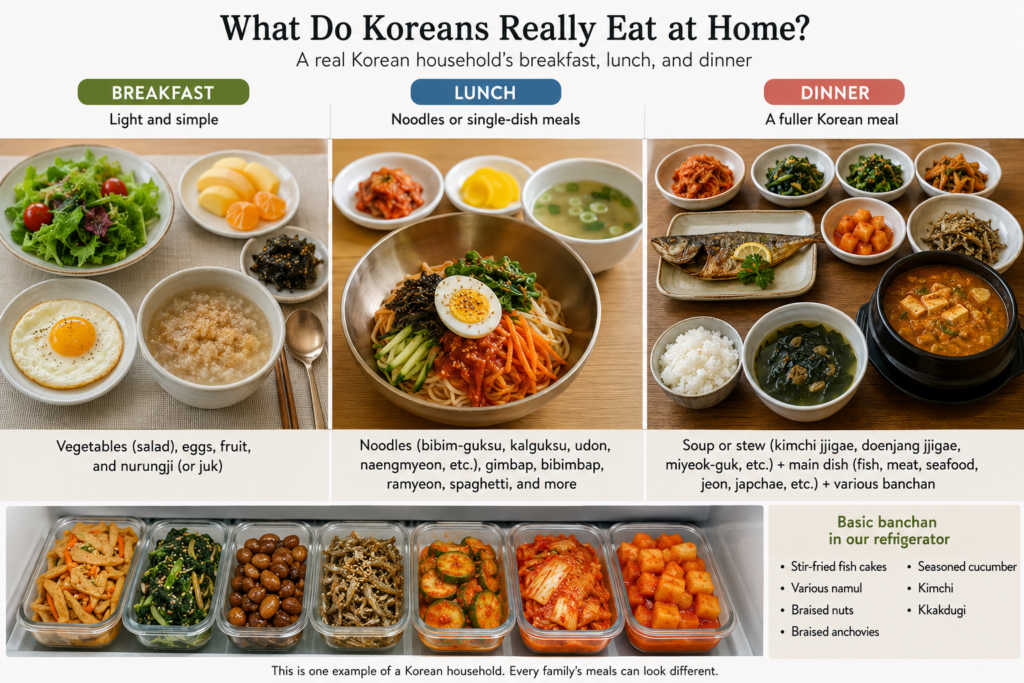
See how one Korean household eats at home, from vegetables and eggs for breakfast to noodle lunches, soup or stew for dinner, and banchan kept in the fridge.
Breakfast, Lunch, and Dinner Look Different in Our Home
Photos of Korean meals often show rice, soup, meat or fish, and several side dishes arranged on one table. That is one way we eat at home, but our three meals do not all look like that. Breakfast usually includes vegetables, eggs, and fruit. For lunch, we often choose noodles or a meal served in one bowl. At dinner, we tend to have soup or stew with fish or meat and some banchan, Korean side dishes, from the refrigerator.
Even when several side dishes appear on our table, we have not necessarily made them all that day. We bring out food we have already prepared and add a soup or main dish for that meal. Some of yesterday’s banchan can taste different alongside a freshly made soup.
This is one example of how our household eats, rather than a standard menu for every Korean family. Even within one home, meals change with the time available and what people feel like eating. Understanding Korean home meals becomes easier when you look at how a meal comes together as well as the names of the dishes.
Breakfast Is Vegetables, Eggs, Fruit, and a Little Porridge or Nurungji
We used to eat rice, soup, and side dishes for breakfast. These days, we tend to have steamed vegetables or salad, eggs, and fruit, with a small serving of juk, Korean rice porridge, or nurungji, scorched rice softened in water. We keep breakfast relatively simple instead of preparing a separate soup, main dish, and several banchan first thing in the morning.
On mornings when we steam vegetables, we might use kabocha squash, broccoli, carrots, or cabbage. The combination changes depending on what is available and what we want to eat. We add a fried egg and fruit, and if we are having porridge, we serve a small amount alongside them. Hobakjuk, or pumpkin porridge, is one of our breakfast options.
This looks different from a Korean breakfast of rice and soup, but it has become familiar to us. We share photos and explain how we put it together in our steamed vegetable breakfast.
Korean households do not all eat the same breakfast. Some have rice and soup; others eat bread. Our own breakfast has changed as we have grown older and our daily routines have shifted.
Lunch Is Often Noodles or a Simple Dish We Feel Like Eating
Lunch is usually more substantial than breakfast, but we tend to keep it simpler than dinner. We especially like noodles, so we alternate among bibim-guksu (spicy mixed noodles), kalguksu (knife-cut noodle soup), buckwheat noodles, udon, naengmyeon (cold noodles), spaghetti, and ramyeon.
When we want something spicy, we might choose bibim-guksu. When we feel like warm broth, kalguksu or udon is a good fit. On hot days, we enjoy naengmyeon or buckwheat noodles. We prepare buckwheat noodles with either a perilla oil dressing or a chilled broth. My wife prefers the perilla oil version, while I prefer cold soba in broth. We explain both in our perilla oil soba and cold soba guide.
On days when we do not eat noodles, we sometimes have gimbap, seaweed rice rolls, or bibimbap, rice mixed with vegetables and other toppings. These meals center on one bowl or plate, so there is less need to bring out several separate side dishes.
Ramyeon is part of our lunch rotation too. When we cook it, we do not also prepare a separate soup and meat dish. Some days we put more time into cooking several foods, while on others we keep things simple. Both belong in an honest picture of what we eat at home.
For Dinner, We Choose a Soup or Stew and a Main Dish
Dinner is the meal in our home that most often follows the familiar Korean pattern of rice and side dishes. We might make kimchi jjigae or doenjang jjigae, a fermented soybean paste stew. On other days, we prepare soup: miyeok-guk with seaweed, doenjang-guk with soybean paste, bugeo-guk with dried pollock, or mu-guk with radish. If these names are unfamiliar, our guide to the differences between guk, tang, and jjigae can help you recognize them.
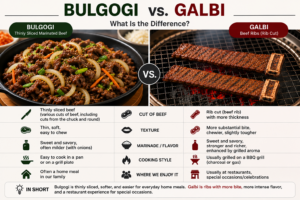
Then we add a main dish we want to eat that evening. Sometimes it is grilled or braised fish. Other times, it is bulgogi or jeyuk-bokkeum, spicy stir-fried pork. When we cook galbi at home, we tend to use a frying pan or air fryer rather than charcoal as a Korean BBQ restaurant might. Boiled beef, seafood dishes, jeon (savory pancakes), and japchae (stir-fried glass noodles) appear on our table too.
We do not serve all of these at once. A soup or stew, one fish or meat dish, and some banchan we already have can make up dinner. For example, if we prepare doenjang jjigae and grilled fish, we might bring out kimchi, seasoned vegetables, and an anchovy side dish from the refrigerator.
Looking at our three meals side by side makes the differences clearer.
| Meal | What we often eat | How we put it together |
|---|---|---|
| Breakfast | Vegetables or salad, eggs, fruit, and a little porridge or nurungji | We follow a simple, familiar routine instead of setting out many side dishes. |
| Lunch | Noodles, gimbap, or bibimbap | We build the meal around one dish we feel like eating. |
| Dinner | Rice, soup or stew, a main dish such as fish or meat, and banchan | We combine freshly cooked food with side dishes from the refrigerator. |
We do not follow this table exactly every day, but it describes the general pattern in our home.
Banchan in the Refrigerator Carries Over to the Next Meal
Our refrigerator often holds kimchi and kkakdugi, cubed radish kimchi, along with foods such as stir-fried fish cakes, namul (seasoned vegetables), side dishes made with nuts or anchovies, and seasoned cucumber. We do not keep every kind on hand all the time, but having some banchan ready means fewer dishes to cook for the next meal.
We might eat namul with doenjang jjigae and grilled fish one evening, then serve the same namul with a different soup and a meat dish at another meal. Kimchi and kkakdugi also appear across several meals. Some parts of the table stay the same while the soup or main dish changes.
That is why the number of small plates does not tell you how long someone spent cooking that day. Several dishes may have been prepared earlier, leaving only the soup and main dish to make. Our guide to different types of Korean banchan explains how to recognize side dishes by their ingredients and preparation.
A home meal can come together by adding what you need to food you already have. Checking the refrigerator helps us decide what else to prepare for that day’s meal.
Eating Alone and Eating With Family Can Mean Different Meals
When eating alone, a meal in one bowl can be convenient. Reheating something already prepared or cooking noodles means fewer dishes to set out. When a family eats dinner together, they might add a main dish to a soup or stew and put out several banchan to share.
Eating at home does not mean making every item yourself, either. Some households include food from a banchan shop or supermarket, use convenient prepared products, or order delivery. The time available and the people at the table can change those choices.
There is no need to decide which of these counts as a “real” Korean home meal. Just as our own breakfast, lunch, and dinner differ, other households have routines that fit their lives. Family size, work schedules, and how much people enjoy cooking can all shape what appears on the table.
Korean Home Meals Do Not Always Consist of Korean Food
Udon and spaghetti are regular lunch options in our home, so traditional Korean food is only part of what we eat. My wife makes pasta and curry as well as Korean dishes. Sometimes she also adds ingredients or seasonings that suit our tastes to a dish from another cuisine.
We might eat doenjang jjigae and fish for dinner one day, then spaghetti for lunch the next. Those meals fit naturally into the same household’s routine. This is easy to miss if your picture of Korean food comes mainly from famous meat dishes or tables filled with banchan.
For a closer look at what we actually cook, visit Our Korean Home Kitchen. There, we share photos of dishes my wife has made, along with the ingredients, preparation, and how we enjoyed them.
When I think about how to explain our home meals, I picture an ordinary evening: taking banchan out of the refrigerator and adding that day’s soup or main dish. We may have eaten vegetables and eggs in the morning and noodles at lunch, but by dinner, rice and side dishes are on the table. Understanding what Koreans eat at home means looking at how foods fit together in everyday life, as well as learning the names of individual dishes.