
Perilla Oil Soba Noodles: Two Ways We Enjoy Buckwheat Noodles at Home
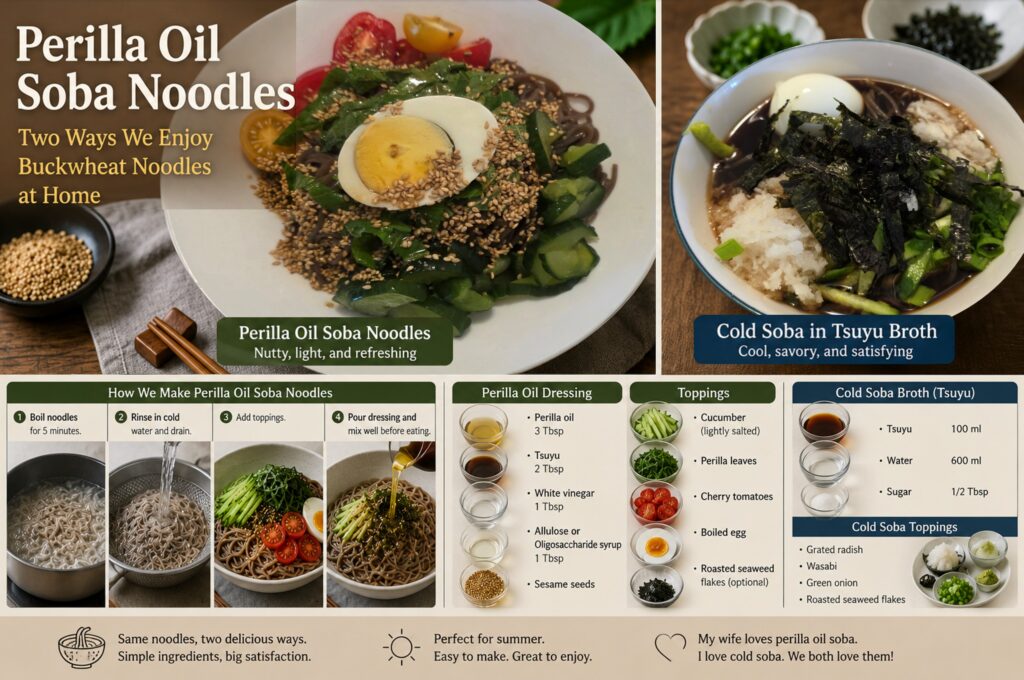
See how we make perilla oil soba noodles and cold soba at home, with simple toppings, homemade seasonings, and two refreshing ways to enjoy buckwheat noodles.
Noodles Often Show Up on Our Lunch Table
We eat noodles quite often for lunch at home.
For breakfast, we tend to keep things relatively simple with vegetables, eggs, fruit, and sometimes a little porridge or nurungji. At lunchtime, however, we often choose whatever kind of noodles we feel like eating that day.
There is quite a variety.
Sometimes we make Korean-style bibim-guksu or kongguksu. Other days, it might be bibim-naengmyeon, mul-naengmyeon, jjajangmyeon, or ramyeon. We also enjoy Japanese udon, as well as Italian pasta dishes such as seafood spaghetti and vongole pasta.
Part of the reason is simple: we like noodles.
They are also convenient to prepare for lunch and can become a satisfying meal without requiring a complicated cooking process.
One noodle we especially enjoy during warmer weather is buckwheat noodles.
At home, we usually prepare the same type of noodles in two different ways.
One is perilla oil soba noodles, with the nutty aroma of perilla oil and a simple dressing. The other is cold soba, served in a chilled tsuyu-based broth.
My wife and I enjoy both, although we have slightly different preferences.
She prefers perilla oil soba, while I prefer cold soba.
So which one we make often depends simply on what we feel like eating that day.
The Soba Noodles We Use
We usually buy Japanese-style soba noodles at a Korean grocery store.
Sometimes we use Korean buckwheat noodles instead, so we do not necessarily use Japanese soba every time.
The soba we often buy comes packaged in individual bundles. We usually cook one bundle per person.
Our preparation is very simple.
We boil the noodles for about five minutes and then rinse them thoroughly under cold water.
Because we are serving the noodles cold rather than hot, rinsing and cooling them after cooking is an important part of the preparation.
Once the noodles are ready, we add several simple toppings and pour the perilla oil dressing over everything just before eating.
Our Simple Perilla Oil Dressing
The main flavor of this dish comes, of course, from perilla oil.
For the dressing, we usually combine:
- 3 tablespoons perilla oil
- 2 tablespoons tsuyu
- 1 tablespoon white vinegar
- 1 tablespoon allulose or oligosaccharide syrup
- Sesame seeds
We mix these ingredients together and add the dressing after the noodles and toppings have been prepared.
Perilla oil gives the noodles their distinctive nutty aroma, while tsuyu adds a savory and slightly salty flavor. White vinegar provides a little acidity, and allulose or oligosaccharide syrup balances everything with some sweetness.
The flavor is not particularly strong or spicy.
That is one of the things we like about it.
The rich aroma of perilla oil goes especially well with the mild, earthy character of buckwheat noodles. Because the seasoning is relatively simple, we can still enjoy the flavors of the individual ingredients.
Cucumber, Perilla Leaves, Tomatoes, and Egg on Top
We add several simple toppings to our perilla oil soba noodles.
For the bowl shown in our photo, we used lightly salted cucumber, sliced perilla leaves, cherry tomatoes, and a boiled egg.
We sometimes add roasted seaweed flakes as well, although there are none in the photo.
Our usual toppings include:
- Lightly salted cucumber
- Perilla leaves
- Cherry tomatoes
- Boiled egg
- Roasted seaweed flakes, optional
There is no need to have every topping available.
This is a meal we make at home, so we can easily change the toppings depending on what we have in the refrigerator.
Once everything is arranged over the noodles, we pour the dressing on top and mix it together before eating.
The cucumber adds freshness and crunch, the perilla leaves add their distinctive herbal aroma, and the egg makes the meal a little more substantial.
Together with the nutty perilla oil and mild buckwheat noodles, these simple ingredients make a satisfying bowl without a complicated cooking process.
We Started Making It After Eating It at a Restaurant in Korea
Perilla oil buckwheat noodles were not something we originally came up with ourselves.
We first ate this type of noodle dish at a restaurant in Korea and enjoyed it enough that we began making our own version at home.
Buckwheat noodles are particularly familiar in Gangwon Province, a mountainous region of Korea where you can find many restaurants serving different kinds of buckwheat dishes.
Rather than trying to reproduce a restaurant dish exactly, we gradually adapted it to the ingredients we keep at home and the flavors we prefer.
We made it this way while living in Korea, and we continue to make it in much the same way in the United States.
That is possible because the ingredients are relatively easy to find at Korean grocery stores here.
Buckwheat noodles, tsuyu, perilla oil, and fresh perilla leaves are all ingredients we can buy without too much difficulty.
Being able to continue making foods we enjoyed in Korea, without having to change them very much, is one of the conveniences of having Korean grocery stores nearby.
We Also Make Cold Soba with the Same Noodles
Perilla oil soba is not the only way we eat these buckwheat noodles.
We also use the same noodles to make cold soba in a tsuyu-based broth.
Although the noodles can be exactly the same, the two dishes taste quite different.
Perilla oil soba is all about the rich, nutty aroma of the oil. Cold soba, on the other hand, has the clean, savory flavor of a chilled soy-based broth.
That means we can use the same package of noodles to make two very different lunches.
For cold soba, we again boil the noodles for about five minutes and rinse them thoroughly in cold water.
Our basic broth uses:
- 100 ml tsuyu
- 600 ml water
- 1/2 tablespoon sugar
This gives us a basic ratio of about one part tsuyu to six parts water.
However, tsuyu products vary considerably in concentration.
The 1:6 ratio works with the product we use, but it should not be treated as a fixed rule for every brand. It is better to check the concentration of your tsuyu and adjust the amount of water to taste.
Grated Radish and Wasabi for Our Cold Soba
The toppings and seasonings we use for cold soba are different from those for our perilla oil noodles.
We usually add:
- 1 tablespoon grated radish
- A small amount of wasabi
- Chopped green onion
- Roasted seaweed flakes
Unlike our perilla oil soba, we do not add sesame seeds to the cold soba.
There are different ways to eat cold soba.
At some restaurants, the noodles and dipping sauce are served separately, and the noodles are dipped into the sauce a little at a time.
At home, we prefer to put the noodles completely into the cold broth and eat them that way.
Ice can also be added to make the broth even colder.
We sometimes add some, but we generally do not like our food extremely cold, so we do not use much ice.
This version tastes very different from the perilla oil noodles.
One has the rich, nutty character of oil, while the other has the refreshing, savory character of a cold soy-based broth.
That difference is exactly why we enjoy making both.
My Wife Prefers Perilla Oil Soba, While I Prefer Cold Soba
My wife and I both like these two ways of eating buckwheat noodles, but our preferences are slightly different.
If she had to choose, my wife would pick the perilla oil soba.
I would probably choose the cold soba.
Fortunately, there is no need for us to decide which one is better.
Some days, the nutty aroma of perilla oil sounds particularly appealing. On another day, I may want noodles in a cool, refreshing broth.
So we simply decide according to our mood.
We especially enjoy both dishes during the warmer months.
In Korea, buckwheat has traditionally been thought of as a “cooling” food, which may be one reason buckwheat noodles have long felt especially appropriate during summer.
For us, there is also a very practical reason.
The noodles cook quickly, and after rinsing them in cold water, we can serve them with fresh toppings or a chilled broth without spending a long time preparing a hot meal.
Why We Often Eat Noodles for Lunch
There is no complicated reason noodles appear so often on our lunch table.
We enjoy them, and they are convenient.
But eating noodles frequently does not mean eating the same thing every day.
Our lunches might include bibim-guksu, kongguksu, bibim-naengmyeon, mul-naengmyeon, udon, ramyeon, or jjajangmyeon.
Sometimes we move away from Korean and Japanese noodles altogether and make seafood spaghetti or vongole pasta.
On other days, lunch might be something completely different, such as the Japanese-style curry rice we also make at home.
We do not really organize our meals according to whether a dish is Korean, Japanese, Italian, or something else.
We simply choose something we enjoy and that works well for the day.
Perilla oil soba and cold soba are part of that rotation.
They are easy to prepare, satisfying to eat, and particularly enjoyable when the weather is warm.
The Buckwheat Noodles We Ate in Korea Are Still Part of Our Home Kitchen in America
The foods we share in Our Korean Home Kitchen are not necessarily limited to traditional Korean dishes.
The noodles in this meal may be Japanese-style soba, and tsuyu is a Japanese-style seasoning.
But buckwheat noodles prepared in these ways are also familiar foods in Korea, and they became part of what we ate while living there.
Now we buy the ingredients from Korean grocery stores in the United States and continue making them much the same way at home.
My wife prefers her buckwheat noodles mixed with fragrant perilla oil.
I prefer mine in a cool tsuyu broth.
Different preferences, but they both begin with the same bundle of buckwheat noodles.
On one day, we might mix those noodles with perilla oil, cucumber, perilla leaves, tomatoes, and egg.
On another, we might put them into a cold broth with grated radish, wasabi, green onion, and seaweed.
For us, choosing between the two is one of the small pleasures of a simple lunch at home.
And on a hot summer day, either one can be exactly what we feel like eating.

Comments 0
Be the first to leave a comment.