
Jat-guksu: Korean Pine Nut Noodles Inspired by Kongguksu
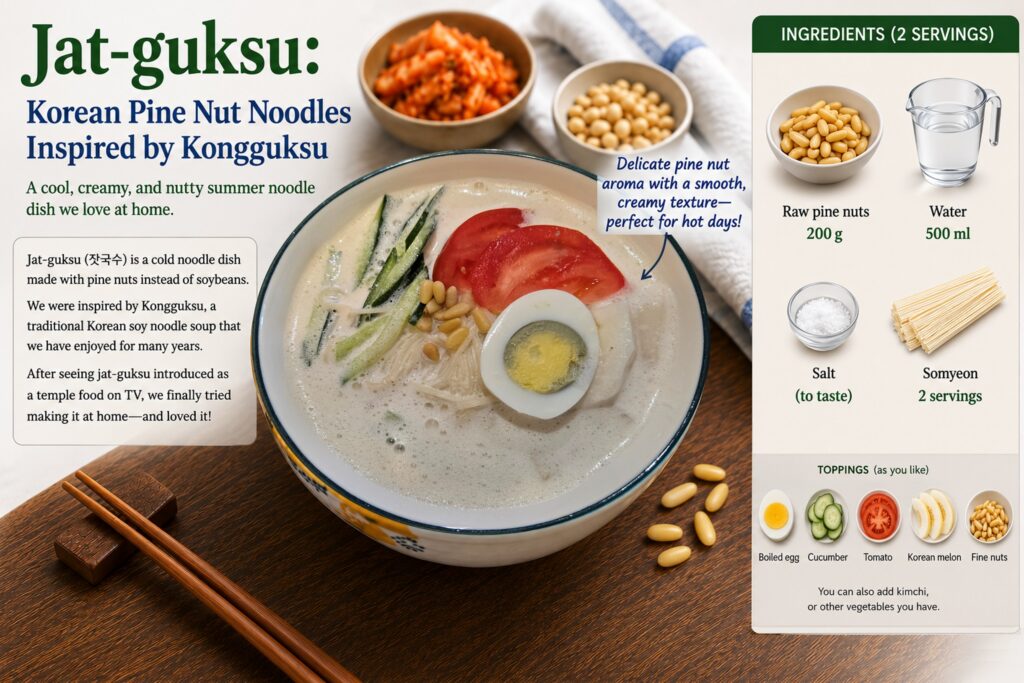
See how we make jat-guksu with pine nuts, water, and somyeon, inspired by Korean kongguksu and one of our favorite cold noodle meals for summer.
A New Idea That Started with a Familiar Korean Summer Noodle Dish
Kongguksu, Korean noodles served in a cold soybean broth, has been one of our favorite summer meals for many years.
We often made it when we lived in Korea, and we still make it the same way after moving to the United States.
During the hotter months in Korea, we might have kongguksu about once every ten days. Sometimes we made it at home, and sometimes we ate it at a restaurant.
It is cool, simple, and filling enough to make a complete lunch.
This time, however, we tried something different.
Instead of making the broth with soybeans, we made it with pine nuts.
I had once seen jat-guksu, or pine nut noodles, introduced on a Korean television program as a temple-style dish. The idea stayed with me, and I thought it would be interesting to try making it ourselves someday.
This was our first attempt.
The result was surprisingly good.
It was similar enough to kongguksu to feel familiar, but the distinctive aroma of pine nuts gave the broth an entirely different character.
Making the Pine Nut Broth Is Surprisingly Simple
We made enough broth for about two servings.
Our basic ingredients were:
- 200 g raw pine nuts
- 500 ml water
- A small amount of salt, added to taste
We bought the pine nuts at Costco.
Unlike soybeans, the raw pine nuts require almost no preparation. There is no need to soak or boil them first.
We simply put the pine nuts and water into a blender and blend them until smooth.
You could leave a little texture if you prefer, but we like a smoother broth, so we blended ours quite finely.
Pine nuts can also be lightly toasted beforehand for an even nuttier flavor. Because this was our first time making jat-guksu, however, we decided to use them raw.
We wanted to taste the natural flavor and aroma of the pine nuts themselves.
We Use Only Water to Preserve the Pine Nut Flavor
When making kongguksu, some people add milk while blending the soybeans to create a richer broth.
For our jat-guksu, we deliberately kept things simpler.
We used only pine nuts and water.
We did not add milk because we wanted the aroma of the pine nuts to remain the main flavor of the broth.
The finished broth can be used immediately.
If you prefer your noodles very cold, you can also add some ice before serving.
We keep the seasoning simple as well. Rather than heavily seasoning the broth beforehand, we add a little salt to taste when we eat it.
There is no complicated sauce or seasoning mixture.
The pine nuts themselves provide the rich, nutty flavor.
We Serve It with Korean Somyeon
For the noodles, we use somyeon, thin Korean wheat noodles.
We cook the noodles in boiling water for about one minute and then immediately rinse them thoroughly in cold water.
Rinsing cools the noodles quickly and also helps remove excess starch from the surface.
After draining them well, we place the noodles in a bowl and pour the freshly blended pine nut broth over them.
The process is very similar to the way we prepare kongguksu.
The major difference is simply what goes into the broth.
Instead of soybeans, we use pine nuts.
Our Toppings Change Depending on What We Have
For the jat-guksu shown in our photo, we added boiled egg, cucumber, tomato, and Korean melon.
We do not always use exactly the same toppings.
This is a home lunch, so we usually work with whatever suitable vegetables and fruit happen to be in the refrigerator.
Cucumber works especially well because of its fresh, crisp texture.
For this bowl, we used:
- Boiled egg
- Cucumber
- Tomato
- Korean melon
- Fine nuts
We use similar toppings when making kongguksu.
That made our first attempt at jat-guksu feel quite familiar. We were essentially preparing a bowl of noodles much like our usual kongguksu, but replacing the soybean broth with a pine nut broth.
Our First Taste of Homemade Jat-guksu
Naturally, the part we were most curious about was the taste.
Visually, jat-guksu and kongguksu can look quite similar.
We also did not notice a major difference in the overall thickness or texture of the two broths.
But the aroma was clearly different.
The pine nuts gave the broth a delicate, elegant nuttiness that we both enjoyed very much.
Kongguksu has the mild, savory nuttiness of soybeans. Jat-guksu has a different fragrance that comes specifically from pine nuts.
For us, using only water with the pine nuts turned out to be a good decision.
There were no other strong ingredients competing with their natural aroma.
Even though this was our first time making jat-guksu, we were both very satisfied with the result.
Pine nuts are considerably more expensive than soybeans, so this probably will not replace kongguksu as one of our regular summer meals.
But it is definitely something we would like to make again.
Jat-guksu and Kongguksu Have a Lot in Common
If you have never tried jat-guksu, one easy way to understand it is to compare it with Korean kongguksu.
The basic structure of the two dishes is very similar.
When we make kongguksu from scratch, we cook soybeans and blend them with water to make the soybean broth.
Sometimes, when we want a more convenient option, we simply buy prepared soybean broth instead.
We then cook somyeon, rinse the noodles in cold water, place them in a bowl, and pour the cold soybean broth over them.
Jat-guksu follows essentially the same idea.
The noodles can be the same.
The toppings can be the same.
Even the thickness of the broth can be quite similar.
The biggest difference is the ingredient used to make the broth and the flavor that comes from it.
Kongguksu has the familiar mild nuttiness of soybeans, while jat-guksu has the distinctive aroma of pine nuts.
We enjoy both.
We Season Our Kongguksu with Salt, Not Sugar
There are different personal preferences in Korea when it comes to seasoning kongguksu.
In our home, we do not add sugar.
We have always preferred to season kongguksu with a little salt, and we treated our jat-guksu the same way.
Rather than making the broth strongly seasoned, we add a small amount of salt when we are ready to eat and adjust it to our own taste.
For jat-guksu in particular, we liked keeping the seasoning minimal.
The simpler the seasoning, the easier it was to appreciate the natural pine nut aroma.
Kongguksu Has Long Been One of Our Summer Foods
For us, kongguksu is a familiar Korean summer meal.
We ate it regularly when we lived in Korea, both at home and at restaurants.
One reason we enjoy it in summer is simply that it can be served cold.
On a hot day, a bowl of cool noodles in a creamy soybean broth can make a very satisfying lunch.
We continue making kongguksu in the United States because the ingredients are still easy for us to find.
Our first bowl of jat-guksu naturally became a summer lunch as well.
Noodles are a regular part of what we really eat at home, especially for simple lunches.
And, as with many noodle dishes we eat at home, kimchi makes a very good side dish.
A bite of flavorful kimchi between spoonfuls of the mild, cool broth gives the meal a contrast we enjoy.
One bowl is enough for us to consider it a complete lunch.
On other summer days, we might choose perilla oil soba or cold soba instead.
Replacing Soybeans with Pine Nuts Changed a Familiar Dish
There was no complicated reason behind our first attempt at jat-guksu.
We already liked kongguksu.
Then I saw a television program introducing a similar noodle dish made with pine nuts and thought it would be interesting to try it ourselves.
For two servings, we blended 200 grams of raw pine nuts with 500 milliliters of water.
We poured the smooth broth over somyeon that had been cooked and rinsed in cold water, then added whatever suitable toppings we had in the refrigerator.
The process was simple.
But changing one main ingredient—from soybeans to pine nuts—gave the familiar style of noodle dish a noticeably different aroma and flavor.
Pine nuts themselves are not an unfamiliar ingredient to us.
We have also enjoyed them in jat-juk, Korean pine nut porridge.
This time, using them as the base for a cold noodle broth gave us another way to enjoy an ingredient we already knew.
A Summer Noodle Dish We Would Make Again
This bowl of jat-guksu was a small experiment in our kitchen.
We started with kongguksu, a summer noodle dish we have enjoyed since we lived in Korea.
Then, after seeing pine nut noodles introduced on television, we decided to replace the familiar soybean broth with a pine nut broth.
It was our first attempt, but the process was easy and the result was delicious.
The bowl still had the cool, smooth character we enjoy in kongguksu, but the pine nuts added their own delicate and elegant aroma.
Because pine nuts are more expensive than soybeans, we probably will not make jat-guksu as frequently as kongguksu.
But when we want something a little different for a summer lunch, we would happily make it again.
For us, home cooking does not always mean preparing the same familiar food in exactly the same way.
Sometimes we take something we already enjoy, change one ingredient, and discover another dish worth adding to our home table.
That is exactly what happened with this jat-guksu.


Comments 0
Be the first to leave a comment.