Why Do Koreans Eat Kimchi With Almost Every Meal?
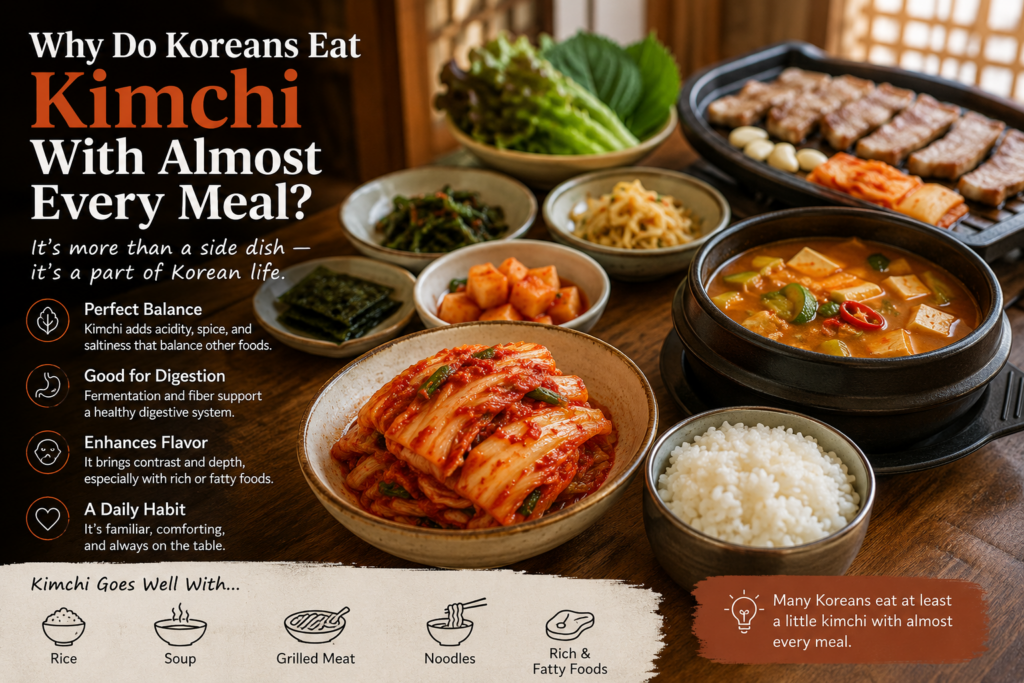
Why do Koreans eat kimchi so often? Explore its role with rice, soup, and meat, plus the everyday habits and personal preferences behind the pairing.
I Eat Kimchi Often, but Only a Little at a Time
I usually have kimchi when I eat a Korean-style meal. That does not mean I eat a large amount. A few pieces throughout the meal are often enough for me. Having kimchi on the table frequently and eating a lot of it at once are two different things.
What I am eating also changes how often I reach for it. With fatty grilled meat such as samgyeopsal, I eat more kimchi than usual. With seolleongtang or gomtang, eating without kimchi feels almost strange to me.
For me, kimchi is a familiar flavor I enjoy a little at a time between bites of other foods. Its place within the meal helps explain why it appears so often on Korean tables.
Kimchi Plays a Different Role with Rice, Soup, and Meat
Plain white rice has a relatively mild flavor. A piece of kimchi adds saltiness, seasoning, and a degree of tanginess that depends on how far it has fermented. A flavor that seems strong when you eat kimchi alone can feel quite different alongside rice.
I notice this especially with seolleongtang and gomtang, Korean beef soups. I eat some warm soup and rice, take a bite of kimchi, and return to the soup. I am so accustomed to this combination that the meal feels as though something is missing without it.
With rich meat, the experience is different again. After several pieces of pork, a bite of kimchi changes the taste in my mouth and makes the next piece more enjoyable. This is a contrast in flavor and texture, not a claim that kimchi removes the fat from the meal.
| Food eaten with kimchi | What kimchi adds to the experience |
|---|---|
| Plain rice | Saltiness and seasoning alongside the mild flavor of rice. |
| Seolleongtang or gomtang | Crunch and a more pronounced flavor between bites of rice and mild soup. |
| Grilled meat such as samgyeopsal | Tanginess and vegetable texture alongside the richness of the meat. |
| Kalguksu or sujebi | A different bite alongside soft noodles or hand-torn dough. |
At samgyeopsal restaurants, kimchi may be eaten as it is or cooked on the grill. I discuss those combinations in more detail in our guide to samgyeopsal.
Kimchi Is Not Just for Meals with Rice
For me, eating kimchi with ramyeon or kalguksu is an everyday combination. I do not give the pairing much thought; the foods simply go together in my usual meals. Kimchi is also a familiar accompaniment to sujebi in Korea. A crisp bite of kimchi offers a different texture after soft noodles or pieces of dough.
That does not mean every noodle dish needs the same kimchi, or that kimchi is compulsory. The seasoning of the broth and the ripeness of the kimchi change the combination. If the food is already strongly seasoned, you may only want a little kimchi alongside it.
If you are trying kimchi for the first time, try a small piece between bites of rice or another dish rather than taking a large mouthful on its own. It may taste different as part of a meal than it does when you judge it by itself.
People at the Same Table May Prefer Different Kimchi
Kimchi appearing frequently does not mean everyone likes the same kind. I prefer kimchi that has not fermented very far, while my wife enjoys a more fermented flavor. We also make baek kimchi, or white kimchi, fairly often at home, and she likes it much more than I do. I think its lightly sour taste is part of what she enjoys.
There are many preferences within the simple statement “I like kimchi.” Some people enjoy a fresh, crisp bite; others prefer the sourness that develops as it ferments. Even the same batch of napa cabbage kimchi can appeal differently depending on when you eat it.
If your first taste did not suit you, there is no need to assume all kimchi will taste the same. The variety and stage of fermentation may both have played a part. Our beginner’s guide to kimchi explains those differences in more detail.
These variations help explain why a table that frequently includes kimchi does not necessarily offer exactly the same flavor every day.
It Is Easy to Serve a Small Portion
There is a practical reason kimchi appears so often, too. If you already have homemade or purchased kimchi, you can take out enough for the meal. It does not require cooking a new side dish each time.
We both make kimchi and buy it. Here in the United States, we keep it in a regular refrigerator and make or purchase smaller quantities as we go.
Even when there are only a few other side dishes, kimchi is easy to place beside rice and soup. A Korean table with several banchan does not mean every dish has been made from scratch for that meal. Kimchi fits naturally into this everyday way of putting food on the table.
It can also become a cooking ingredient. Well-fermented, sour kimchi can be used in stew, fried rice, or savory pancakes, taking on a different role from the small side dish served with rice. Our guide to kimchi jjigae explores one of those uses.
I Notice Its Familiarity Most When It Is Missing
The moments when I really crave kimchi are not limited to being abroad. It happens when I eat tonkotsu ramen with a rich, fatty broth at a Japanese restaurant, or spaghetti in a rich cream sauce at an Italian restaurant. The lingering richness of the food matters more than where I happen to be eating it.
Although I normally eat only a few pieces of kimchi, during meals like these I find myself really wanting a bite in between. A flavor I barely think about when it is always on the table becomes much more noticeable when it is unavailable. That is how familiar kimchi has become to me.
Still, not every Korean eats kimchi at breakfast, lunch, and dinner. Preferences differ, and so do the meals people eat. There is no rule that you must take kimchi out of the refrigerator whenever you have bread or a salad.
“Koreans eat kimchi with almost every meal” is best understood as a description of its familiar place in Korean-style meals. Some people, like me, eat it frequently but only a few pieces at a time.
To understand kimchi, look at the rice, soup, or meat beside it as well as the kimchi itself. The way it changes each bite, together with years of familiarity, helps explain why it keeps returning to the table.