Bulgogi vs. Galbi: What Is the Difference?
Compare the beef cuts, marinades, textures, and cooking styles of these Korean favorites—and why bulgogi and galbi can offer very different dining experiences.
Bulgogi and Galbi May Seem Similar, but They Are Quite Different
Bulgogi and galbi are two of Korea’s best-known beef dishes.
Both can have sweet and savory flavors built around soy sauce, and both are delicious with rice.
For someone new to Korean food, that can make the difference between them seem confusing.
But once you actually eat them, bulgogi and galbi are quite different.
The first major difference is the cut and thickness of the meat.
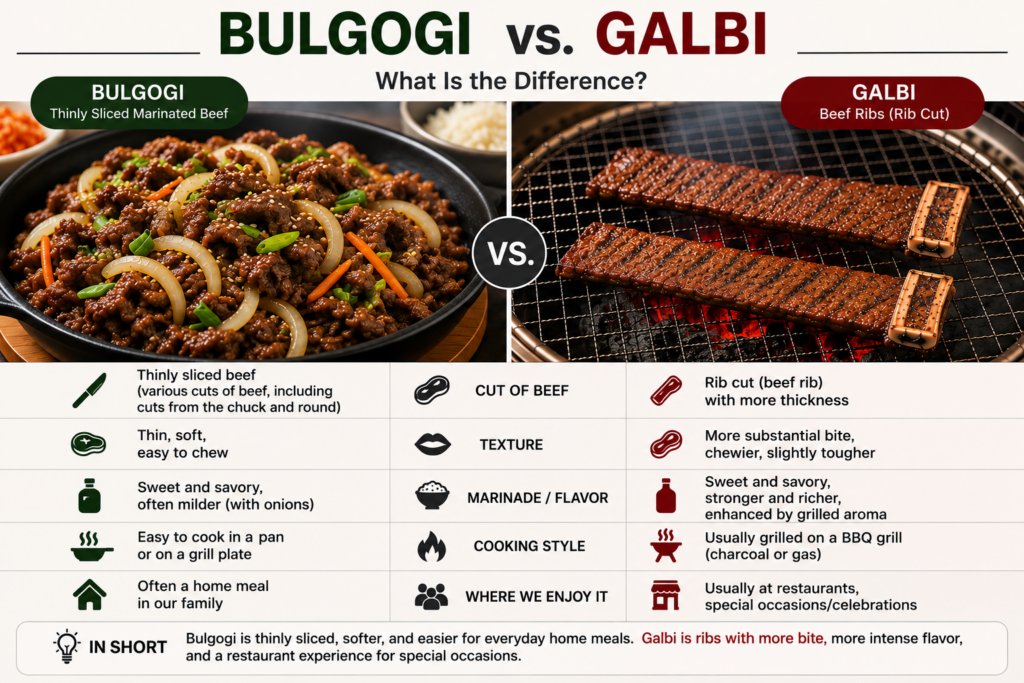
Bulgogi is generally made with thinly sliced beef. Galbi, as its name suggests, uses rib cuts and usually has a more noticeable meaty texture than thinly sliced bulgogi.
The cooking experience can also be different.
Bulgogi is easy to cook at home in a pan or on a grill plate, often together with vegetables such as onions.
Galbi is strongly associated with grilling, especially the experience of cooking ribs over a grill at a Korean BBQ restaurant.
In our family, the two dishes also occupy different places in everyday life.
We eat bulgogi more often at home, but when we go out for Korean beef, we are much more likely to choose galbi.
The Biggest Difference Starts With the Beef
The most basic difference between bulgogi and galbi is the meat itself.
Bulgogi is generally made with thinly sliced beef.
At home, we usually make bulgogi with thinly sliced sirloin.
If you want to explore the dish itself in more detail, see our complete guide to Korean bulgogi.
Because the meat is thin, it absorbs seasoning easily and cooks relatively quickly.
Galbi uses beef ribs.
The meat may be served attached to the bone or cut and prepared in ways that make it easier to grill and eat, but the important distinction is that galbi is based on a rib cut.
So the difference between the two dishes does not begin with the marinade.
A simple way to start thinking about them is:
Bulgogi = thinly sliced beef
Galbi = beef ribs
From there, differences in texture, seasoning, cooking, and the overall dining experience become easier to understand.
Why Does Bulgogi Often Feel Softer?
In my experience, bulgogi feels softer and easier to eat than galbi.
One important reason is the thickness of the meat.
Because bulgogi is thinly sliced, it is easy to take a bite and chew.
Galbi has a more substantial meat texture.
Well-prepared galbi can certainly be tender, but I generally find it a little chewier and slightly tougher than thinly sliced bulgogi.
That is not necessarily a disadvantage.
Some people may actually prefer the more noticeable bite and texture of galbi.
If I had to describe the difference simply, I would say:
Bulgogi → thinner, softer, and easier to eat
Galbi → a more substantial bite and more noticeable meat texture
Of course, the actual tenderness can vary depending on the cut and quality of the beef, how it is prepared, the marinade, and how long it is cooked.
Do Bulgogi and Galbi Use the Same Marinade?
Both dishes can have sweet and savory flavors based on soy sauce, so their seasonings may seem similar at first.
But there is an important distinction.
Not all galbi is marinated galbi.
Beef galbi can be served as saeng galbi, which is fresh or unseasoned galbi, or as yangnyeom galbi, which is marinated galbi.
So when we directly compare the seasoning of bulgogi and galbi, it is more accurate to compare bulgogi with yangnyeom galbi.
Recipes vary widely among restaurants and households, but both can use ingredients such as soy sauce, sweetening ingredients, garlic, and other seasonings.
Even when the marinades belong to a similar sweet-and-savory flavor family, however, the finished dishes do not taste the same.
The cut and thickness of the meat are different.
The ingredients cooked with the meat can be different.
And perhaps most importantly, the cooking methods can create very different results.
Yangnyeom Galbi Tastes Stronger to Me
When I compare the two, yangnyeom galbi usually tastes stronger to me than bulgogi.
I do not think that difference comes from the marinade alone.
Galbi is often grilled at a restaurant.
As the marinated meat cooks over the heat, the grilling adds another layer of roasted and charred aroma.
To me, that combination of marinade and grilled flavor makes yangnyeom galbi taste more intense than the bulgogi we make at home.
Our homemade bulgogi also includes plenty of onion.
As the onions and beef cook together, the onions release moisture and their own flavor into the dish.
For me, this makes the saltiness and seasoning of our bulgogi feel somewhat gentler than the flavor of grilled yangnyeom galbi.
This is not a universal rule about all bulgogi and galbi.
It is how I experience the difference between the bulgogi we make at home and the yangnyeom galbi I usually eat.
The sweetness, saltiness, and intensity of either dish can vary considerably from one household or restaurant to another.
The Cooking Experience Is Also Quite Different
Bulgogi and galbi differ not only when you eat them but also when you prepare them.
Bulgogi is relatively easy to make at home.
Thinly sliced marinated beef can be cooked in a pan or on a grill plate, often together with vegetables such as onions.
Because the meat is thin, it cooks quickly.
That is one reason we make bulgogi at home much more often than galbi.
We can cook galbi at home too.
But for us, it feels more inconvenient.
Grilling galbi indoors can produce a lot of cooking smell, especially as the meat and marinade cook over high heat.
So the difference is not that galbi cannot be prepared at home.
For our family, it is more about which dish is easier and more comfortable to prepare at home.
Bulgogi wins easily.
At Home, We Eat Bulgogi More Often
If we are choosing between the two for a meal at home, we are much more likely to make bulgogi.
Convenience is a major reason.
We can cook the prepared beef in a pan, add onions and other ingredients, and serve it with rice.
That is enough to make it the main dish of a normal meal.
We do not need special cooking equipment.
And compared with grilling galbi indoors, we worry less about strong cooking smells remaining in the house.
For our family, bulgogi therefore feels like a familiar beef dish that is relatively easy to prepare as an everyday home meal.
That does not mean bulgogi is less special or less valuable than galbi.
It simply means the two dishes have developed different roles in our family’s daily life.
But When We Eat Out, We Usually Choose Galbi
When we go out to eat, the situation is almost the opposite.
Our family enjoys galbi much more when dining out.
Galbi feels more inconvenient to prepare and grill at home, and we do not particularly enjoy having the grilling smell remain indoors afterward.
At a galbi restaurant, none of that is a concern.
Instead, we can enjoy grilling the meat at the table and have the full Korean BBQ experience.
That tabletop grilling experience is one part of what makes Korean BBQ different from many other styles of barbecue.
Over the years, that restaurant experience has become strongly connected with galbi for our family.
So for me, the difference between bulgogi and galbi is not only:
thinly sliced beef vs. rib cuts
There is also a difference in how they fit into our lives:
At home → Bulgogi
Eating out → Galbi
This is our family’s experience, of course, not a rule that all Korean families follow.
Galbi Has Also Been a Special-Occasion Food for Our Family
Galbi is connected with special family occasions in my memories.
For events such as birthdays and graduations, our family often went out to eat galbi.
It made sense.
Bulgogi was something we could prepare relatively easily at home, while going to a galbi restaurant gave us an opportunity to enjoy something that was more inconvenient to cook ourselves.
The experience of grilling the ribs at the restaurant and eating them with a variety of side dishes also felt different from an ordinary home meal.
So when I think of galbi, I do not think only about the flavor of the beef.
I also remember family meals at restaurants on special days.
That may be another difference between bulgogi and galbi that cannot be explained simply by describing ingredients.
Even two Korean beef dishes can feel very different depending on where, when, and with whom you have eaten them over the years.
Rice and Doenjang Jjigae Feel Different With the Two Dishes in Our Family
Both bulgogi and galbi go very well with rice.
But when I think about how our family actually eats the two dishes, there is an interesting difference.
When we have bulgogi at home, we can make bulgogi the main dish and simply eat it with rice.
We do not feel that we always need doenjang jjigae with it.
Bulgogi alone can feel like a complete and natural main dish for the meal.
Galbi feels different to me.
When I eat galbi, having rice and doenjang jjigae with it feels very natural.
But I would not turn this into a rule that says, “Galbi should be eaten with doenjang jjigae.”
The difference may have less to do with the dishes themselves and more to do with where our family has usually eaten them.
We have usually eaten bulgogi at home.
We have usually eaten galbi at restaurants.
After repeatedly ordering rice and doenjang jjigae with galbi at Korean BBQ restaurants, the combination of galbi + rice + doenjang jjigae may simply have become familiar to me.
It is an interesting reminder that our eating habits can be shaped not only by flavor, but also by the places and situations in which we repeatedly experience a food.
Saeng Galbi Makes the Difference Even Clearer
Bulgogi and yangnyeom galbi can both have sweet and savory seasoning, so it is understandable that someone new to Korean food might see them as somewhat similar.
Saeng galbi makes the distinction much clearer.
Saeng galbi is not covered in a strong marinade, allowing the flavor and texture of the beef itself to play a larger role.
Bulgogi, by contrast, depends much more on the combination of thinly sliced beef and seasoning.
With saeng galbi, you can more directly experience the rib cut, its texture, and the flavor created as the meat cooks on the grill.
When I eat both saeng galbi and yangnyeom galbi in the same meal, I prefer to eat the saeng galbi first and the marinated galbi afterward.
The stronger seasoning of yangnyeom galbi can make the more delicate flavor of saeng galbi harder to appreciate if you eat it first.
So when trying to understand “Bulgogi vs. Galbi,” remember one important point:
Galbi does not automatically mean marinated beef.
For a closer look at fresh and marinated galbi, rib cuts, and how galbi is commonly eaten, see our detailed guide to Korean galbi.
Bulgogi vs. Galbi at a Glance
If you are new to the two dishes, this is a simple way to understand the difference.
Bulgogi
- Generally uses thinly sliced beef.
- Often has a sweet and savory soy sauce-based marinade.
- Usually feels soft and easy to eat because the meat is thin.
- Can be cooked together with vegetables such as onions.
- Is relatively easy to prepare in a pan or on a grill plate.
- In our family, it is the one we eat more often at home.
Galbi
- Uses rib cuts.
- Can be either saeng galbi or yangnyeom galbi.
- Usually has a more noticeable meaty texture than thinly sliced bulgogi.
- Yangnyeom galbi can develop a strong combination of marinade and grilled flavor.
- In our family, we enjoy it more often at restaurants than at home.
- It is also connected with special family meals such as birthdays and graduations.
Once you understand these differences, Bulgogi and Galbi on a Korean restaurant menu no longer look like two versions of the same sweet Korean beef dish.
Which Should You Try First: Bulgogi or Galbi?
There is no single correct answer.
If I were introducing Korean food to someone for the first time, I would probably recommend bulgogi first.
The meat is thin and easy to chew, and its sweet and savory flavor can feel approachable.
It is also very easy to enjoy with rice.
But if you ask my wife the same question, she gives a different answer.
She recommends galbi.
She simply prefers the flavor, texture, and experience of eating grilled ribs.
Even within our family, we would make different recommendations.
That is because the question is not really about which dish is objectively better.
It is about what kind of food and dining experience you prefer.
If you want tender, thinly sliced beef that is easy to eat, bulgogi can be an excellent place to start.
If you want a more noticeable meat texture and the experience of grilling Korean ribs at the table, galbi may be more appealing.
If the entire restaurant experience is new to you, our guide to eating Korean BBQ for the first time explains what to expect from the grill, meat, banchan, and table.
Frequently Asked Questions
Are Bulgogi and Galbi the Same Thing?
No.
Both are well-known Korean beef dishes and can use seasonings from a similar sweet-and-savory flavor family, but the cut and thickness of the meat, texture, and cooking style are different.
What Is the Biggest Difference Between Bulgogi and Galbi?
The most basic difference is the meat.
Bulgogi is generally made with thinly sliced beef, while galbi uses rib cuts.
Is Galbi Always Marinated?
No.
Beef galbi can be served as saeng galbi, which is fresh or unseasoned, or yangnyeom galbi, which is marinated.
When directly comparing the seasoning of bulgogi and galbi, it is therefore more accurate to compare bulgogi with yangnyeom galbi.
Are Bulgogi and Yangnyeom Galbi Marinades Similar?
They can have similarities.
Both may use soy sauce and ingredients that create sweet and savory flavors.
However, recipes vary by restaurant and household, and differences in the cut, thickness, and cooking method of the meat can produce very different final flavors and textures.
Which Is More Tender, Bulgogi or Galbi?
In my experience, bulgogi usually feels softer and easier to eat.
One important reason is that bulgogi beef is sliced very thinly.
Actual tenderness, however, depends on the cut and quality of the meat, preparation, marinade, and cooking method.
Is Bulgogi Korean BBQ?
Bulgogi is often introduced as one of the classic foods associated with Korean BBQ, but it does not have to be cooked by diners on a tabletop grill.
It is also very commonly prepared at home in a pan or on a grill plate.
Which Is Easier to Cook at Home, Bulgogi or Galbi?
For our family, bulgogi is much easier.
Galbi can certainly be prepared at home, but we find the preparation and grilling more inconvenient, and we especially prefer to avoid the strong grilling smell indoors.
That is one reason we make bulgogi much more often at home.
Which Is Better for a Special Occasion, Bulgogi or Galbi?
That depends entirely on the family and personal preference.
In our family, galbi has often been connected with restaurant meals for birthdays, graduations, and other special occasions.
For us, that makes galbi feel particularly connected with family celebrations.
So Which Is Better, Bulgogi or Galbi?
Bulgogi and galbi can share some similar sweet and savory flavors, but they are ultimately very different dishes.
Bulgogi combines thin, tender slices of beef with seasoning and is relatively easy to prepare at home.
Galbi offers the texture of a rib cut and, especially when grilled at a restaurant, can bring together the meat, marinade, grilled aroma, and the larger Korean BBQ experience.
The two dishes have also developed different roles in our family’s life.
At home, we eat bulgogi more often.
When we go out, we enjoy galbi more often.
For me, bulgogi feels like a familiar and comfortable home meal.
Galbi is more closely connected with memories of restaurant meals with my family on birthdays, graduations, and other special occasions.
And if you ask which one a beginner should try first, I would choose bulgogi.
My wife would choose galbi.
Perhaps that is one of the best ways to understand the difference.
Neither bulgogi nor galbi is simply “better.” They offer different cuts of beef, different textures, different cooking experiences, and potentially very different memories around the table.
Which one you should try first depends on what kind of experience you are looking for.