Korean Ssam Explained: Why Koreans Wrap Meat in Lettuce and Perilla Leaves
Learn how to make Korean ssam with lettuce, perilla, and other leaves, with examples from our table and tips for choosing fillings and seasonings.
My Wife and I Make Different Ssam With the Same Meat
At a Korean BBQ restaurant, you will often see lettuce and perilla leaves beside the grill. Placing cooked meat on a leaf, adding a little seasoning, and wrapping it together is one way to make ssam. If this is your first time, you may wonder whether rice and garlic are required or how many leaves to use.
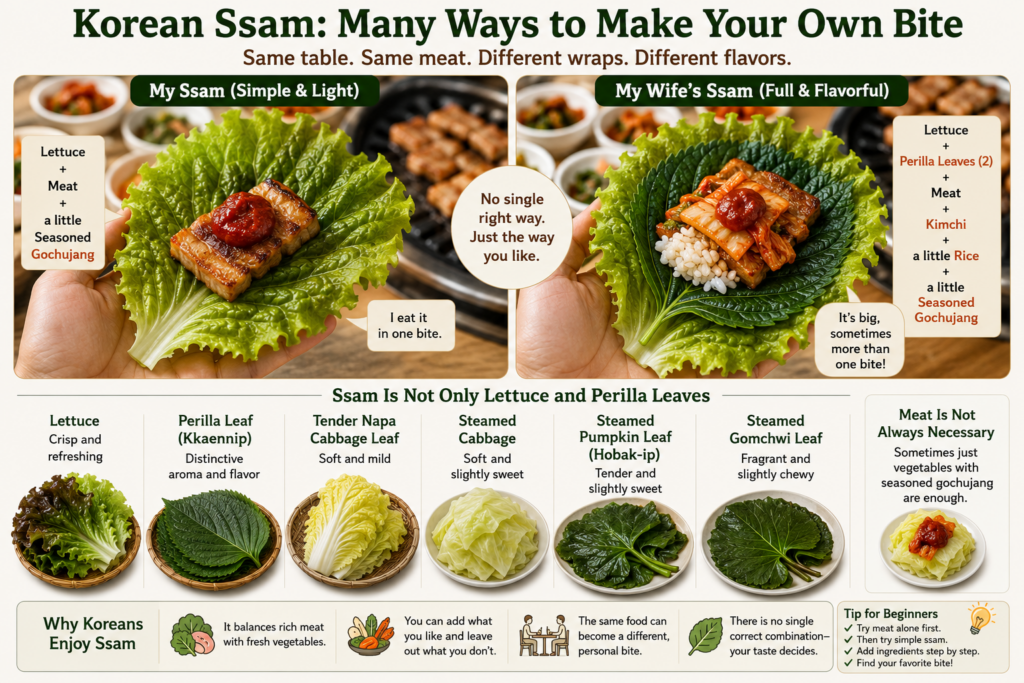
I keep mine simple: lettuce, one piece of meat, and a little seasoned gochujang. I eat rice separately instead of putting it inside the wrap. My wife loves the aroma of perilla leaves, so she layers them with lettuce and adds a little kimchi and rice along with the meat.
Ssam is a way of wrapping food in leaves or vegetables and eating it together, rather than a dish that requires a fixed set of ingredients. The same meat at the same table can become a different bite depending on the leaves and fillings you choose.
Lettuce wraps at Korean BBQ restaurants are a familiar example, but ssam does not have to contain grilled meat. At home, we also use steamed cabbage and other leafy vegetables.
Lettuce Adds Freshness, While Perilla Adds a Distinctive Aroma
Eating meat on its own and wrapping it in lettuce create different textures from the first bite. Lettuce adds a relatively mild flavor and a fresh texture. After several pieces of a rich cut such as samgyeopsal, or pork belly, a lettuce wrap can make the same meat feel different.
Perilla leaves have a more pronounced aroma. If you enjoy it, it can add to the pleasure of eating the meat, but it may be unfamiliar at first. Try lettuce and perilla separately before layering several leaves together so you can notice the difference.
I prefer lettuce and usually eat lettuce and perilla separately. My wife sometimes layers them, using two perilla leaves on top of one lettuce leaf. Layering changes the aroma and texture, but it also makes the wrap larger.
Perilla leaves are sometimes called “sesame leaves” in English, but the kkaennip used for ssam comes from the perilla plant. Sesame and perilla are different plants, so it helps to distinguish them when searching for ingredients in English.
| Leaves or Vegetables for Ssam | What They Add |
|---|---|
| Lettuce | A relatively mild flavor and fresh texture |
| Perilla leaves | A distinctive aroma alongside the meat and seasoning |
| Lettuce and perilla layered together | The texture of lettuce combined with perilla’s aroma |
| Tender inner napa cabbage leaves | Crunch and gentle sweetness |
| Steamed cabbage | Soft leaves and sweetness surrounding the filling |
Start With One Leaf and a Small Filling
For your first ssam, place a lettuce leaf in your palm and add one small piece of cooked meat. Add a little ssamjang, then fold the edges of the leaf inward around the filling. You do not need to make a perfect shape or roll it tightly.
A wrap that fits comfortably in one bite lets you taste the leaf, meat, and seasoning together and helps keep the filling from falling out. If the leaf is large, you can tear it into a manageable size. If a wrap turns out too big, avoid forcing it into your mouth and use less filling for the next one.
I use only a few ingredients, so I usually eat my ssam in one bite. My wife’s wraps contain more, and sometimes they are too large for a single bite. Eating ssam in one bite is convenient, but it does not need to be treated as a rule regardless of the wrap’s size.
After your first wrap, try changing one ingredient at a time. Use perilla instead of lettuce or add a little kimchi to see what changes the flavor. If you also want help with ordering and grilling, see how to eat Korean BBQ for the first time.
You Do Not Need to Add Rice, Garlic, and Kimchi All at Once
Photos of ssam often show meat, rice, garlic, chili peppers, and kimchi packed together. But you do not need every ingredient on the table to complete a wrap. More ingredients make the wrap larger and the flavor more complex.
Adding a little rice brings rice, meat, and seasoning into the same bite. My wife likes that combination, while I eat my rice separately. A wrap without rice is just another way to enjoy ssam.
Neither of us likes putting raw garlic in our wraps. We eat grilled garlic, but usually separately. At work dinners and other meals, however, I have eaten with many people who add raw garlic to their ssam. Choose according to whether you enjoy its sharp bite.
The same flexibility applies to kimchi and shredded green onion salad. Adding an already seasoned side dish can make the wrap’s seasoning and aroma stronger, so adjust the amount of sauce too. Leave out garlic or chili peppers if they feel too strong, and add only what you enjoy to the next wrap.
Add Ssamjang or Seasoned Gochujang a Little at a Time
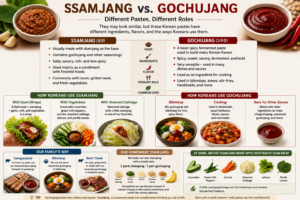
Ssamjang is a familiar condiment for ssam. It adds the savory flavor and saltiness of doenjang, along with the aromas of other seasonings, to the meat and vegetables. Too much can cover up the other ingredients, so start with a little. My guide to ssamjang explains its ingredients and flavor in more detail.
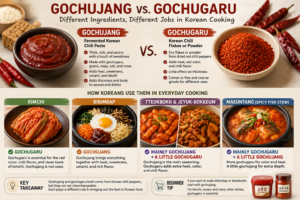
At home, we sometimes use our homemade seasoned gochujang in samgyeopsal wraps. Both my wife and I add only a small amount. A seasoning does not become ssamjang simply because it goes into a ssam; seasoned gochujang has different ingredients and flavors. I compare the choices in ssamjang vs. gochujang.
If the meat or side dishes inside the wrap already provide enough seasoning, you can try it without adding another sauce. Consider what is inside each wrap rather than always using the same amount.
After adding the sauce, notice whether you can still taste the leaf, meat, and other fillings. Add a little more to the next wrap if needed, or use less if it tastes too salty or strongly seasoned.
We Often Wrap Pork but Prefer Grilled Beef on Its Own
We make ssam with moksal and hangjeongsal as well as samgyeopsal. We enjoy the combination of pork and the texture of fresh leaves. Even so, we do not wrap every piece. We may eat a few pieces in wraps and then enjoy the next piece on its own.
Grilled beef is different for us. My wife and I prefer to enjoy the meat’s flavor rather than wrap it in lettuce or perilla. This is our preference, not a general rule against making ssam with beef.
When we eat beef as suyuk, or boiled and sliced meat, our approach changes. We wrap our homemade beef shank suyuk in steamed cabbage with seasoned bok choy. The bok choy provides the seasoning, so we do not prepare a separate dipping sauce. I describe the combination in how we make beef suyuk at home.
Whether we want a wrap depends on more than the type of meat. Grilling or boiling it, and choosing different vegetables and seasonings, can change how we enjoy it.
At Home, We Also Use Steamed Cabbage and Pumpkin Leaves
At home, we also make ssam with tender inner napa cabbage leaves, steamed cabbage, steamed pumpkin leaves, and steamed gomchwi leaves. Fresh lettuce has a different texture from softened, cooked leaves, and each kind has its own aroma.
We sometimes fill steamed cabbage with meat or tuna. At other times, we simply add a little ssamjang without another filling, or use seasoned gochujang. Even without meat, the idea of wrapping food or seasoning in a leaf stays the same.
You do not need to recreate a restaurant’s selection at home. Make a small wrap with the edible leaves and side dishes you have prepared, then adjust the filling according to the leaves’ softness or crunch and the strength of the seasoning.
Start simply with one lettuce leaf. Next, try perilla or add a little rice, and compare it with steamed cabbage at home. Just as my wife and I make different ssam, you can find your own favorite combination at the same shared table.