Why Do Koreans Use Metal Chopsticks?
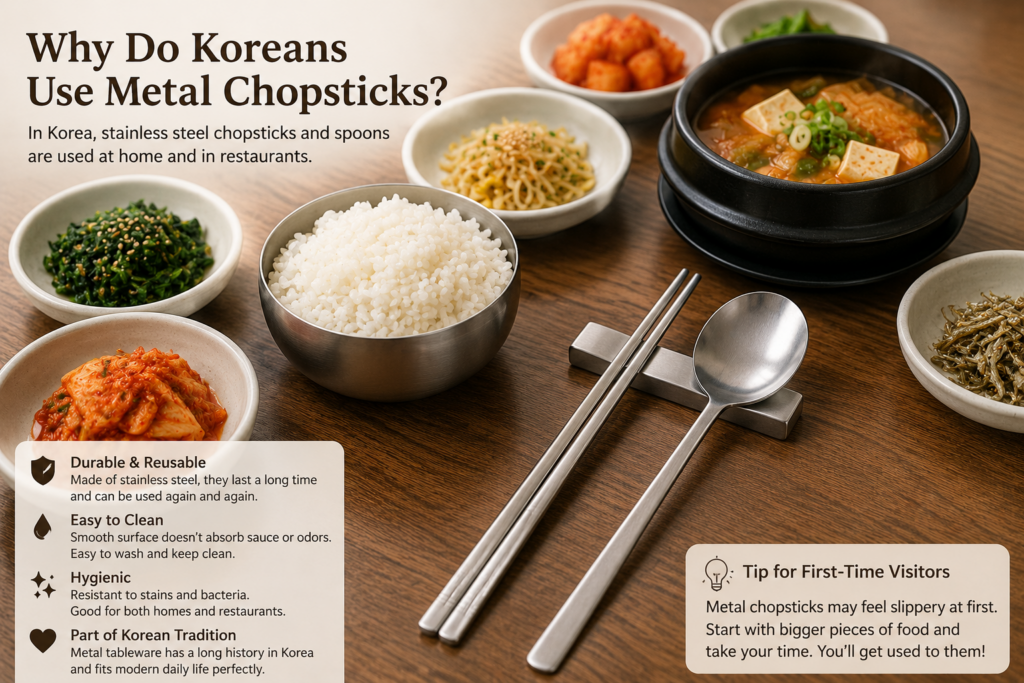
Discover why metal chopsticks are common in Korea, how stainless steel fits everyday meals, and what to do if they feel slippery at first.
Metal Tableware Traditions and Everyday Practicality Both Matter
When you pick up chopsticks at a Korean restaurant, they may feel different from the wooden ones you are used to. The surface is smooth, and the part resting against your fingers may feel thin and flat. Even someone comfortable with chopsticks might drop a few pieces of food.
Stainless steel chopsticks are common in Korean homes and restaurants. Their popularity is difficult to explain through a single story from the past. It helps to consider both Korea’s tradition of metal tableware and the practical qualities of a material that lasts and can be washed repeatedly.
Metal chopsticks are familiar eating utensils in Korea, but that does not mean they are the most comfortable choice for everyone. My family uses them at home, though I also use wooden chopsticks when eating a simple meal outdoors.
Today’s Stainless Steel Chopsticks Are Different From Older Metal Utensils
Korea’s use of metal tableware did not begin with modern stainless steel. Older spoons and chopsticks were made from materials such as brass and silver, while utensils made from wood and other materials also existed. Materials varied with the period and people’s circumstances, so we should not imagine everyone in the past using the same chopsticks found in restaurants today.
One frequently repeated explanation says that royalty used silver chopsticks to detect poison in food and that this practice led to today’s custom. That story alone, however, cannot explain why stainless steel chopsticks became widespread. Stories about silver utensils and the spread of modern tableware need to be considered separately.
Rather than treating one royal practice as the sole origin, I find it more useful to look at the relationship between an older tradition of metal tableware and the convenience of modern manufacturing and maintenance. Historical silver or brass utensils and today’s stainless steel sets are all metal, but they are neither the same material nor the same product.
Stainless Steel Is Convenient to Wash and Reuse
The practical advantages of metal chopsticks become clear when you think of them as tools used every day. They do not break easily, can be washed and reused many times, and do not readily absorb food colors or odors. At home, a set of utensils can last for years.
Restaurants repeatedly provide utensils to customers, collect them after meals, and wash them for the next use. Durability and ease of cleaning are useful in that setting. Spoons and chopsticks can also be provided in matching stainless steel sets.
Metal does not stay clean automatically, though. Food and grease can remain on the surface, so proper washing is still necessary. Wooden chopsticks also require different care depending on whether they are disposable or coated, reusable products. The material alone does not tell you how clean a particular utensil is.
| Feature of Metal Chopsticks | What It Means in Everyday Use |
|---|---|
| Durability for repeated use | They are convenient to wash and use for a long time at home or in restaurants. |
| A surface that does not readily absorb food | Colors and odors are less likely to soak into the material. |
| A smooth surface | It is convenient to wipe, but food may slip. |
| Different thicknesses and weights | Even metal chopsticks can feel quite different from one pair to another. |
I Find Metal Chopsticks More Familiar When Eating Several Side Dishes
Metal chopsticks feel more familiar and comfortable in my hands than wooden ones, especially when I eat rice with several different banchan, or side dishes.
When I pick up food with broth or sauce using wooden chopsticks, I sometimes notice the surface becoming damp. I may also notice seasoning from the previous dish remaining as I move to the next one. The finish or coating on wooden chopsticks makes a difference, of course, but I find the smooth surface of my usual metal chopsticks more comfortable.
If necessary, I lightly wipe seasoning from the tips with a napkin. This is simply my habit for removing some sauce during a meal, not a substitute for washing the utensils.
That does not mean I avoid wooden chopsticks. Disposable wooden ones are convenient when I eat something simple, such as gimbap or ramyeon, outdoors. For me, the choice depends on the setting and what feels familiar rather than one material always being better.
For more on tasting side dishes and eating them with rice or the main dish, see how to eat Korean banchan.
Thin, Flat Chopsticks Can Feel Slippery at First
Many metal chopsticks commonly used in Korea have a relatively thin, flat grip. If you are accustomed to thicker, rounder wooden chopsticks, you may notice the shape as much as the material.
Not all Korean metal chopsticks have the same design, however. Some are more rounded, some are hollow and lightweight, and others have textured or grooved tips. Metal chopsticks are not necessarily heavy, nor are they all equally slippery.
Small or slippery foods, such as beans or muk, a savory jelly, may slide out from between smooth tips even when you apply pressure. Squeezing harder can also break softer foods apart. It takes time to get used to the weight, thickness, and grip of a different pair.
Koreans do not use chopsticks perfectly from the beginning, either. Children learn while dropping food, and adults do not all hold chopsticks in exactly the same way. What looks effortless often reflects years of practice during everyday meals.
A Spoon Usually Sits Beside the Metal Chopsticks
To understand metal utensils at a Korean table, look at the spoon beside the chopsticks as well. Together, a spoon and chopsticks are called sujeo, and using them as a set is a familiar part of Korean dining.
You might pick up side dishes or meat with chopsticks and use the spoon for broth. For rice or solid ingredients in a jjigae, either utensil may be convenient depending on the situation. Having chopsticks does not mean you must eat everything with them.
I explain how I switch between the two for rice, soup, and side dishes in why Koreans use both a spoon and chopsticks.
Metal can become hot when it stays in contact with hot food or cookware. Picking up food and moving it during a meal is different from leaving chopsticks on a hot grill. Keep grilling tongs separate from your personal eating utensils, and avoid resting spoons or chopsticks across hot pots or grills.
Begin With Foods That Are Easier to Pick Up
If metal chopsticks feel unfamiliar, start with a manageable piece of meat or a side dish that is easy to grip rather than a small bean or slippery piece of muk. Line up the tips and move one piece at a time instead of trying to pick up a large amount.
Holding the chopsticks too tightly can tire your hand. Try keeping the lower chopstick relatively steady while moving the upper one, and practice slowly. You do not need to eat at the same pace as everyone else from the start.
If food keeps slipping, use your spoon or ask whether the restaurant has a fork or wooden chopsticks. Not every restaurant will have them, but a short request such as “포크 있어요?”—“Do you have a fork?”—can help. For more ways to communicate what you need, see how to order Korean food if you don’t speak Korean.
Metal chopsticks are durable everyday tools at the Korean table, and using them becomes more familiar with practice. Dropping a few pieces of food does not have to make the meal difficult. Use your spoon as well, and enjoy the food at a pace that feels comfortable.