How to Order Korean Food If You Don’t Speak Korean
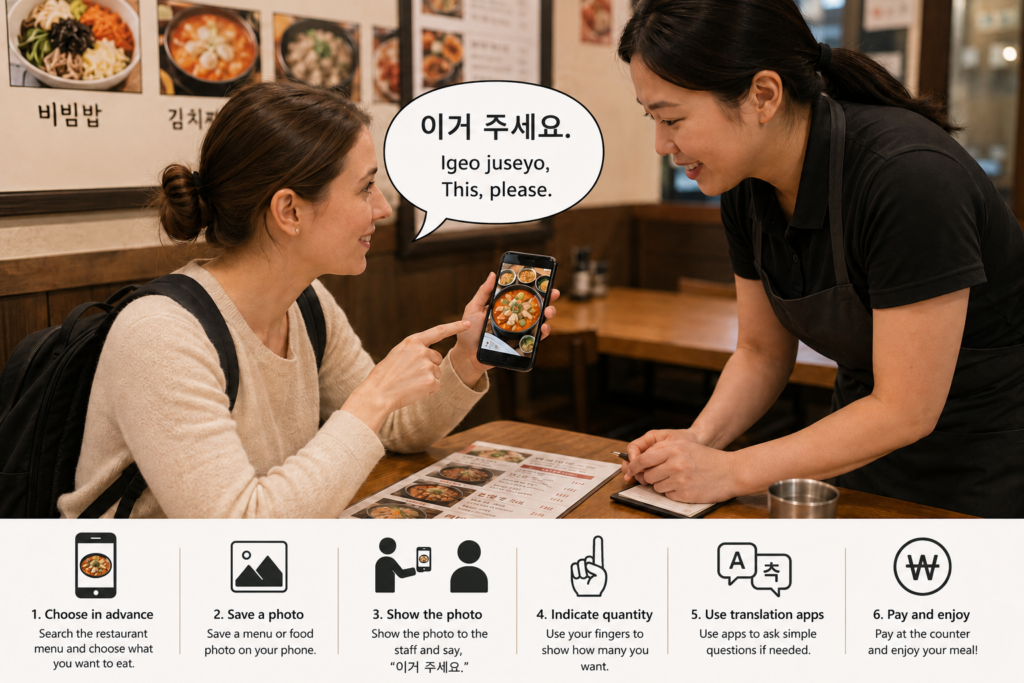
Order Korean food with menu photos, pointing, simple phrases, and translation apps. Learn to confirm quantities, request less spice, and ask for help.
Start by Pointing to a Dish and Showing the Quantity
You may know which Korean food you want to try but feel unsure about how to order it at a restaurant. There may be no English menu, and the staff may not be comfortable explaining dishes in English. You do not need to pronounce every food name correctly to place an order.
Point to the dish you want and show how many you would like. Keep questions about spice levels and other requests short, and handle them one at a time. If words are not enough, use a photo or show a message on your phone.
A menu item to point to and the short phrase “이거 주세요” (Igeo juseyo, “This, please”) can be enough to get started. What matters is making sure you and the staff understand which dish and quantity you mean.
I Save Food Photos Before Visiting Restaurants Abroad
I sometimes visit restaurants in countries where I cannot communicate easily in the local language. When that happens, I prefer to choose what I want before arriving rather than trying to understand the entire menu at the table.
I look up the restaurant and browse its menu and food photos. When I find something I want, I save a photo on my phone. Showing that photo when ordering takes away much of the pressure to pronounce the name correctly or translate the menu in a hurry.
Visitors to Korea can use the same method. Save a menu photo that includes the dish’s name so the staff can identify it easily. A photo from the restaurant you plan to visit is more useful than a picture of a similar dish from somewhere else.
An older photo may show something no longer on the menu, or the restaurant may have run out that day. Show the photo and first ask, “이거 있어요?” (Igeo isseoyo?, “Do you have this?”). The picture explains what you want; the restaurant still needs to confirm whether it is available.
Give the Quantity for Each Dish You Point To
If the menu has photos, point to the picture. If the dishes are numbered, show the number. Even on a menu with only text, you can point to the relevant line. Once the staff can see which item you mean, ordering becomes much easier without having to read its name aloud.
For one order, say “이거 하나 주세요” (Igeo hana juseyo). For two, say “이거 두 개 주세요” (Igeo du gae juseyo). If you cannot remember the numbers, point to the item and hold up the appropriate number of fingers. When ordering several dishes, indicate each one and its quantity separately.
Keep your group size separate from the number of dishes you are ordering. Two people do not necessarily need two of every item. You might choose one large dish to share or two individual meals.
For meat or another item sold by the serving, you can say “이거 2인분 주세요” (Igeo i inbun juseyo), meaning “Two servings of this, please.” My guide to reading a Korean restaurant menu explains servings, small–medium–large sizes, and minimum orders.
| Korean Phrase | Romanization | Meaning |
|---|---|---|
| 이거 있어요? | Igeo isseoyo? | Do you have this? |
| 이거 하나 주세요. | Igeo hana juseyo. | One of these, please. |
| 이거 두 개 주세요. | Igeo du gae juseyo. | Two of these, please. |
| 이거 2인분 주세요. | Igeo i inbun juseyo. | Two servings of this, please. |
Show your saved photo when asking about availability. For quantities, point to the menu item and hold up one or two fingers. Use the last phrase for dishes sold by the serving.
Use Translation Apps for One Question at a Time
If there is no English menu and no food photography, a translation app’s camera feature can help you read the menu. If the translated name still does not explain the dish, look for a food photo or check its Korean name. A translated menu entry will not necessarily tell you every ingredient or how the food is prepared.
When asking the staff a question, separate different concerns instead of putting them into one long sentence. If you want to know about spice, portion size, and whether rice is included, start with “Is this spicy?” and then move to the next question.
You do not have to read the translated Korean aloud. Show the screen and give the staff time to read it. If you already know the dish you want, displaying its Korean name, such as 불고기 for bulgogi, can also help.
If you cannot decide, show the menu and say “추천해 주세요” (Chucheonhae juseyo), meaning “Please recommend something.” Mention any preference first. “안 매운 거 추천해 주세요” (An maeun geo chucheonhae juseyo), meaning “Please recommend something that isn’t spicy,” gives the staff a clearer starting point.
Ask About Less Spice Before Placing Your Order
I also ask for less spice when ordering haemuljjim, a spicy seafood dish. Korean diners do not all enjoy the same level of heat, so there is no need to feel awkward about stating your preference.
For an unfamiliar dish, first ask “이거 매워요?” (Igeo maewoyo?), meaning “Is this spicy?” If it is spicy but you still want to try it, ask “덜 맵게 가능해요?” (Deol maepge ganeunghaeyo?), meaning “Can you make it less spicy?” If the answer is yes, you can request “덜 맵게 해 주세요” (Deol maepge hae juseyo), or “Please make it less spicy.”
Not every dish can be adjusted. A sauce or broth may already be prepared, making it difficult to change the heat level. Ask when ordering rather than waiting until the food arrives.
Also, what a staff member considers “a little spicy” may feel different to you. “Less spicy” does not mean “not spicy at all.” If spicy food is difficult for you, asking “안 매운 거 있어요?” (An maeun geo isseoyo?), meaning “Do you have something that isn’t spicy?” makes your needs clearer and can help you choose another dish.
For more on how heat varies with the dish and seasoning, see how spicy Korean food really is.
If You Cannot Understand the Answer, Use the Menu or Your Screen
Understanding the Korean answer can be harder than asking a question you have prepared. You might say “Please recommend something,” only to receive a long explanation of several dishes.
Instead of hearing the same explanation repeatedly, show the menu and ask the staff to point to their recommendation. You can prepare the message “메뉴에서 가리켜 주세요,” meaning “Please point to it on the menu,” in your translation app. If they show you two choices, point to the one you want.
If the quantity or size is unclear, check the item and number again. For example, if you are ordering one bibimbap and one bulgogi, point to each in turn and confirm one of each. A brief check is more useful than nodding without understanding.
Check Your Selections and Order Confirmation on a Kiosk or Tablet
If the restaurant uses an ordering device, first look for English or another language option. Photos and prices can make choosing easier than explaining your order aloud, although not every device offers English.
After selecting a dish, check the quantity and any options for size or spice level. Adding an item to a cart may not submit the order, so look for a message confirming that it has gone through. Follow the screen’s instructions about whether payment is required now or after the meal.
If you cannot work out which button to press, point to the screen and say “도와주세요” (Dowajuseyo), meaning “Please help me.” If you are unsure whether the order was submitted, ask the staff before placing the same order again.
Short Phrases and Pointing Also Help During the Meal
For water, say “물 주세요” (Mul juseyo). To ask for more of a side dish whose name you do not know, point to its plate and say “이거 조금 더 주세요” (Igeo jogeum deo juseyo), meaning “A little more of this, please.” For a small personal plate, ask “앞접시 주세요” (Apjeopsi juseyo).
If the staff point toward a self-service station, they may be directing you to get what you need there. Ask first if you are unsure whether a refill is available or costs extra. My guide to eating Korean banchan explains serving yourself and asking for refills.
If you want to take leftovers with you, point to the food and ask “남은 음식 포장돼요?” (Nameun eumsik pojang dwaeyo?), meaning “Can I take the leftovers to go?” This may depend on the food and the restaurant. If they say yes, you can request “포장해 주세요” (Pojanghae juseyo), or “Please pack it to go.”
| Korean Phrase | Romanization | Meaning |
|---|---|---|
| 물 주세요. | Mul juseyo. | Water, please. |
| 이거 조금 더 주세요. | Igeo jogeum deo juseyo. | A little more of this, please. |
| 앞접시 주세요. | Apjeopsi juseyo. | A small plate, please. |
| 추가 비용이 있나요? | Chuga biyongi innayo? | Is there an extra charge? |
| 남은 음식 포장돼요? | Nameun eumsik pojang dwaeyo? | Can I take the leftovers to go? |
| 계산해 주세요. | Gyesanhae juseyo. | I’d like to pay, please. |
When it is time to pay, simply approaching the cashier often makes your intention clear. If needed, say “계산해 주세요” (Gyesanhae juseyo). For the wider restaurant experience, including seating, self-service, and payment, see what to expect on your first Korean restaurant visit.
Start by showing which dishes and quantities you want, then confirm any requests one at a time. A saved photo or a finger pointing at the menu is a useful beginning. When words are not enough, your screen and simple gestures can help you finish the order.