What Is the Difference Between Guk, Tang, and Jjigae?
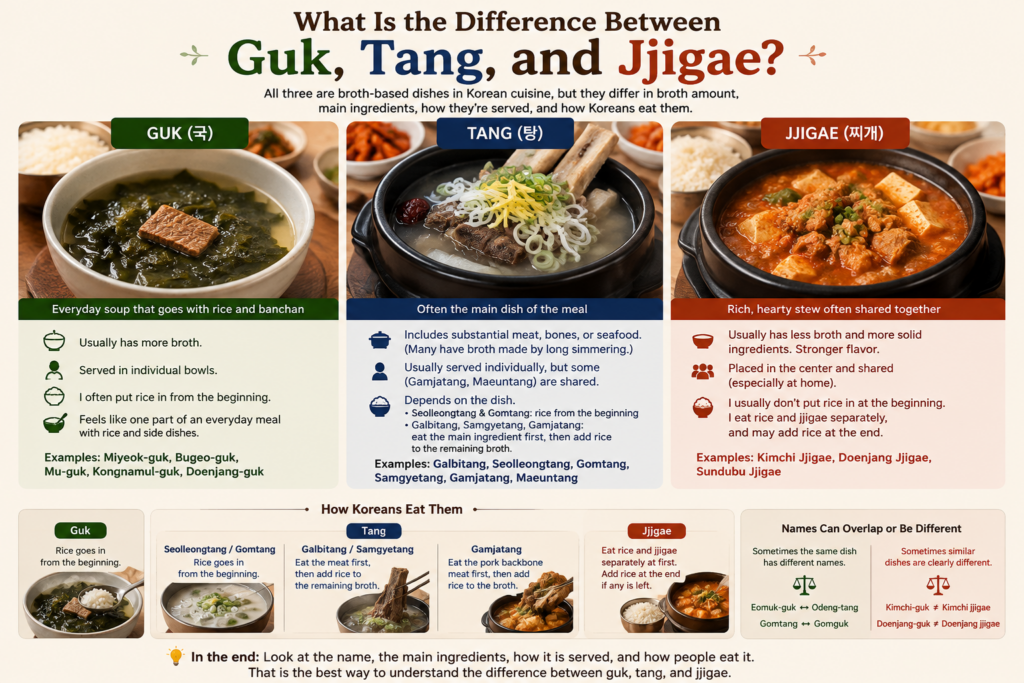
Learn how guk, tang, and jjigae differ in broth, ingredients, serving style, and the way Koreans eat them with rice, with examples from our family table.
Look at the Broth and the Dish’s Place in the Meal
When you see miyeok-guk, galbitang, and kimchi jjigae on a Korean menu, you may wonder why three dishes containing broth have different names. English menus often translate guk and tang as “soup” and jjigae as “stew,” but those words alone do not explain how each dish is eaten with rice.
Guk generally has a generous amount of broth and accompanies rice and banchan. Jjigae tends to contain a higher proportion of solid ingredients and have a more concentrated flavor. Tang includes dishes such as seolleongtang, whose broth develops through long cooking, as well as maeuntang, made by simmering fish and vegetables with spicy seasoning. Thinking of tang as a middle stage between guk and jjigae can make the distinction harder to understand.
In our home, we serve guk in individual bowls from the beginning, while jjigae usually goes in the center of the table to share. I sometimes put rice into guk right away, but I start a meal with my rice and jjigae separate. These differences in serving and eating are as familiar to me as differences in the amount of broth.
| Type | What to look for | Familiar examples | Something to keep in mind |
|---|---|---|---|
| Guk | Usually plenty of broth, often eaten alongside rice and banchan. | Miyeok-guk, mu-guk, bugeo-guk, kongnamul-guk | Some, such as sundae-guk, are the centerpiece of a meal. |
| Tang | The main ingredients, such as meat, bones, or fish, are enjoyed along with the broth. | Galbitang, seolleongtang, gomtang, samgyetang, maeuntang | Cooking time, broth concentration, and individual or shared serving styles vary. |
| Jjigae | Often more solid ingredients and stronger seasoning than guk. | Kimchi jjigae, doenjang jjigae, sundubu jjigae | Restaurants may serve it in individual portions. |
These are useful tendencies when you are getting acquainted with Korean food. They are not a formula that classifies every dish.
Guk Is a Familiar Bowl Beside Rice and Banchan
Miyeok-guk (seaweed soup), bugeo-guk (dried pollock soup), mu-guk (radish soup), and kongnamul-guk (soybean sprout soup) are familiar companions to rice at home. With a bowl beside your rice, you can alternate spoonfuls of broth with banchan or add rice directly to the soup.
When I eat miyeok-guk, doenjang-guk, bugeo-guk, or mu-guk, I often put rice into the broth from the beginning. I do not follow a rule about how much soup I should eat before adding it. Rice in soup with banchan alongside feels like a natural meal to me.
Many of the guk dishes I regularly eat are relatively straightforward to prepare compared with a tang whose broth simmers for a long time. Still, a short cooking time does not define guk. Some versions simmer with meat for a substantial time, and others use doenjang or gochugaru for flavor. Guk is not always clear or mild.
Nor does guk always play a supporting role. Sundae-guk, a soup containing Korean blood sausage, can be the centerpiece of an entire meal. The word guk in a name does not mean you should expect a small side dish.
The Same Kimchi or Doenjang Can Make Different Guk and Jjigae
Comparing dishes made with the same main ingredient makes the difference between guk and jjigae easier to see. Both kimchi guk and kimchi jjigae contain kimchi, but kimchi guk puts more emphasis on generous spoonfuls of broth. With kimchi jjigae, the kimchi, meat, tofu, and other solid ingredients play a larger part as you eat them with rice.
Jjigae generally has a higher proportion of solid ingredients and more concentrated flavor than guk. “Concentrated” does not necessarily mean thick or spicy. The broth can still be fluid while carrying a strong flavor from kimchi, doenjang, or meat. My guide to kimchi jjigae looks more closely at how the kimchi’s maturity and the other ingredients shape the dish.
Doenjang-guk and doenjang jjigae offer a similar comparison. Both use fermented soybean paste, but the proportions of broth and solid ingredients, the ingredients themselves, and the seasoning can differ. In our home, individual bowls feel natural for doenjang-guk, while doenjang jjigae usually goes in the center to share. For a closer look at the stew with tofu and vegetables, see my guide to doenjang jjigae.
Sharing is not a requirement, though. Order sundubu jjigae or doenjang jjigae at a restaurant and it may arrive in a small earthenware pot for one person. Serving it individually does not turn it into guk.
Tang Often Puts the Main Ingredients and Broth at the Center of a Meal
At a galbitang restaurant, the large bowl of beef short ribs and broth is the focus of the meal. Seolleongtang and gomtang are also dishes people go out to eat as a main meal, with rice, kimchi, and kkakdugi, or cubed radish kimchi, alongside. Samgyetang feels particularly substantial: you eat a whole chicken along with glutinous rice and other ingredients tucked inside it.
Seolleongtang and gomtang, which develop their broth by simmering meat or bones for a long time, are useful examples when learning the word tang. But not every tang follows the same lengthy cooking process. Cooking time alone cannot explain maeuntang, in which fish and vegetables simmer with seasoning.
Serving styles vary too. Galbitang and seolleongtang commonly come in large individual bowls. Gamjatang may arrive in a shared pot filled with pork backbone, potatoes, and vegetables. Maeuntang can also be served in a pot for several people.
The word tang alone therefore cannot tell you the broth’s color or concentration, or how many people the dish serves. Look at the specific name, such as galbitang or gamjatang, as well.
When I Add Rice Depends on Which Tang I Am Eating
With seolleongtang or gomtang, I usually put rice into the broth from the start. With galbitang, I eat the ribs first; with samgyetang, I start with the chicken. Once I have eaten a good portion of the main ingredient, I eat rice with the broth or mix it in.
I approach gamjatang in a similar way. First, I pick the meat from the bones, then eat rice with the remaining broth. For me, working through those substantial pieces is an important part of the meal.
I do not eat every seafood tang the same way, either. With kkotgetang, or crab soup, I like to eat the crab meat first and then put rice into the remaining broth. With fish-based maeuntang, I usually keep the rice separate, eating rice, fish, and broth in turn.
| Dish | How I usually eat it |
|---|---|
| Seolleongtang and gomtang | I mix rice into the broth from the beginning. |
| Galbitang and samgyetang | I eat the ribs or chicken first, then have rice with the broth. |
| Gamjatang | I eat the meat from the bones first, then have rice with the remaining broth. |
| Kkotgetang | I eat the crab meat first, then mix rice into the broth. |
| Fish-based maeuntang | I generally keep my rice separate from the broth. |
These are my preferences, not an eating order that every Korean follows. Someone else may taste the broth first or keep their rice separate throughout the same meal.
With jjigae, I start by eating bites of rice with a little broth or some of the solid ingredients. Near the end, I may mix a little remaining rice into the jjigae. If the pot is shared, you can take a portion into your own bowl before mixing it with rice.
Names Such as Eomuk-Guk and Odeng-Tang Can Overlap
Eomuk-guk and odeng-tang are sometimes used for similar fish cake dishes served in broth. Gomtang may also be called gomguk. These names show why the amount of broth or cooking time cannot draw a perfect boundary between guk and tang.
Koreans do not calculate the ratio of broth to solid ingredients every time we name a dish. We use familiar names such as miyeok-guk, galbitang, and kimchi jjigae. A guk does not automatically become tang because it has cooked longer, and a tang does not become jjigae simply because some broth has reduced.
That does not make the distinctions meaningless. Kimchi guk and kimchi jjigae, or doenjang-guk and doenjang jjigae, can differ in flavor concentration and the way they fit into a meal despite using the same central ingredient. Several characteristics contribute to the distinction between guk, tang, and jjigae, so comparing familiar examples is more useful than relying on one rule.
On a Menu, Look at the Dish’s Name and What Comes in the Bowl
When ordering for the first time, start with ingredients named in the dish: miyeok means seaweed, galbi means ribs, and kimchi jjigae names its main ingredient directly. Menu photos can help you see the balance of broth and solid ingredients and whether the dish comes in an individual bowl or a pot to share.
Do not judge spiciness or portion size from guk, tang, or jjigae alone. Doenjang-guk can contain hot peppers, and a jjigae may be sold as either an individual meal or a dish for several people. For help checking whether rice is included and understanding ordering units, see how to read a Korean restaurant menu.
All three are eaten both at home and in restaurants. In our household, serving guk individually and putting jjigae in the center feels familiar, but at a restaurant I may receive a jjigae all to myself. The same person adjusts how they eat to the dish and the way it is served.
Try a bowl of miyeok-guk, a bowl of galbitang, and a meal of kimchi jjigae with rice on separate occasions. Notice how much of the experience comes from spoonfuls of broth, eating the solid ingredients, and combining the dish with rice. Those three names gradually become more familiar through the meals themselves.