
Homemade Dotori-muk Muchim: Korean Acorn Jelly Salad
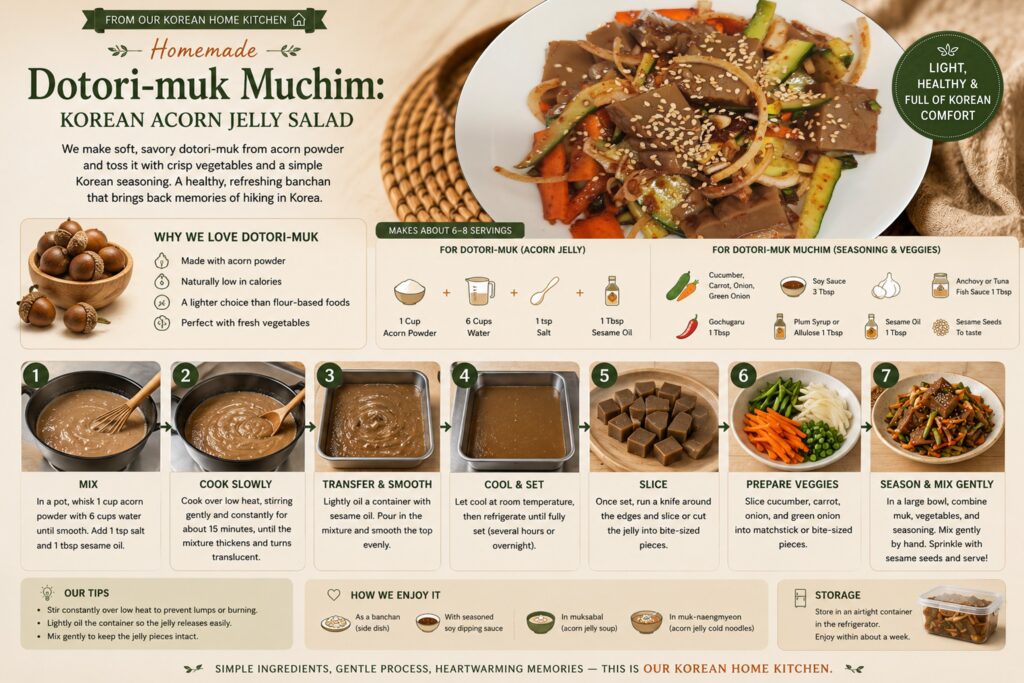
Learn how we make dotori-muk from acorn powder at home and turn it into Korean acorn jelly salad with fresh vegetables and a simple seasoning.
From Acorn Powder to a Korean Home Side Dish
Dotori-muk, or Korean acorn jelly, is a familiar food in Korea. Its soft, slightly springy texture makes it easy to eat simply with a soy-based dipping sauce, but it is also commonly mixed with fresh vegetables and seasoning to make dotori-muk muchim.
In Korea, ready-made dotori-muk is easy to find at grocery stores, so there is often little reason to make it from scratch. When we lived in Korea, we usually bought it already made.
Then one day, while shopping at a Korean grocery store in the United States, we happened to find a package of acorn powder.
We thought, “Why not try making dotori-muk ourselves?”
That was how we first started making it at home.
The process turned out to be much simpler than we expected. A package of acorn powder also makes quite a lot of muk, so it can be an economical way to enjoy it at home.
The flavor is very similar to the ready-made dotori-muk we used to buy, but perhaps because we make it ourselves, the homemade version tastes even better to us.
How We Make Dotori-muk at Home
The ratio we use is simple: one part acorn powder to six parts water.
We use a small paper cup as our measure, combining one cup of acorn powder with six cups of water in a pot.
We slowly stir the mixture until the acorn powder is well dissolved. Then we add about one teaspoon of salt and one tablespoon of sesame oil.
We cook it over low heat for about 15 minutes, stirring gently as it cooks.
At first, the mixture is thin and watery. As it heats, it gradually becomes thicker and develops the smooth, dense consistency that will eventually become muk.
There is no need to rush this step. We simply keep the heat low and continue stirring until the mixture is fully cooked and thickened.
Letting the Acorn Jelly Set
Before transferring the cooked mixture, we lightly coat the inside of a container with sesame oil.
This makes it easier to remove the muk after it has set.
We pour the cooked mixture into the container, smooth the surface, and leave it at room temperature to cool.
Once it has cooled, we place it in the refrigerator and let it set.
The result is homemade dotori-muk that looks and tastes very similar to what we can buy at a Korean grocery store.
Making acorn jelly from scratch may sound complicated at first, but the actual process is surprisingly straightforward.
Turning Dotori-muk into Dotori-muk Muchim
One of our favorite ways to use homemade dotori-muk is to make dotori-muk muchim, a seasoned acorn jelly salad.
Dotori-muk itself has a mild flavor. When it is combined with crisp vegetables and a savory, slightly spicy seasoning, however, it becomes a completely different dish.
At home, we usually add cucumber, carrot, onion, and green onion.
The vegetables do not require complicated preparation. We simply cut them into pieces that are easy to eat together with the sliced muk.
The contrast is what makes this dish enjoyable: crisp fresh vegetables alongside the soft and tender acorn jelly.
Our Simple Seasoning for Dotori-muk Muchim
For the seasoning, we usually combine:
- 3 tablespoons soy sauce
- 1 tablespoon Korean anchovy fish sauce or tuna fish sauce
- 1 tablespoon gochugaru (Korean red pepper flakes)
- 1 tablespoon minced garlic
- 1 tablespoon maesil-cheong (Korean plum syrup) or allulose
- 1 tablespoon sesame oil
- Sesame seeds to taste
If you enjoy more heat, you can also finely chop a Cheongyang chili pepper or jalapeño and add it to the mixture.
I do not handle very spicy food particularly well, so we usually leave out the Cheongyang chili.
One advantage of cooking at home is that there is no need to make a Korean dish hotter than you enjoy. The seasoning can always be adjusted to suit your own taste.
Mix It Gently
There is one thing we are particularly careful about when making dotori-muk muchim.
Acorn jelly is very soft and can break apart easily.
After adding the sliced muk, vegetables, and seasoning, we gently mix everything together by hand rather than stirring it vigorously.
We only mix enough to distribute the seasoning without breaking the pieces of muk.
A final sprinkle of sesame seeds finishes the dish.
The result combines soft acorn jelly, crisp vegetables, and a savory, nutty seasoning in every bite.
A Food That Reminds Me of Hiking in Korea
For me, dotori-muk muchim is more than a side dish. It also brings back memories of hiking in Korea.
Around popular mountains and hiking trails in Korea, it was common to find small restaurants serving dotori-muk muchim.
After coming down from a hike, a plate of seasoned acorn jelly could be especially satisfying.
I particularly remember eating dotori-muk muchim with a glass of makgeolli, Korea’s traditional rice wine. After a hike, that combination tasted exceptionally good.
The soft muk, crisp vegetables, flavorful seasoning, and cool makgeolli somehow went perfectly together.
Now, when we make dotori-muk in our kitchen in the United States, those memories sometimes come back.
A package of acorn powder that we happened to find at a Korean grocery store ended up reconnecting us not only with a familiar Korean food, but also with memories of eating it back in Korea.
How We Eat Dotori-muk at Home
We usually eat dotori-muk as a banchan, or side dish.
Rather than finishing an entire batch at one meal, we refrigerate the leftover muk and use it over the next several meals.
And we do not always make dotori-muk muchim.
Sometimes we simply slice the muk and serve it with a seasoned soy sauce. At other times, we add it to a cold noodle or broth-based dish and enjoy it more like muksabal or muk-naengmyeon.
That versatility is one of the things we like about making a batch of dotori-muk at home.
We also tend to think of it as a lighter alternative to many flour-based foods. Combined with plenty of fresh vegetables, dotori-muk muchim fits well with the way we prefer to eat at home these days.
An Unexpected Find at a Korean Grocery Store
We did not originally plan to start making dotori-muk from scratch.
We simply happened to see acorn powder at a Korean grocery store and decided to give it a try.
We mix the powder with water, slowly cook it until thick, let it set, and then combine the finished muk with whatever suitable vegetables we have prepared.
There is nothing elaborate about the process.
But in many ways, this is what jipbap, or Korean home cooking, means to us.
It does not mean that everything must follow a strict traditional recipe or that every ingredient has to be made from scratch. It can simply mean finding accessible ingredients, preparing them in a practical way, adjusting the flavors to our own taste, and turning them into food we genuinely enjoy eating at home.
The dotori-muk muchim I once enjoyed with makgeolli after hiking in Korea has now become a side dish we make in our own kitchen in the United States.
These are exactly the kinds of everyday foods and stories we want to share through Our Korean Home Kitchen.


Comments 0
Be the first to leave a comment.