
Steamed Kabocha Squash: Stuffed with Cheese, Beef, and Egg
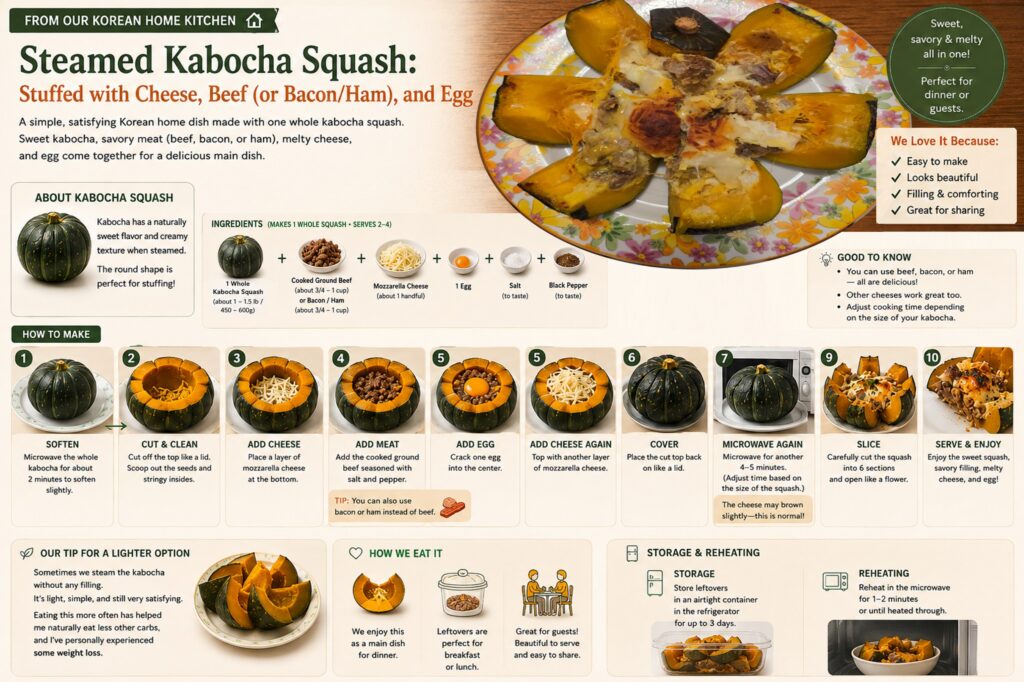
See how we make steamed kabocha squash filled with cheese, beef, and egg for a simple, filling main dish in our Korean home kitchen.
A Steamed Kabocha Dish We Often Made in Korea
Kabocha squash is delicious even when it is simply steamed. When cooked until tender, it has a natural sweetness and soft texture, so it can be enjoyed without much seasoning.
In Korea, steamed kabocha squash is sometimes served as a side dish at restaurants. Some versions are drizzled with oligosaccharide syrup or another sweetener to add extra sweetness.
We have also made steamed kabocha squash at home for many years.
But the version we often make is a little different from simply steaming the squash.
We fill the inside with cheese, meat, and an egg, then cook everything together. The natural sweetness of the kabocha combines with the richness of the cheese and the savory flavor of the meat, turning it into something substantial enough to serve as a main dish.
We used to make it this way when we lived in Korea, and it is still one of the dishes we enjoy at home.
A Simple Dish Made with One Kabocha Squash
We use one whole kabocha squash.
First, we microwave the whole squash for about two minutes. This softens it slightly and makes the raw squash a little easier to handle.
After taking it out of the microwave, we cut open the top and remove the seeds from inside.
The empty center then becomes the space for the filling.
For the kabocha shown in the photo, we used:
- 1 whole kabocha squash (about 1 ~ 1.5 lb / 450 ~ 600 g)
- Cooked ground beef
- About one handful of mozzarella cheese
- 1 egg
- Salt
- Black pepper
We cook the ground beef beforehand and season it simply with salt and pepper.
Once that is ready, all we need to do is fill the squash.
Layering the Cheese, Beef, and Egg
We start by placing some mozzarella cheese at the bottom of the hollowed-out kabocha.
Next comes the cooked ground beef.
Then we crack one egg into the center and add another layer of mozzarella cheese on top.
Our basic order is:
Cheese → Cooked Ground Beef → Egg → Cheese
As everything cooks, the cheese melts and the beef and egg come together inside the soft kabocha.
The browned cheese you can see in the photo was not browned separately in an oven. It simply cooked a little more in the microwave.
Sometimes We Use Bacon or Ham Instead of Beef
One thing we like about this dish is that the filling does not have to be exactly the same every time.
The kabocha in the photo was made with ground beef, but we do not always use beef.
Sometimes we use bacon or ham instead of ground beef.
Bacon and ham already have their own seasoning and distinctive flavors, so they give the dish a different character from ground beef. Because they can also be saltier, we adjust any additional salt accordingly.
The cheese can be changed as well.
We usually use mozzarella, but there is no reason it has to be mozzarella every time. A more flavorful or already seasoned cheese can also work well.
For us, this is not the kind of home dish that requires one exact filling.
Some days we use ground beef. Other times we may use bacon or ham.
Changing the ingredients depending on what we have at home is part of what makes home cooking enjoyable for us.
Back into the Microwave
After filling the squash, we put the top back on like a lid.
Then we microwave it again for about four to five minutes.
The exact cooking time can vary because kabocha squash comes in different sizes and thicknesses.
Four to five minutes worked for the squash we used, but the time should be adjusted depending on the size of your squash.
Once the kabocha is tender and the egg and cheese inside are cooked, it is ready.
Cutting It into Six Pieces Makes a Beautiful Presentation
After cooking, we could simply put the whole squash on the table, but we like to cut it into six sections and open the pieces outward, as shown in the photo.
The melted cheese, beef, and egg remain in the center while the bright yellow-orange kabocha spreads around them.
This is one reason we think the dish works especially well when we have guests.
The preparation is not particularly complicated, but the finished dish looks much more elaborate than the amount of work involved.
Placed in the center of the table, it is also easy for everyone to take a piece.
For us, it is a practical main dish that tastes good and looks attractive enough to serve to guests.
The Kabocha Skin Is Edible, but We Have Different Preferences
The skin of cooked kabocha squash is edible.
My wife and I happen to have different preferences about it.
She eats the skin along with the squash, while I usually leave the skin behind.
So even when we are eating the same dish, I tend to eat only the soft flesh, while my wife eats the skin as well.
Small differences like this are simply part of the way we eat at home.
The Sweetness of Kabocha Goes Well with Cheese
One of my favorite things about this dish is the combination of kabocha and cheese.
Kabocha already has a natural sweetness. When melted cheese is added, that sweetness combines nicely with the rich, savory flavor of the cheese.
With meat and egg inside as well, the dish is much more filling than plain steamed squash.
We usually eat it as a main dish for dinner.
If we do not finish the whole squash, we refrigerate the leftovers and reheat smaller portions for breakfast or lunch the next day.
On the other hand, leaving out the cheese and meat creates a much simpler and lighter version.
The same kabocha squash can become a very different meal depending on how we choose to prepare it.
Sometimes We Simply Steam the Kabocha
We do not always fill the squash with cheese and meat.
Sometimes we simply cook the kabocha by itself.
Prepared this way, we can enjoy its natural sweetness without the richness of the additional ingredients.
For me, plain steamed kabocha can also be surprisingly filling. When I eat enough of it, I naturally tend to eat less of other carbohydrate-heavy foods at the same meal.
There was a period when I ate steamed kabocha quite often, and during that time I personally experienced some weight loss.
That is simply my own experience rather than a claim about what kabocha will do for everyone.
For us, steamed kabocha is not something we eat because we consider it a special diet food. It is simply a familiar food that is satisfying and easy to eat, especially when we do not have much of an appetite.
Why We Use Kabocha Instead of Butternut Squash
In our earlier story about Korean pumpkin porridge, we explained how we used butternut squash when we could not find kabocha.
For hobakjuk, butternut squash worked surprisingly well as a substitute. The flavor was similar enough that we enjoyed the porridge very much.
For this stuffed steamed squash, however, we use only kabocha.
The reason is more about shape than flavor.
For this dish, we remove the seeds and use the hollow center to hold cheese, meat, and egg. The round shape of kabocha makes it particularly suitable for filling this way.
Butternut squash has a long, narrow shape and is much less convenient for this preparation.
So while butternut squash works well for our pumpkin porridge, we prefer kabocha for this particular dish.
A Filling Meal We Make Again and Again
For us, this stuffed steamed kabocha is not something reserved only for special occasions.
We made it regularly when we lived in Korea, and we still make it whenever we feel like having it.
The process is simple: soften one kabocha, remove the seeds, fill it with cheese, meat, and an egg, and finish cooking it in the microwave.
We can also change the flavor from one meal to another by using bacon or ham instead of ground beef, or by trying a different cheese.
Most often, we serve it as the main dish for dinner and reheat any leftovers for breakfast or lunch the next day.
When guests come over, we can cut it into six sections, open it beautifully on a plate, and place it in the center of the table for everyone to share.
The natural sweetness of kabocha, melted cheese, savory meat, and egg make it both satisfying and comforting.
It is not a complicated dish, but it tastes good, looks inviting, and is easy to share.
For us, this is another example of the kind of food we actually cook and eat in Our Korean Home Kitchen.

Comments 0
Be the first to leave a comment.